04 October 2018

Kellri's 18 Module Challenge - Day 6: DMG Monastery Dungeon by Gary Gygax

Day 6 - A Module You Can Play with Children: DMG Monastery Dungeon by Gary Gygax
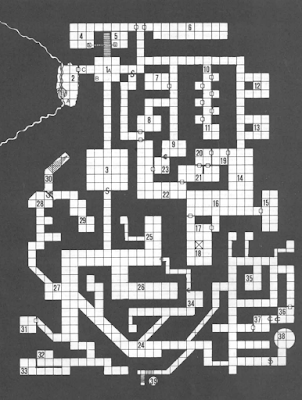
 
The DMG Monastery Dungeon map by Gary Gygax
The Monastery Dungeon, 1979


Why I Love the Monastery Dungeon

  • It's iconic design not only represents the one and only map in the Dungeon Masters Guide, but it is also central to the Example of Play
  • Like all good dungeon designs, the monastery map is extensible, and built-in hooks help to coach a fledgling Dungeon Master how to further refine its contents:
    • hints about additional monsters types from the Wandering Monster table:  goblins in 7-8, bandits in 4-5, fire beetles in 12-13, ghouls from 24, evil cleric and hobgoblins from 35-37, skeletons from 27
    • references from early keys to further ones yet-to-be-designed:  the map's description in 2 mentions the secret door 28, the treasury at 29, and the caverns below this level; a secret entrance/exit is also mentioned in passing on page 96, in the description of the DMG's "three" maps (the other two sadly non-existent), and while not identified specifically, the stairs at 39 are suggestive of such a portal
  • Despite being a pretty small dungeon (although it's still bigger than some levels of Rappan Athuk...), the map design offers a variety of challenges and tactical options for players (and monsters!) to leverage in play, including looping corridors, several secret and concealed doors, and a number of potentially-deadly dead-ends.
If you're looking for some additional inspiration, you should check out Timrod's excellent and intertwined blog pieces on the relationships between the DMG Monastery Dungeon, T1's Moathouse dungeon level, and the wilderness environs of B2 Keep on the Borderlands.  Jonathan Tweet also wrote the ready-made "Dungeon of the Fire Opal" adventure for this dungeon map in Dungeon Magazine #84 (Jan/Feb 2001; you will, however, need to convert it from 3.0 back to AD&D....).

I have in fact followed-up on the suggestions to expand the monastery dungeon with my own second level caverns map, as well as modifications and expansion to the first level map, and the keying of both.  More will follow on that front, later!

Three Runners Up

There are many good candidates here to choose from, but I've focused on rookie/neophyte players as my target audience for the child players for today's challenge.  Gygax's B2 Keep on the Borderlands and T1 Village of Hommlet are fan-favorite campaign starters for a reason, but they're also not good modules for novice players, since both require levels of both strategic and tactical acumen lacking in most children.

I'm limiting myself to three, otherwise I'll just end up recreating my favorites list each day:
  • B1 In Search of the Unknown by Mike Carr (TSR, 1978):  more forgiving that B2 or T1, the first level's design in particular does an excellent job of teaching new players how to play the game
  • L1 The Secret of Bone Hill by Lenard Lakofka (TSR, 1981):  an excellent bridging scenario that teaches new players the ropes of the first wilderness explorations (B10 Night's Dark Terror also does this well), and also details the Bone Hill ruined castle and dungeon, the town and inhabitants of Restenford, and outlying locations in the surrounding wilds
  •  "Trouble at Grog's" by Grant and David Boucher (TSR, March/April 1987 in Dungeon Magazine #4):  a good introductory scenario for players with a more dramatic bent, perhaps: the PCs must solve the mystery of who's framing the local half-ogre tavern owner for a local crime spree

My other posts in Kellri's 18 Day Module Challenge:

  1. Day 5: S3 Expedition to the Barrier Peaks by Gary Gygax
  2. Day 4: "Deep Shit" by Jeff Barber
  3. Day 3: A Fabled City of Brass by Anthony Huso
  4. Day 2: Masks of Nyarlathotep by Larry DiTillio
  5. Day 1: Empire of the Ghouls by Wolfgang Baur
  6. Day 0: These are a Few of My Favorite Things...

03 October 2018

Kellri's 18 Module Challenge - Day 5: S3 Expedition to the Barrier Peaks by Gary Gygax

Day 5 - A Module that Needs to be Played by a BIG Party: _S3 Expedition to the Barrier Peaks_ by Gary Gygax


Like its predecessor S1 Tomb of Horrors (TSR, 1978), S3 Expedition to the Barrier Peaks was first published to support TSR's "D&D for Prizes" tourney at Origins II in 1976.  The module we know and love wasn't formally printed until 1980:

 
S3 Expedition to the Barrier Peaks: 1976 Origins II tournament version, above a copy of TSR's 1980 first printing module.
S3 Expedition to the Barrier Peaks:
1976 Origins II tournament version,
above a copy of TSR's 1980 first printing module.


Why I Love S3 Expedition to the Barrier Peaks

  • S3 is one of the most highly-lethal adventures I've run, and probably surpasses S1 Tomb of Horrors for the droves of PCs sent to early graves beneath its chromium lights
  • High-tech lasers, grenades, power armor, robots, and androids abound that will (appropriately) perplex and befuddle the players while folding-spindling-and-mutilating their PCs with with efficiency!
  • Introduces oodles of new and unique monsters (both flora, fauna, fungi, and more!), including some personal favorites---aurumvorax, froghemoth, gas bats, russet mold---as well as rarely-encountered iconic monsters like the eye of the deep, intellect devourer, and the iconic illustration-booklet-cover mind flayer!
  • Features some of Rob Kuntz's best design work:  Expedition to the Barrier Peaks builds upon materials from the Expanded Castle Greyhawk, including from Kuntz's Garden of the Plant Master/Garden of Tharizdun level, as well as the infamous Machine Level 
  • The 1980 publication of S3 was TSR's only adventure to include color interior artwork all rendered by the incomparable Erol Otus, who's fabulous pieces feature throughout the art-heavy book as well:


    Cover art of S3 Expedition to the Barrier Peaks, TSR 1980, by Erol Otus
    S3 Expedition to the Barrier Peaks, TSR 1980


Three Runners Up


The lethality-factor isn't the only criteria that requires a large party of PCs to tackle an adventure---extended forays without the ability to reprovision require more redundancy in a party as well as a higher-reliance on clerics and druids to create/purify food and water, too.  Many classic adventures feature such extended expeditions, including the G-D modules, X1 and WG6 for their rapacious and dinosaur-infested wilds, and the unforgiving deserts of X4-X5-X10, but in the end, I settled on the following three:
  • "The Dancing Hut" by Roger E. Moore (TSR, March 1984 in Dragon Magazine #83):  what's not to love about the scariest witch in the world and her multi-planar tesseractian, self-defending, and senient mansion-turned-death trap?  If you want to add some further twists to the adventure, you can leverage David Nalle's "The Bogatyrs of Old Kiev" article from Dragon #53 and/or Lisa Smedman's 1995 Dancing Hut of Baba Yaga (TSR, 1985), in addition to its original artifact entries in Eldritch Wizardry and the Dungeon Masters Guide.
  •  S1 Tomb of Horrors by Gary Gygax (TSR, 1975, 1978, 1981):  the classic PC shredder---its provides 20 pregens for a reason!
  • WG5 Mordenkainen's Fantastic Adventure by Rob Kuntz (TSR, 1985):  Kuntz's classic 3-level dungeon, later expanded through the Maure Castle series of levels via Dungeon Magazine


My other posts in Kellri's 18 Day Module Challenge:

  1. Day 4: "Deep Shit" by Jeff Barber
  2. Day 3: A Fabled City of Brass by Anthony Huso
  3. Day 2: Masks of Nyarlathotep by Larry DiTillio
  4. Day 1: Empire of the Ghouls by Wolfgang Baur
  5. Day 0: These are a Few of My Favorite Things...

02 October 2018

Kellri's 18 Module Challenge - Day 4: Deep Shit by Jeff Barber

Day 4 - A Module That Takes Place Underwater or in the Air: "Deep Shit" by Jeff Barber


"Deep Shit" is a Blue Planet 1st edition convention scenario set on the water world of Poseidon:

A secret underwater lab on the exoplanet Poseidon has gone silent. The last transmission indicates the on site security chief went mad and began to slaughter everyone on the station. A team of commandos from Global Ecology Organization (GEO) has been sent in to investigate why. They will have to deal with storms, the station’s defenses, and a renegade genetically enhanced super soldier.

Written by Jeff Barber of Biohazard Games (also previously a founder of Pagan Publishing), "Deep Shit" is somewhat analogous to Jeff's previous Pagan underwater scenario, "Grace Under Pressure" (co-written with John Tynes in The Unspeakable Oath #2 from 1991), but differs from its predecessor in some significant ways.  Run many times throughout the 1990s, Jeff also ran "Deep Shit" in April 2017 for the Role-Playing Public Radio crew; the podcast presents the entire four-hour scenario, from start to finish.    


Why I Love "Deep Shit"


This four-hour, timed convention scenario is full of action and suspense, and somewhat mimics the structures of the films Aliens and The Abyss.  The PCs are GEO super soldiers who drop planet-side through a brutal storm (a la , and, like the Colonial Marines, must determine the nature of the silence from the scientific research station.   

Unlike Aliens, the PCs have no advance intelligence about what could be causing the radio silence, and the entire facility sits on the ocean floor (like GUP).  The super troopers are probably a bit more powerful than Colonial Marines, too, but as they explore the research stations to determine what's happened to its scientists, the mystery of what happened only deepens when some of the PCs begin to succumb to the madness that infected the security chief....

Jeff runs a tight convention game:  he gets the game up and running and done within four hours, all the while leveraging sound effects and music, props and lighting to ratchet up the tension throughout the scenario.  Even in what appears to be a conventional bug-hunt-meets-Cthulhu set-up, Jeff also manages to surprise the players with unexpected twists and turns in the development of the PCs' mission. 

I don't want to spoil the scenario further, so feel free to check out the RPPR podcast if you'd like to learn more.


Three Runners Up


I'm limiting myself to three, otherwise I'll just end up recreating my favorites list with each day's entry:


  •  "Can Seapoint be Saved?" by Bob Waldbauer (TSR, July 1983 in Dragon Magazine #75):  a short adventure for 4th-7th level PCs tasked to vanquish the pirates threatening the town of Seapoint for their sea-caves lair
  • "Grace Under Pressure" by John Tynes and Jeff Barber (Pagan Publishing, 1991 in The Unspeakable Oath #2; reprinted in The Resurrected, Volume 1: Grace Under Pressure in 1993):  a fabulous underwater scenario, GUP would have been my #1 choice for this today if I hadn't played "Deep Shit" too
  • "The Plight of Cirria" by Grant and David Boucher (Dungeon Magazine #9, Jan/Feb 1988):  an 8th-12th AD&D adventure in which a female cloud dragon hires a group the PCs to discover and recover her male mate, who, as it turns out, was imprisoned on a cloud fortress by an evil archmage....

My other posts in Kellri's 18 Day Module Challenge:


  1. Day 3: A Fabled City of Brass by Anthony Huso
  2. Day 2: Masks of Nyarlathotep by Larry DiTillio
  3. Day 1: Empire of the Ghouls by Wolfgang Baur
  4. Day 0: These are a Few of My Favorite Things...


01 October 2018

Kellri's 18 Module Challenge - Day 3: A Fabled City of Brass by Anthony Huso

Day 3 - A Module You Like with a Place in the Title: _A Fabled City of Brass_ by Anthony Huso


Unlike yesterday's choices, which felt very limited to me, today's selections very-much span a cornucopia of good adventuring options!  Choosing what place-based titles to eliminate meant making some tough choices:
  • I decided to exclude Castle Greyhawk since I've not played it as a published adventure, and it's not really been published yet (although I have DM'd several of the levels extracted from it, and have designed my own version too)
  • I also disqualified other unpublished module manuscripts that I've played or run, like Kuntz's Lost City of the Elders and Castle El Raja Key, Barker's Jakallan Underworld, Chainsaw's Foolsgrave, etc., since they've not yet been printed or made generally available
  • Other favorite adventures unfortunately lack place names in their titles (or fit later categories better than this one, in some cases):  WG5 Mordenkainen's Fantastic Adventure (although I could squeak by using "Maure Castle" I imagine...), Yellow Clearance Black Box Blues, 
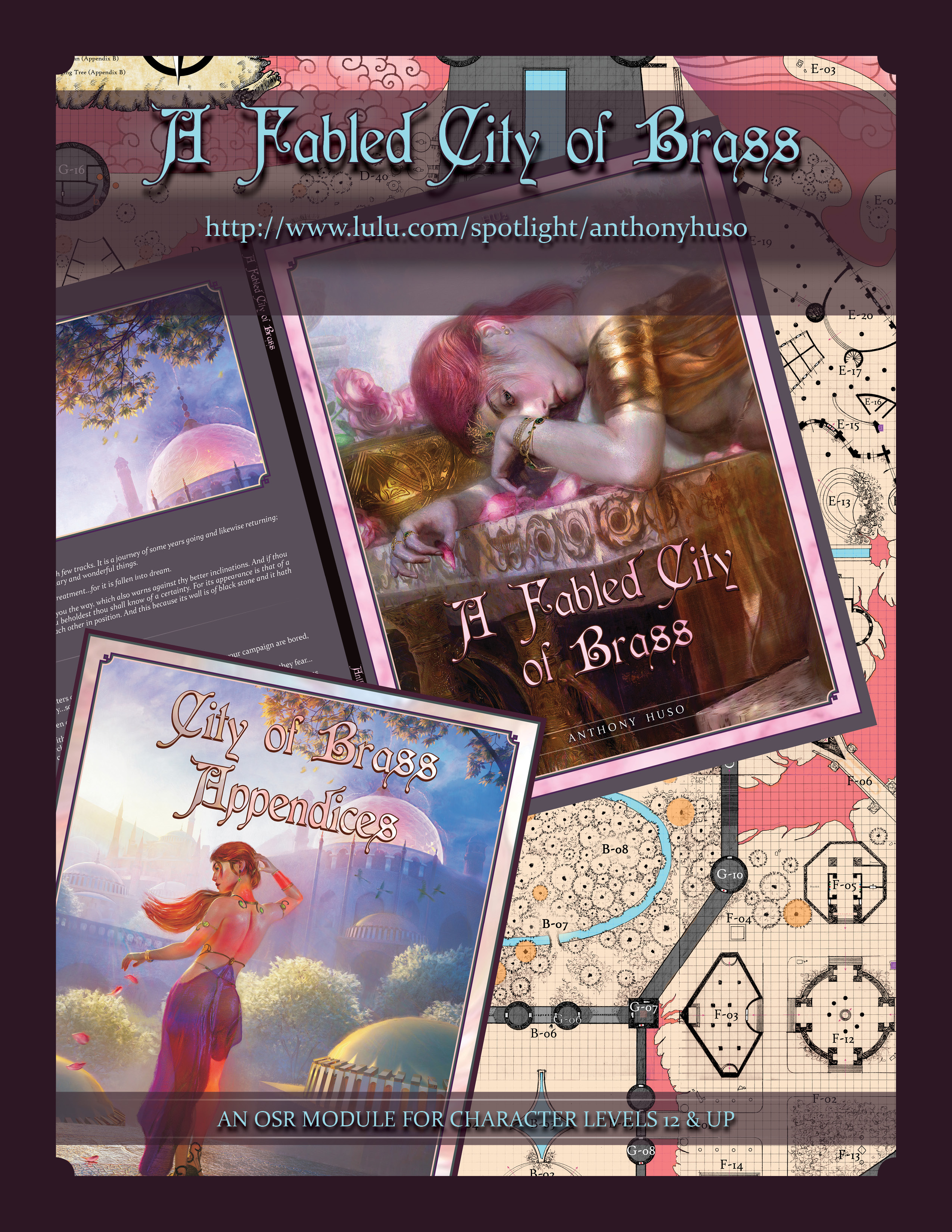
After much deliberation, I finally settled in on a more-recent OSRIC title for today's module---Anthony Huso's A Fabled City of Brass:

A Fabled City of Brass map - by Anthony Huso


Anthony's take on the storied home of the efreet returns to the origins of its mythology via Scheherazade's Tales of A Thousand and One Nights, and is a two-volume set:


A Fabled City of Brass - the books, by Anthony Huso
A Fabled City of Brass -
the books, by Anthony Huso


Why I Love A Fabled City of Brass

There are many reasons why any gamer could love Huso's take on the City of Brass, given it's wonderful skill in leveraging the OSRIC/1e rules set, but here are mine:

  • Huso's high-level (12th+), extra-planar version of the City of Brass offers a fitting capstone for any AD&D campaign 
  • It evokes the feel of both the Arabian Nights stories as well as Dave Sutherland's iconic Dungeon Masters Guide cover illustration:
    David C. Sutherland III's 1979 Dungeon Masters Guide cover artwork
    David C. Sutherland III's 1979 Dungeon Masters Guide cover artwork
  • Huso leverages AD&D's own lore like a pro---he even goes a step further, recommending Rob Kuntz's "(To the) City of Brass" 1987 RPGA tournament module as an introduction to the setting
  •  The Appendicies book contains random encounter tables, new flora, 29 new monsters, 6 new spells, 40 new or expanded magic items (including artifacts like the Codex of the Infinite Planes, Ehlissa Amooyan's Bejeweled Nighingale, and the Jacinth of Inestimable Beauty), 5 pregen/playtest PCs, and a 4+ page comprehensive index

Three Runners Up


I'm limiting myself to three, otherwise I'll just end up recreating my favorites list with each entry, and in today's case, the limitation is imperative:  there are just too many good adventures with evocative place names in their titles!

So, my somewhat-angst-ridden, winnowed-down listing of merely three runners-up includes:
  • The Original Bottle City by Robert J. Kuntz (Pied Piper Publishing 2008; Black Blade Publishing 2014):  the only true dungeon level published from Gygax and Kuntz's Castle Greyhawk
  • Caverns of Thracia by Jennell Jaquays (Judges Guild 1978; Goodman Games, 2016):  Jaquay's classic mega-dungeon!
  • D1 Tomb of Abysthor by Clark Peterson and Bill Webb (Necromancer Games, 2002):  an OOP and under-appreciated 3.0-era classic that, while not as large as a true mega-dungeon, offers a compellingly-designed and large dungeon environment, with ties back to Necromancer Games' best early products---Crucible of Freya, Bard's Gate, Demons & Devils, and Rappan Athuk

My other posts in Kellri's 18 Day Module Challenge:

  1. Day 2: Masks of Nyarlathotep by Larry DiTillio
  2. Day 1: Empire of the Ghouls by Wolfgang Baur
  3. Day 0: These are a Few of My Favorite Things...

30 September 2018

Kellri's 18 Module Challenge - Day 2: Masks of Nyarlathotep by Larry DiTillio

Day 2 - A Module You Like with a Monster in the Title:  _Masks of Nyarlathotep_ by Larry DiTillio


Masks of Nyarlathotep: Perilous Adventures to Thrwart the Dark God was first published as a 140 page boxed set by Chaosium in 1984, with one scenario from the original box version cut and published in Terror Australis in 1987.  Masks was fully reintegrated with the third printing in 1996's Complete Masks of Nyarlathotep, which also added four new encounters to the campaign.  

 
Masks of Nyarlathotep 1st edition boxed set and later reprints
grodog's Masks madness - from first edition onward!


Written by Larry DiTillio and developed by Lynn Willis, Masks is a masterpiece of campaign-adventure design, and features the following globe-trotting adventure chapters/locations, each originally published as as stand-alone booklet within the box (with "City in the Sands" in Terror Australis):
  • New York 
  • London 
  • Egypt 
  • Kenya 
  • Shanghai 
  • Australia - City in the Sands (in Terror Australis)
  • Extensive Play Aids and Handouts

The Masks of Nyarlathotep Companion was created by the membership of the venerable Yog-Sothoth.com Call of Cthulhu fan site to add historical resources and context to teh campaign, to fill perceived gaps, and correct errors/omissions in the original text.  The Companion was published in a semi-final form for free in PDF format in 2013.  A print edition was funded via Kickstarter in 2015 in conjunction with Sixtystone Press, and finally appeared in 2017. 


Masks was also recently updated to Call of Cthulhu 7th edition, and vastly expanded in response in part to the Masks Companion's critiques and additions:  the new version is at least 869 pages (with the main adventure book being 666 pages in length!).  An analysis of the expanded content in the new edition was shared by Mike Mason of Chaosium on the YSDC forums.  The new edition is available in PDF from Chaosium, and the print edition will ship in mid-November 2018.  The new edition looks gorgeous:


Masks of Nyarlathotep 7th edition
Masks of Nyarlathotep 7th edition (2018)

I've still not checked out CoC 7e, and doubt that I will pick up the main rules set, but I will definitely get Masks 7e once it's available.

Why I Love Masks of Nyarlathotep


It's #1!  Masks is the best adventure written for any RPG, ever.  I like it better than the Giants-Drow modules for AD&D, better than the Enemy Within for Warhammer FRPG, better than MERP's Court of Ardor, annd better than Paranoia's Yellow Clearance Black Box Blues.  And I do love all of those too; I just love Masks more!

Why you ask?  Well, Masks offers the best of what defines excellence in a role-playing game adventure to me: 
  • Inspires me to dig into the materials, to research and to create more adventure based upon its already-robust framework, in order to make the game shine at the table
  • Epic in scope, in tone/mood, and in execution:  Masks is what I want every game to feel like at the table, no matter what game I'm playing
  • Player choices matter in its sandbox environment, and the players' successes and failures drive the entire scenario---with the fate of the world in the balance!
  • Offers a defining and common play-experience that unites generations of gamers


Three Runners Up


I'm limiting myself to three, otherwise I'll just end up recreating my favorites list with each entry.

This one was hard, since many of my most-favorite adventures don't feature monster names in the titles, so:
  • Dark Druids (Chaotic Henchmen, 2015):   Rob Kuntz's original Greyhawk campaign scenario set in the Gnarley Forest, with wilderness and dungeon environs
  •  "Treasure of the Dragon Queen" by Rutgers University Gamers:  an AD&D convention tourney I played c. 1983
  • Walker in the Wastes (Pagan Publishing, 1994):  Pagan's Ithaqua campagin for Call of Cthulhu


My other posts in Kellri's 18 Day Module Challenge:

  1. Day 1: Empire of the Ghouls by Wolfgang Baur
  2. Day 0: These are a Few of My Favorite Things...

29 September 2018

Kellri's 18 Module Challenge - Day 1: Empire of the Ghouls by Wolfgang Baur


Scot "Kellri" Hoover posted his 18 Day Module Challenge today, and I think this is just the kick-in-the-pants that I need to get this wayward blog back on track!  So, for those who are link averse, here's Scot's concept summary:
"Despite my [Kellri's] own focus on classic and/or old-school AD&D modules - you should feel free to choose anything you like, even something for another edition of the game or one you've written.  Ideally we should all discover something new that we might like to include in our own gaming."

Now, I have written about my favorite RPG game system and adventures back in May (this topics arises often enough on old school message boards, in one form or another, that I started saving my responses in a file back in December of 2005), and I'm leveraging many of my favorites from that listing, but several of Scot's criteria for the challenge will push me outside the bounds of my previously-defined lists, too.  And the scope of each day's challenge will also give me an opportunity to talk about the cools things in each module that I love, as well as to mention some favorite runners-up. 

So, without further ado, here's my tossing of the gauntlet to accept Scot's challenge!:

Day 1 - A Module from a Series:  _Empire of the Ghouls_ by Wolfgang Baur

Empire of the Ghouls by Wolfgang Baur (Open Design, 2007)

Empire of the Ghouls by Wolfgang Baur (Open Design, 2007; RPGgeek entry) is both a sequel and a prequel, of sorts, nominally set in the World of Greyhawk.  Empire of the Ghouls is a 3.5-era sequel to and expansion upon Baur's late 2e-era "Kingdom of the Ghouls" adventure from Dungeon Magazine #70 (September 1998); both are also prequels to the reappearance of true ghouls in the "Age of Worms" Paizo-era Greyhawk adventure path, in Baur's "A Gathering of Winds" (Dungeon #129, December 2005), which is itself a site-based sequel to Erik Mona's excellent "Whispering Cairn" adventure which kicked off the Age of Worms in Dungeon 124 (July 2005).

Woflgang was running his patron-funded Open Design projects years before Kickstarter, Indiegogo, or Patreon were a twinkle in some VC's eye; Open Design eventually morphed into Baur's Kobold Press, still going strong today.  Empire of the Ghouls was Baur's third Open Design project, and I think it's still the biggest project he's written (I need to confirm that).  Baur distributed Empire of the Ghouls in PDF format, and patrons of the project could also purchase at-cost paperback or hardcover editions of the book from Lulu.   

The book itself is 160 pages, and, like D1-3's drowic underworld, presents a long-term campaign environment spanning the drowic underworld and a subterranean wilderness.  When Denis "Maldin"Tetreault began working up his Greyhawk Underdark maps, I worked with him to insure that Baur's pieces were included as part of the larger regional maps he built.  Empire of the Ghouls details The Ghoul Imperium---the true ghouls' cults, religions, and magics; Darakhan, the White City of the Ghouls---their capital; 31 varied underdark locations of interest; and 18 new or new-to-3.x monsters.  

Ghoulish Underdark Environs Map


Why I Like Empire of the Ghouls

The adventure campaign's sub-title helps to set this module apart from the beginning:  "A Cannibal Adventure-Campaign for 9th-12th Level Characters."  That really sets the tone for its content and background, encounters and adversaries, a tone of horror and consumption that's not readily evident in most D&D adventures.  

I also like the interconnections between the various texts that Empire of the Ghouls builds upon, draws from, and alludes to.   Baur does an excellent job of placing the ghouls within the greater D&D underworld, and gives them sufficient space to breathe and to define their own cultural identity, while still firmly situating them inside the scope of D&D's mythologies and legendry.  

Empire of the Ghouls, like many of the Gygax and Kuntz classic TSR adventures, also provides many hooks and opportunities for the DM to make the adventure his or her own---by offering allusive hooks for the DM to create, as well as places for easy and obvious expansion to build out further from the provided design.  A must for any of well-designed adventure.

In addition to its ties to the World of Greyhawk, Empire of the Ghouls also reaches back to H. P. Lovecraft's ghouls---Pickman from "Pickman's Model" and "The Silver Key", and the ghouls of the Dreamlands, too.  These offer a more-refined evil to the standard ghouls and ghasts of the 1977 Monster Manual.  

Three Runners Up


I'm limiting myself to three, otherwise I'll just end up recreating my favorites list with each entry:
  • Dave Cook's A1 Slave Pits of the Undercity (TSR, 1980):  the first module I bought on my own, and the launching point for the Slavers series
  • Gary Gygax's D1 Descent into the Depths of the Earth (TSR, 1978):  a favorite of mine, probably my third favorite in the giants-drow series of adventures
  • Rob Kuntz's MOZ4 Eight Kings (Creations Unlimited, 1988; Different Worlds, 2004):  the finale to Kuntz's Xaene/Zayene modules, and the best archmage's extra-planar wizardly laboratory ever published to date

Allan.

24 September 2018

Monsters Not in DMG Appendix C - Dungeon Random Monster Tables by Monster Level


While working on keying the recently-redesigned and -expanded dungeon level 2 of my version of Castle Greyhawk, I discovered that many monsters from the 1977 Monster Manual were not, in fact, represented in the Dungeon Masters Guide's Appendix C's Dungeon Random Monster Tables, which list dungeon monster encounters by Monster Level:

DMG Appendix C - Dungeon Random Monster Tables - Monster Level

Since I use the DMG Appendix C tables to help populate run-of-the-mill dungeon encounters, using only the Appendix C tables would preclude certain monsters/types of monsters from showing up all, without some tinkering.

The analysis of these tables (as well as those that appear in the Fiend Folio and the Monster Manual II) reveals that the following noteworthy---to my eye, anyway---MM monsters are missing from the standard dungeon encounter tables by monster level:

The above is not an all-inclusive list, and this is not to imply that these monsters don't appear in Appendix C at all, merely that they're not present in the Level I to Level X tables listed by monster level for use as random dungeon encounters.  (Also noteworthy:  both the nycadaemon and mezzodaemon from D3 Vault of the Drow appear in the tables, too, although drow do not, nor do other new creatures introduced with TSR's new modules). 

In fact, several classes of monsters were largely absent from the dungeon-specific encounter tables, some of which were quite surprising (and some of which made some sense, of course).  Taken as a whole, the following types of monsters do not appear in the Appendix C tables by Monster Level (again, for random determination of dungeon encounters):
  • animals (normal and giant)
  • aquatics
  • avians
  • faeries
  • pre-historic beasts
  • wilderness-only creatures (including those from extreme environs)

The lack of axe beaks, tyrannosaurus rex, giant eagles, ixitxachitl, leprechauns, mastodons, tigers, treants, unicorns, whales, and yeti makes sense in many cases---after all, how often are you DMing a mega-dungeon beneath a Castle in the Unseelie Court, set in Pellucidar, or in the frozen north?---so excluding them from standard dungeon environments makes perfect sense at the baseline level.

Several of the missing classic monsters were later added to the updated tables published in the Fiend Folio and MM2, including the anhkheg, bulette, lizard man, and giant scorpion, which helps to insure that such fan-favorite monsters are more-easily encountered in our mega-dungeons. 

I do wonder why some these monsters are absent from the tables, and speculate somewhat on possible causes as follows:
  • A simple editorial oversight?  This seems less likely to me since the MM was published at least a year in advance of the DMG, and would have been readily available as reference.
  • Some of the more-recently created monsters may have been excluded from the first drafts of the DMG tables, or perhaps not have been top-of-mind for the DMG team---the water weird, for example, is mentioned in the Preface of the MM as the creation of Ernie Gygax (and was first published in the 1976 tourney Lost Caverns of Tsojconth), and Erol Otus' remorhaz and anhkheg (from The Dragon #2 in August 1976 and #5 in March 1977, respectively); other relatively-recently created creatures like the beholder and the demons and devils from Eldritch Wizardry (April 1976) do appear in the tables, so perhaps this does fall back on editorial oversight?
  • Perhaps most early mega-dungeon designs didn't include the aquatic, avian, etc. classes of creatures as part of their standard dungeon encounters' repertoire?  This also seems unlikely, because Rob Kuntz and Gary Gygax have both discussed the need for larger rooms for large, flying creatures in the deeper levels of Castle Greyhawk, so perhaps the world will  never know....
Of course all of these monsters are easily added to a dungeon key through DM fiat, or through a more-systematic revision to the Appendix C encounter tables, but at least now know you that some creatures are missing in the first place, and you can remember accordingly to include them when designing your dungeon encounters.

Happy gaming!

Allan.

04 July 2018

A request for grodog's Castle Greyhawk playtesting stories

I'm starting to work in earnest on the writing required to complete the levels from my version of Castle Greyhawk that have received the most playtesting over the past several years:  The Iounic Caverns, The Heretical Temple of Wee Jas, The Black Reservoir, Diamonds in the Rough, Escape from Level 14, etc. (and not necessarily in that order). 

To that end, if you've played in any of my games at Gary Con, North Texas RPG Con, KantCon, SoCal Mini Con, Lake Geneva Gaming Convention, on my semi-regular trips back to South Jersey, etc., I'd appreciate reminders from our games about things that still stand out in your memories. 

I have most of my lists of players from each session for playtesting credit, my monster HP scratch sheets, and my maps and encounter keys of course, but some encounters and events were certainly improvised during play, and it's those that I'm most-looking to try to freshen in my memory as I begin more-formal writing for the levels. 

Most of my maps are posted to my site @ http://www.greyhawkonline.com/grodog/gh_castle_grodog.html and I'll go through and tag the usual suspects from over the years too. 


I'm not just looking for good player stories either.  If you've played and not had as good a time as you would have liked, input on how I could improve the session is welcome as well! 

Thanks!

Allan.