Showing posts with label design. Show all posts

09 March 2026

grodog's Approach to Designing Mega-Dungeons - Part 2: the Function of Size

 ...or, a Meditation and Reflection on What grodog Likes Best about Playing in AD&D Mega-Dungeons


Boromir on the futility of mapping all of Castle Greyhawk
Sean Bean on the futility of finishing
Castle Greyhawk


If you've not read it, you may want to visit part one in this series first:  grodog's Approach to Designing Mega-Dungeons - Part 1: the Maps.   If you already read it, I revised it a bit while writing this article, since I'd left a sentence fragment dangling in the middle of discussing the "Best Presentation in Print" and "Pulls It All Together" criterial for my favorite mega-dungeons.

Drafting this follow-up post has taken me two weeks rather than one since life's remained pretty busy of late.  That will probably continue through the remainder of March, so follow-up posts may also appear a bit more slowly than I'd originally thought (surprise, surprise ;) ).  

Size Matters

In Part 1: The Maps, I wrote a bit about designing maps for mega-dungeons, with the explicit assertion that mega-dungeons and their levels should be large, and by large I mean a few different things:

  1. Size as Coolness
  2. Size as Options
  3. Size as Really Freaking Huge
Let's tackle them one at a time.

Size as Coolness

The classic mega-dungeons have immense gravitas, so here size helps to deliver on the potential, the rumor, and the legend of Castle Greyhawk---Undermountain, or Caverns of Thracia, or Maure Castle, or [insert your favorite mega-dungeon name instead].  Bringing that legend to life at the table may be challenging, but the rest of the attributes I call out below help to support that mythic sense of awe---hopefully!

Implicit is my assertion that a mega-dungeon is cooler when it's bigger, which definitely (and coincidentally ;) ) aligns with my aesthetic preferences, but here are some thoughts on how larger levels actually make for cooler game play, using one of my designs as an example.

grodog's Recessive Gallery Level


grodog's Recessive Gallery Level


Recently reprinted in Fight On! Magazine #15 (Spring 2024), I'd forgotten that I'd previously shared this map on my grodog's Castle Greyhawk page, too---I had thought it was a "newly revealed" level when I offered it to Iggy to include in the zine.  So much for exclusivity, and my memory....  The full-sized version is at https://www.greyhawkonline.com/grodog/gh_castle_grodog_level_07-filled.jpg if you're curious.  

The map is unfinished, and incomplete:  many encounter areas drawn don't currently allow ingress, save by digging, passwall, or etherealness; there's not much added for intra-level stairways yet; ramps, trapdoors, and stairs up/down to adjacent levels aren't much present yet either (although placeholder spaces for these are present); pits are mostly unmarked (although the central double-T trap at the corner of the 30' wide cooridor where it turns N from E is a pit that opens into a holding/monster chamber below); etc.  That's pretty normal for how I work my maps up---some areas that are currently shown as inaccessible rooms may be filled in during the final version, or may have standard or secret doors added.  Or may remain inaccessible, and require digging or magic to enter---although I tend not to do that a whole lot, overall.  

This level is drawn on an 8.5x11" sheet of graph paper, gridded at 8 spi, making it pretty big:  64 squares N-S (~640') x 88 squares E-W (~840').  In this level, I placed several large chambers, intended in part as lairs for competing dragons.  When I redraw this to finish it, I'll likely use two of our Black Blade 11x17" sheets, for 17x22" dimensions drawn on the 6 spi side, so that'll allow 102 squares x 132 squares, which will let me fill out the rest of the level's edges that currently run off the sheet---I did this with the "Iounic Caverns" level maps, as well as my original Level 1 map too (if you click on the images in that blog post, they'll still load, but they don't display in the blog post due to Cloudflare).  The level will likely enlarge a bit further, similar to my process on Level 1, with some additional sub-level areas being added (or perhaps being relocated.  I may also connect the large southern chamber to one on my "Diamonds in the Rough" level, which has a very similar vibe with draconic presences; to do that, however, just might require a third sheet....).   

The larger encounter areas include, starting at top-right and moving clockwise:
  • overlapping encounter areas at different elevations along the 3- to 5-o'clock arcs
  • temple chamber in the southern 6-o'clock area, via the skull/lightbulb shaped room and the multi-level complex to it's immediate NE
  • large off-edge chamber at the south 7-o'clock, possibly a dragon lair; this is accessed via a Gygaxian room maze of octagons joined by squares that likely has teleports protecting the lair
  • upside-down coffin-shaped hexagonal chamber at the confluence of several large and/or long corridors, at the 10- to 11-o'clock positions in the NW corner; I think this is the primary dragon on the level
  • top N at 12-o'clock is another room maze of regular hexagons
  • central N at 12-o'clock to 12:30-o'clock is where the titular Recessed Gallery resides
The use of different sized sheets and grid-sizes for the levels in a mega-dungeon help to hide the edges of each level, so that the players won't automatically be able to find an edge and then circumnavigate the level's periphery:  it makes exploration less predictable, and each level more distinctly unique, and keeps the players guessing "just how large is this level?" which is definitely a good thing!  Both room mazes and the long corridors along the left/W similarly blur that edge, breaking it in the case of the room mazes and the 7-o'clock S large chamber.  The ragged right-hand E edge similarly leaves gaps, which should suggest searching for some of the secreat areas too.

The large size of the level helps to support these kinds of larger, cyclopean (to HPL for a moment) corridors and chambers, which increase that sense of awe and immensity that I want players to experience have when they're exploring Castle Greyhawk.  Large spaces and long corridors that extend well-beyond the range of visible light sources, including continual light at 6"radius and bullseye lanterns at 8" range, increase player paranoid and build that sense of scope, or vastness, in particular when that extends above (and sometimes below!) your current walking surface---PCs are moving through an ocean of darkness, in their tiny island bubble of illumination.  Peter Fitzpatrick's cover art for Knockspell #4 amply illustrates this concept nicely:
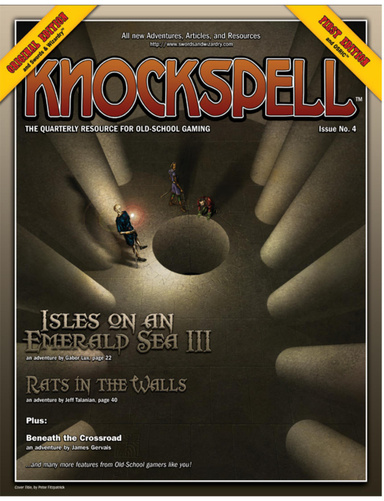

Knockspell #4 cover art by Peter Fitzpatrick
Knockspell #4 cover art
by Peter Fitzpatrick


The scenes of Thorin's company marching through Erebor while Smaug is "not at home" also convey this sense of cyclopean immensity too:


Erebor, The Lonely Mountain from The Battle of Five Armies (2014)
The dwarves exploring Erebor, The Lonely Mountain,
from "The Battle of Five Armies" (2014)


Very large levels also provide additional options during game play, as I detail next.

Size as Options

In many ways, the mega-dungeon offers the most concentrated essentials available for playing AD&D---AD&D in its most "pure" form, if you will.  Within its boundary walls, the mega-dungeon encapsulates the essence of AD&D play, and challenges the players in all aspects of the game:  all classes, monsters, spells, magic items, encounters, and treasures are on the table.  All PC classes have equal opportunity to rise in glory, or to die trying in the agony of defeat.  All DM encounters may be mowed down in the player pursuit of XP, or may mature into recurring villains like Obmi or Eclavdra.  

Showcasing the breadth of possibility for the whole of AD&D does not mean that simple and  "anything goes" funhouse environs are the required format for mega-dungeons---whether built by Zagig Yragerne, Halaster Blackcloak, or the scions of Uncle from Maure Castle---but that in gaming there, all tools are available to the players and the DM.  All PC classes should have equal opportunity to shine, including druids, assassins, barbarians, and bards, among all the remaining PC and NPC classes (well, maybe not cavaliers.... ;) ).  All PC races should be able to flex their detection muscles too---dwarves finding stonework traps and elevators, gnomes determining sloping passages and direction of travel, elves and half-elves finding secret doors, and half-orcs acting as intermediaries with humanoids, and gnomes and hobbits entering small spaces.  

A related aspect that larger mega-dungeon levels support is expandable capacity:  the mega-dungeon keeps inspiration and creativity flowing by offering plenty of room for sub-levels, side levels, split levels, demi-planes, and other pet projects.  This keeps the players and the DM creatively intrigued and engaged, since formerly-explored areas can be enriched with new encounter areas, perhaps even via variable features, and allows the creation of distinctly unique challenges and areas to support less-common and non-standard classes, monsters, and encounter types.  

I group these two together under their own heading since I see them both as closely-related but different approaches to supporting options.  The breadth of possibility focuses on the wide expanse of core rules and their supplemental additions and expansions, while expandable capacity focuses on the actual dungeon level, its architecture, and environs, rather than the rules that govern what encounters occur within the level.  

Size as Really Freaking Huge

These attributes drill down into the above two, but still stand-out in my mind as important criteria that merit their own focus and discussion.

Verticality as Large and Open Spaces:  Large monsters like dragons and rocs, elementals and purple worms need wide and spacious areas to operate within, so dungeon level designs need to provide room for such creatures , and to accommodate the tactical selection of encounter terrain being brought to bear in combat and flight by both mega-dungeon inhabitants and invaders.  

This is where the the 20' to 50' wide corridors from the DMG's Appendix A come into play, along with the chambers and rooms of unusual shape and size (CaRoUSSs, perhaps ;) ).  However, long or wide corridors that connect to central plazas, squares, or parade grounds can serve similar functions, too, as can numbers of 10' wide corridors converging into hubs, with their long lines of sight.

Verticality as Depth Within and Between Levels:  Verticality is highly-valued in the mega-dungeon design ethos, and is generally credited to Jennell Jaquays' Caverns of Thracia and Dark Tower, which feature movement up and down within levels, across and between levels, and vertical features spanning multiple levels like chasms and wells, balconies and overlooks, and interconnected cavern systems.

Verticality within a level is, in my mind, nearly as important as verticality between levels, but both are essential to good mega-dungeon play.  The levels need room to breathe, to provide the space required for those large encounter areas, and that means that they probably need 50 to 100 feet of depth per level (those pits that don't fall through into a new level below need to fit within the level's depth, along with the headroom for those 30 to 50' ceilings.  

To give room for those spaces, the depth between levels should likely be 50 or more feet.  That also allows room for smaller clusters of rooms at landings, or off of stairs.  It also helps to keep players guessing about the depth that they're going down between levels---if each level is only 10 feet down from the previous one, they'll have an easier time guessing where their PCs are, and the challenges that their PCs will face.  


Multi-Level Dungeon Features, from The Dungeon Architect Part 2
Multi-Level Dungeon Features
from Roger Musson's "The Dungeon Architect, Part 2"
Artwork by Iain McCaig


Verticality as Total Depth:  As the space within and between levels increases, the mega-dungeon grows downward, deeper into the depths.  First DM'd at GaryCon II and North Texas RPGCon #2, my "Escape from Level 14" scenario thrust the PCs from the level 10 dungeon challenge they were expecting and dumped them lost into level 14.  They needed to find their way up and out, if possible.  

For that scenario, built using my old Castle Greyhawk elevations, they were ~4200 feet below the surface, which is about 8/10th of a mile.  Earth's deepest mines are ~2 1/2 miles down, so as I build my new elevation maps, I'll allocate the necessary room for each level's footprint (as a placeholder I only used 50 feet per level, for the most part, in the original versions), which will increase the depths for the lower dungeon levels even further.  That should also enable connections to the drowic underworld for some of the deepest levels, perhaps.

Big and complex enough that players and their PCs can get lost:  For reasons to get the PCs lost in the first place, see Roger Musson's "Dungeon Architect" articles, referenced in the first article of this series.    

Getting lost is a design function of the mega-dungeon's size, interconnectedness within and across levels, and its external connections to other environments ("extraconnectedness" perhaps?).  Teleporters---with or without similarly-designed areas of levels---are not the main reasons that PCs get lost in mega-dungeons.  Flight from encounters is why PCs get lost.  Players can't map while fleeing at , and if they end up going up/down a level, fall into a pit or a chute to another level, wander down a sloping passage, etc., then they're well and truly lost, and the entire tenor of the evening changes to finding a path back to familiar ground.  

When PCs are lost, strange actions may be taken, like:  
  • players desperately consulting the mappers, trying to guesstimate distances and turn counts travelled 
  • gnome, dwarf, and stout halfling PCs being consulted for GPS coordinates
  • characters asking for directions, or bribing (or charming) dungeon denizens for the same
  • divination spells suddenly being memorized
...to say nothing about the possibility of the party running into other encounters as they flee blindly hither and yon ;)

Sufficiently vast in scope that the players and their characters will never completely explore the largest levels, much less the entirety of the mega-dungeon itself.  Always will some monsters  remain undiscovered and undefeated, traps unsprung, enigmas unsolved, and treasures unlooted.


Boromir on the futility of mapping all of Castle Greyhawk
Sean Bean on the futility of finishing
Castle Greyhawk


As Boromir asserts, one does not beat Castle Greyhawk by exploring its every nook and cranny, and then move onto the next checkbox in the AD&D gaming experience ;)

Next Up?

For part three, I will examine how I key mega-dungeon levels, including the types of paper/sheets I use, and some volume-based keying strategies, unless I tangentialize on other topics first---such as traps, a dungeon encounter type that I hold great love for.   We'll see! 

Thanks for reading and your comments!

Allan.

23 February 2026

grodog's Approach to Designing Mega-Dungeons - Part 1: the Maps

...or, a Meditation and Reflection on What grodog Likes Best about Playing in AD&D Mega-Dungeons


Introduction

This post is my response to a recent discussion of my mapping style and inspirations over on reddit, begun by user SydLonreiro, who asked

For my first AD&D dungeon, I would like to map it like Grodog, but I don’t know how to do it. I’m not sure whether he developed a specific method for doing so, or whether some of you map large dungeon levels in this way. I want to create a dungeon the way Kuntz would, and map it in this style, because it seems like the right approach for preparing my sessions — and I love this type of map. 


I was quite tickled to discover the thread after Heather and I returned from dinner celebrating St. Valentine's Day (we never go out on a Valentine's date on the actual day/weekend when it's usually so crazy-busy), and I spent some time this weekend noodling a bit in response to SydLonreiro and also to user chaoticneutral262, who raised some Qs/concerns about mapping style relative to encounter keys that I plan to tackle a bit later.

And, as it turns out, SydLonreiro is building his own mega-dungeon for use among his friends, and plans to run it in a very "Gygax 75" manner using OD&D, which is quite cool.

grodog's Inspirations and Design Sources

To begin to answer some of SydLonreiro's questions on the mapping front, I tend to wear my key inspirations on my (tie-dyed) sleeves, including:

  • The original mega-dungeon levels of Castle Greyhawk and Castle El Raja Key designed by Gary Gygax and Rob Kuntz in particular, alongside a variety of other old-school designers like Jennell Jaquays (Caverns of Thracia) and Phil Barker (Empire of the Petal Throne's Jakallan Underworld)
  • In the OSR/contemporary era, I particularly favor works large-scale dungeon designs by Richard Barton, Chainsaw, Anthony Huso, Gabor Lux, Tony Rosten, Keith Sloan, and Trent Smith, among others
  • Architectural artwork including M. C. Escher's non-Euclidean optical-illusions, Piranesi's Imaginary Prisons which echo with a vastness that definitely catches my eye, and Philippe Druillet's Elric Le Necromancien--first published in the year I was born!

Some of my favorite dungeon design articles include these pieces:

  • "Hints of D&D Judges - Part 3: The Dungeons" by Joe Fisher in The Dragon #2 (August 1976) - another excellent example of early dungeon design advice that stands the test of time; I particularly like Fisher's active and imaginative example treasures, use of watery areas, and recounting of Castle Greyhawk lore
  • Gygax's various early 1970s articles about D&D play and design, mostly-summarized on my web site at https://www.greyhawkonline.com/grodog/gh_castle_sources.html 
  • The Players Handbook's section on "Successful Adventures" in pages 107-109
  • "The Dungeon Architect"--Roger Musson's classic from White Dwarf 25 (June 1981), 26 (August 1981), and 27 (October 1981) is an excellent three-part series that covers dungeon origins, NPCs (creators, raiders, inhabitants), and dungeon construction (architecture, traps/tricks/teleporters/etc.), and dungeon design models (silly, ecological, etc.).  Reprinted in Best of White Dwarf Articles Volume 2 (complied in 1983), where I first read it.  I'd still love to reprint this someday (along with some of Paul Vernon's WD articles too)!
  • Gabor Lux's "Dungeon layout, map flow and old school game design" originally published on ENWorld 15 July 2006 and reprinted at K&KA on 12 July 2011
  • Matt Finch's "Megadungeon Tactics: Mission-Based Adventuring" in Knockspell #4 (Spring 2010)
  • Trent Smith's essays on adventure design in his Heroic Legendarium pages 97-118

We've enjoyed some good discussions about design theory articles like the above over on ODD74 at essential references for dungeon designers and K&KA at megadungeon resources.

grodog's Mega-Dungeon Design Aspirations and Touchstones

The design approaches exemplified through the works created by our past and present masters come together as a set of internal tendencies and design northstars that I aspire while working on my mega-dungeon levels.

These lurk behind the scenes in my Favorite Mega-Dungeons post as well as some of my favorite adventures too:  both the original list, and my expanded and revised lists.  The qualities I called out as key to my favorite designers' levels were:

  1. Best Environments to Explore and Map
  2. Most-Fun Encounters
  3. Most-Fun Puzzles, Enigmas, and Centerpiece Encounters
  4. Coolest Maps
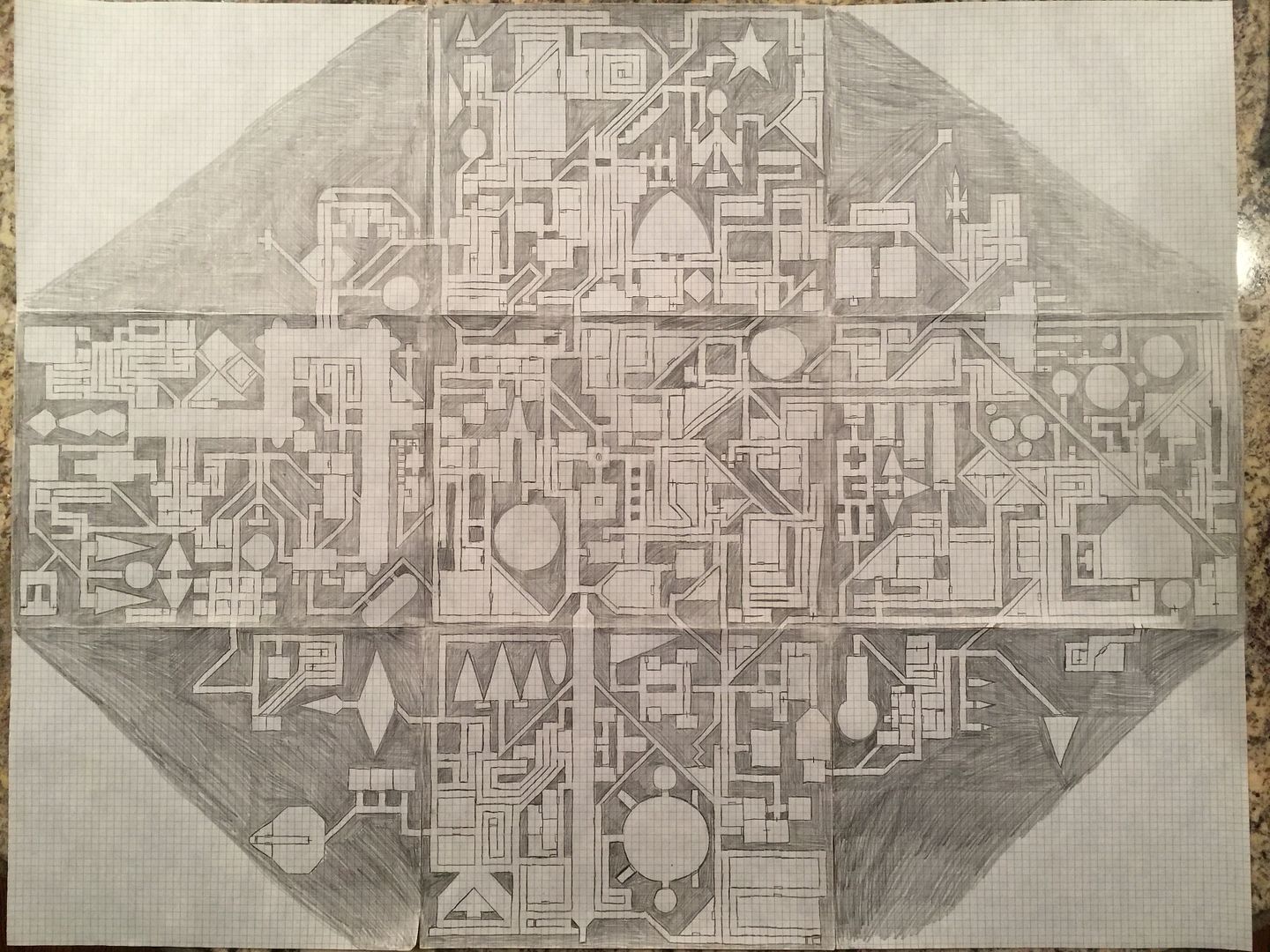
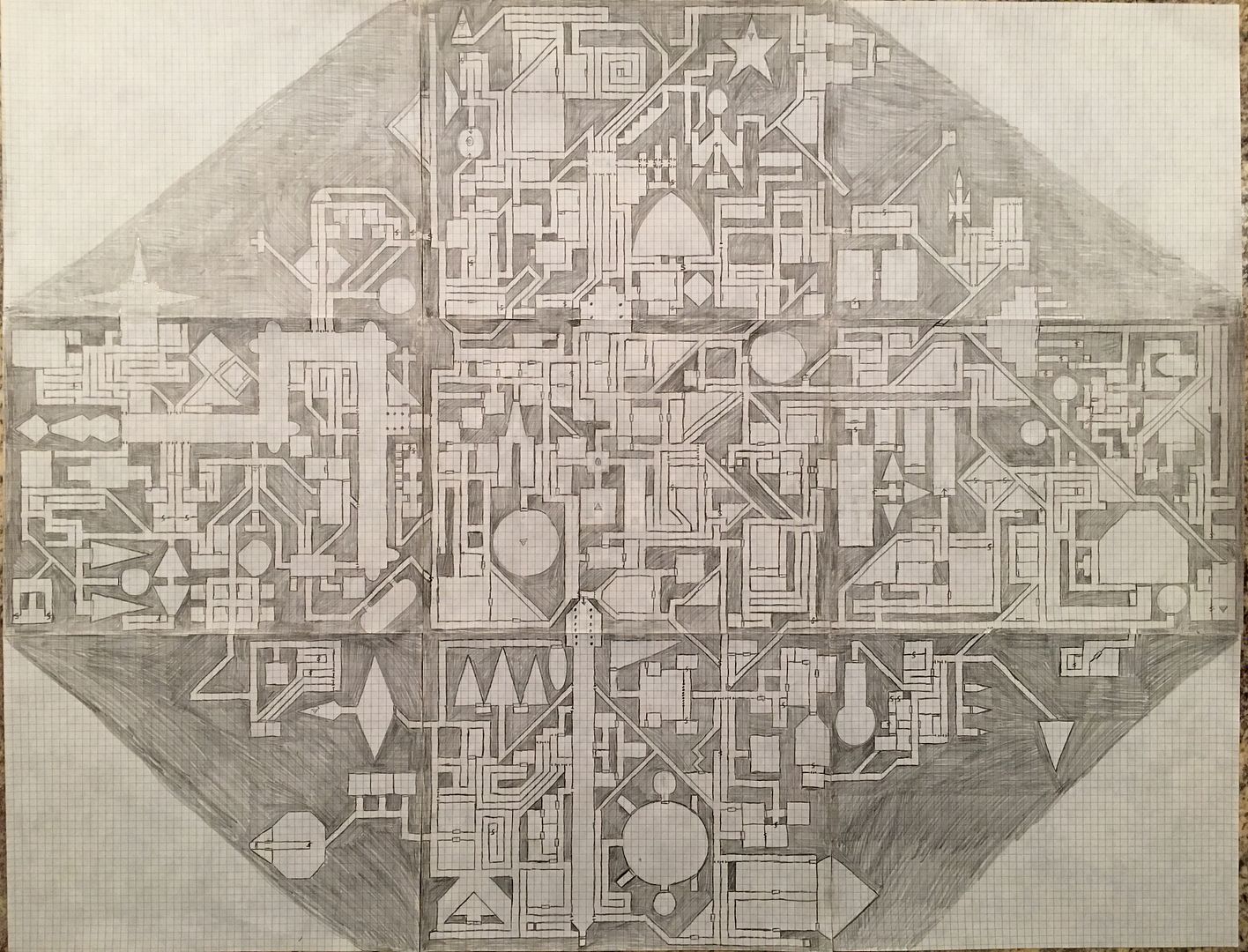
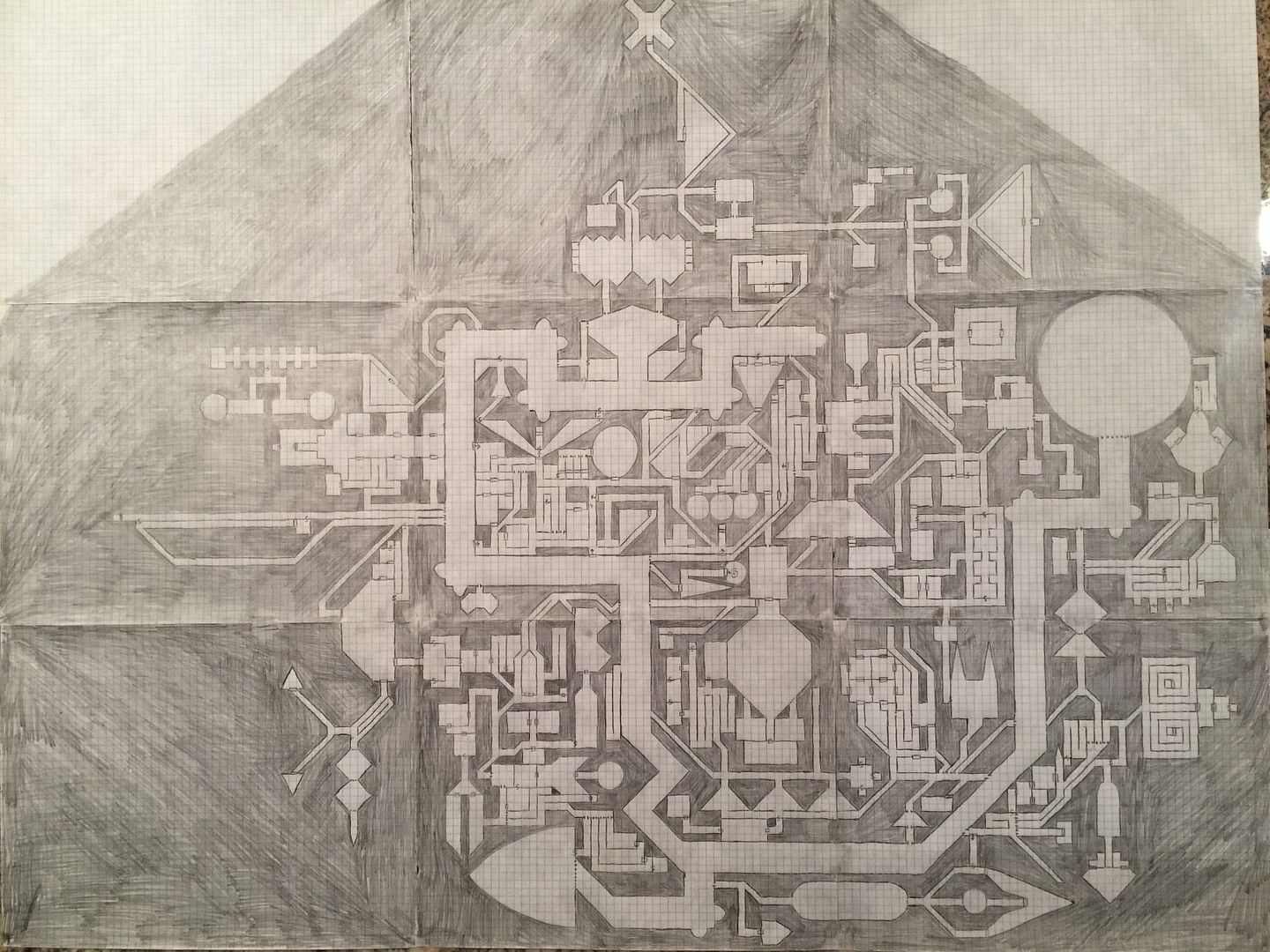
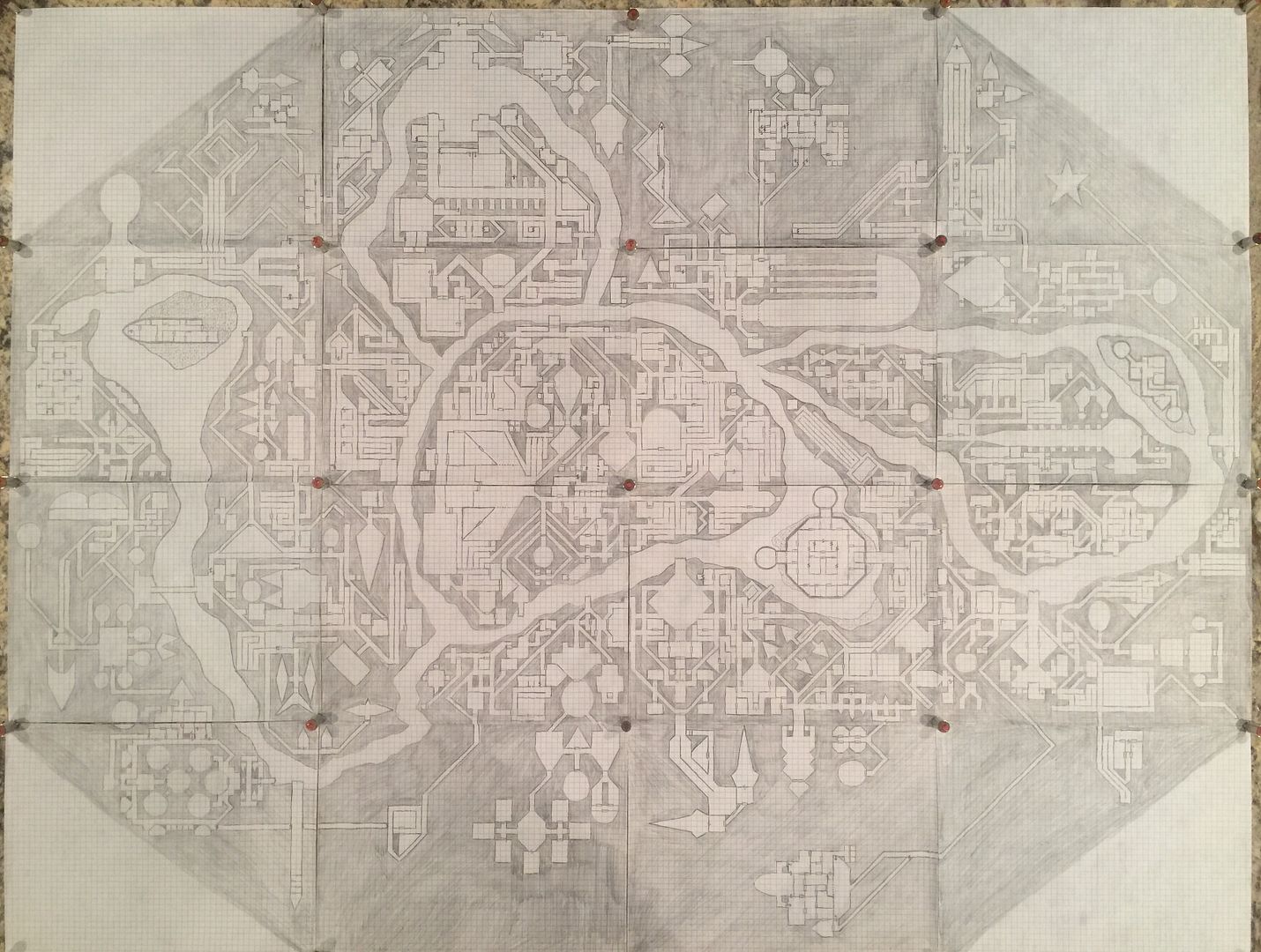
I listed a fifth and sixth pair of attributes too (Best Presentation in Print and Pulls It All Together), but at the time I'd not felt that any in-print products did a mega-dungeon justice, and that few published ones managed to pull it all together as a complete product.  Tomb of Abysthor (Necromancer Games, 2001) and Maure Castle (Paizo Publishing, 2004-2006) come closest, with ToA at 7 levels with 2 sub-levels and MC published 4 levels with 3 sub-levels (including the free "The Warlock's Walk" level on the now-defunct Pied Piper Publishing discussion boards and in The Oerth Journal #23).  Rob outlined a vision defining 18 total levels for Maure Castle, but Paizo lost the licenses for Dungeon and Dragon, so the series ended, incomplete.  Caverns of Thracia (Necromancer Games, 2004) and Foolsgrave are runners up,  at 4 levels with 2 sub-levels and 3 very very large levels, respectively.  CoT is about the same size as The Temple of Elemental Evil, but is significantly more complex and interesting as a dungeon, so I don't consider ToEE a mega-dungeon and generally consider Thracia as the minimum viable footprint to be a "true" multi-level mega-dungeon.  Foolsgrave, however, counters that since it's levels are substantially larger than the three other published mega-dungeons combined:  its three levels are built from 29 levels worth of footprintthe other mega-dungeons' levels were drawn at one sheet per level, and total only 18 sheets worth of dungeons.  It captures that majesty and scope that's so essential to the mega-dungeon exploration experience.  

I'm sure you've already noticed that #1 and #4 both focus on the maps, and that's a huge factor in my design approach:  I almost-always begin with drawing a map then keying it, rather than building the keys and designing the map to fit them (which really is something I should try sometime...).  And #2 and #3 are really both two sides of the same coin on the encounter keys—I just emphasize the puzzles, enigmas, and centerpieces a bit more by calling them out specifically over the dungeon dressing, monsters, treasures, traps, hazards, and riddles encounter types.

In thinking about these while working on a recent article about Anthony Huso's OSR designs, I revised and expanded those first four precepts to six:

  1. Compelling and Imaginative Creativity
  2. Inspiring Environments to Explore and Map
  3. Fun and Challenging Encounters
  4. Great Layout and Information Presentation
  5. Modular but Filled with Inspirational Expandability
  6. Tempered in the Crucible of Campaign Playtesting

And while they track to my general adventure design sensibilities, my favorite mega-dungeon design preferences remain fairly rooted in the idea that bigger = better.  In a 2016 discussion on putting the "mega" back in the mega-dungeon, I wrote:


My sense is that mega-dungeons are driven by both focus and size.
 

In terms of focus, a mega-dungeon that grounds an entire campaign is a campaign dungeon—and IIRC Trent Smith coined that term some years ago. In my mind "mega-dungeon" and "campaign dungeon" are related but not synonymous terms. I have placed several mega-dungeons in my Greyhawk campaigns—Castle Greyhawk, Blackmoor Castle, Maure Castle, a series of inter-related ruined Suloise dungeon complexes below the Sea of Dust, a great dungeon carved out of the glacial Black Ice, etc., etc. Other than Castle Greyhawk and Maure Castle, however, none of the others are campaign dungeons in my games, since they're not the focus of my players' activity. Castle Greyhawk provides that primary focus (with some interleaving with Maure Castle from time to time), so it is the campaign dungeon in most of my Greyhawk campaigns. 

In terms of size, a mega-dungeon is sufficiently large that it cannot be completed during game play. That size can be accomplished in a variety of ways, depending on how the DM approaches their dungeon design: 

  • very large individual levels: I try to vary the sizes of my dungeon levels by creating them using differently-sized graph sheets, and I have 8.5x11 sheets that are 4, 5, 6, 8, 10, and 20 squares per inch, 11x17 sheets that are 5, 6, 8, and 10 spi, and 1 big pad of 17x22 sheets at 4 spi. You can fit a LOT of dungeon onto an 8 spi 8.5x11 sheet, much less an 11x17 one, let me tell you! The gigantic poster maps of Undermountain, Mammoth Dungeons, and Armaron are probably the best examples of this style of dungeon that have been published (that I'm aware of). Barrowmaze's poster maps from the KS also fall into this scale (although I'm not sure whether poster maps were done for Barrowmaze Complete or not??), and the large and inter-related cavern levels in Castle of the Mad Archmage do as well. Phil Barker's Jakallan Underworld from EPT also falls into this category, along with Arden Vul. 

  • lots and lots of levels and sub-levels: the levels can be in physical proximity, and thus attached to the dungeon, or adjacent at the planetary or planar levels, and potentially exist physically in another multiverse. Rappan Athuk features many small levels, as do the Mines of Khunmar. 

  • connections to other large dungeons: Scott Casper created teleporters between Castle Greyhawk and Maure Castle in his Castle Greyhawk webcomic, for example, which intertwines both of those mega-dungeons, effectively doubling their already prodigious sizes, with the added complexity that you could be teleporting within a level, across levels within the same mega-dungeon, or across mega-dungeons! 

  • vastness of the environs: think of Erebor or Moria in terms of simply how huge they are, regardless of whether they're really mappable as levels at all; Holmes' "Underworld" in his Boinger and Zereth fictions is said to delve the entire planet: "What race or races built the maze, no one knew. In the opinion of the sages of Caladan, many layers of dungeons and underworld were laid down, one atop the other, as the world crust was formed, so that now no one knew or even guessed how many levels extended below the surface" (Maze of Peril back cover text).  This also suggests another scope of "mega"—that of depth below the surface, which naturally brings to mind the G-D modules and drowic underworld, Verne's Journey to the Center of the Earth, Pellucidar, etc., etc.


For related discussion, see putting the "mega" back in the mega-dungeon at K&KA and Megadungeon Definition? at Dragonsfoot.


Foolsgrave - Chainsaw's Ultimate Mega-Dungeon

I still don't think that anyone has topped Chainsaw's brilliant Foolsgrave levels, which are vast and beautiful and visible from inception through conclusion in his Foolsgrave (development thread, spoilers) at K&KA, with the finished maps shown below at https://knights-n-knaves.com/phpbb3/viewtopic.php?p=225505#p225505:

Old Level 1


New Level 1


Level 2


Level 3


More to follow, later in the week!

Allan.

22 April 2025

A Brief History on the Development and Design of the Planar Cosmology in AD&D

I was reading a good discussion a couple of months ago (in February 2025) about the nomenclature for the power levels of different types of demons over on Dragonsfoot, when the topic veered a bit more planar in focus.  This proved interesting, since it highlighted some inconsistencies between lower-planar monsters' alignments and the planes that they were assigned to within their descriptions in the Monster Manual.

This made me ponder and reflect a bit, after which I realized just how much planar content development in AD&D was compressed into the three-year span from July 1977 to August 1980's release of Deities & Demigods.  There's a little development before, and significant additions afterward, as my planar bibliography demonstrates, but that three-year window is very significant!


Planar Development Timeline, 1977-1980

  1. 1977:  Gary Gygax’s first article on the planes appears in "Planes" in The Dragon #8 (July 1977). It introduces the first visual of what will become the Great Wheel, and calls out the new spell Vanish as a means to enter the Ethereal (also spelled as the Etherial in the article, a spelling employed by Tramp in his "Wormy" comic stories).


    The Great Rectangle?? - D&D's first planar schematic, from The Dragon #8 (July 1977)
    The Great Rectangle?? - D&D's first planar schematic,
    from The Dragon #8 (July 1977)


    This planar diagram isn't oriented as we've grown used to seeing it---here, the lower planes are on the left side of the diagram, with The Abyss occupying the traditional location of the Nine Hells, while the devils reside in the traditional location for the Seven Heavens.

    As Gary states at the end of that piece, “This writer has used only parts of the system in a limited fashion. It should be tried and tested before adoption.”—so, the planar concepts were in the process of being developed while the Monster Manual was being finalized.  Gary returns to this playtesting focus a few times during this planar development spurt.

  2. The Monster Manual is published in December 1977, and vastly expands the planar monsters without really codifying the planes much at all (as its five-point alignment system demonstrates).  

    The five vs. nine alignments is somewhat telling, since one of the aspects that Gary mentioned in the TD#8 article on page 28 is that, "As of this writing I foresee a number of important things arising from the adoption of this system. First, it will cause a careful rethinking of much of the justification for the happenings in the majority of D&D campaigns.... Third, and worst from this writer’s point of view, it will mean that I must revise the whole of D&D to conform to this new notion."

    Those revisions were not yet finalized, and clearly not fully-introduced in the MM either,  despite Gary sketching out some of their architectural outlines six months earlier.  

    (Aside:  I wonder if the amount of work required to introduce the new planar underpinnings into the system is part of why Gary felt justified to declare AD&D to be a new game significantly different from OD&D).  

  3. 1978 sees some of Steve Marsh's first public writings about the planes in D&D, in his  zine series "Elaikaises' Tower #2" and "Elaikaises' Tower #3" articles in Lords of Chaos #4 (Spring 1978) and #5 (May 1978).

    I'll follow-up on these soon, after I reread them in depth and compare them to the material I have from Steve's player characters folder, and to the 1980 TSR memo below.

  4. The Players Handbook reiterate (and reorient!) the Great Wheel with its release in June 1978.  Here, the planes are reoriented to match the positions of the alignments in the original graph from The Strategic Review #6 (February 1976) and in the PHB itself:


    Revised planar architecture for AD&D,
    Players Handbook (1978)


  5. "Elementals and the Philosopher's Stone" by Jeff Swycaffer in The Dragon #27 in July 1978 is directly commented upon by Gary in TD#32 (see below), and begins the wider community-based discussions about the planes in response to Gary's initial outlay of them in TD#8.

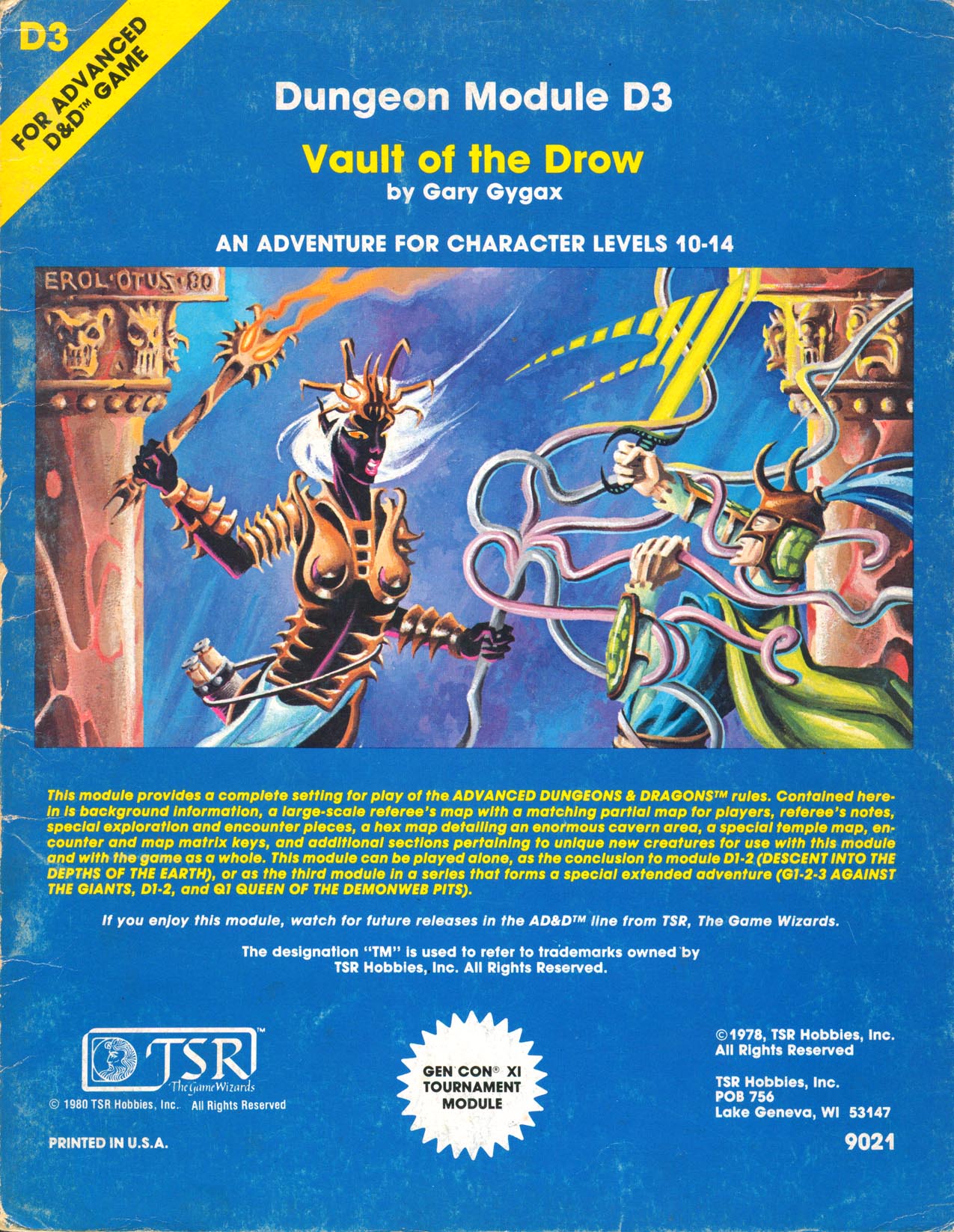
  6. D3 Vault of the Drow introduces mezzodaemons and nycadaemons as new creatures---and by implication, daemons as a new type of denizen of the lower planes---at GenCon XI in August 1978.  

  7. 1979:  While the barghest wasn’t widely known until its publication with the release of Monster Manual 2 in 1983, it first appeared in The Dragon #26 in June 1979 (and its text remains notably unchanged in MM2), and speaks to Gehenna's inhabitants in a manner consistent with other entries in the MM.

  8. The Dungeon Masters Guide's release at GenCon XII in August 1979 provides some suggestions and guidance on planar matters, but spends far more words on how to convert characters back and forth from AD&D to Boot Hill and Gamma World rather than focusing on the planes themselves, unfortunately.  

  9. Gary’s "Playing On the Other Planes of Existence" in The Dragon #32 in December 1979 talks to night hags, nightmares, daemons, and larva as known dwellers in Hades, codifies the 1979’s DMG guidance on converting BH and GW as parallel worlds in AD&D, and follows up on the ideas of the Greyhawk campaign's short-lived subway excursion into the real world of Earth mentioned in TD#30 (October 1979).

    But going forward very little of OD&D's wild and wooly days of "Sturmgeschutz and Sorcery" in The Strategic Review #5 (December 1975) or "Faceless Men & Clockwork Monsters" in The Dragon #17 (August 1978) remains in AD&D's planar conceptions.

    Gary also responds directly to Jeff Swycaffer's article in TD#27, and concludes with another appeal to the fan base:  "If you have opinions which you wish to share with us, please drop me a line.   Better still, if you have what you believe is an outstanding treatment of one of the planes, why not submit it to TSR's design department?" (page 13).  

  10. 1980:  Ed Greenwood's seminal article, “From the City of Brass… …to Dead Orc Pass… In One Small Step: The Theory and Use of Gates” in The Dragon #37 (May 1980) details  the use of gates as a travel device in the fantasy and science fiction of the 1960s and 1970s, focusing on the works of Michael Moorcock, Roger Zelazny, and Philip Jose Farmer, James H. Schmitz, and C. J. Cherryh.  

    In that same issue's “Greyhawk: the Shape of the World” article, Gary updates us on the development of the ten elemental planar modules with Steve Marsh---and these are in addition to Skip William’s unpublished Shadowland module set in the Plane of Shadow (Gary opines that “perhaps that should be Quasi-plane of Shadow”) as being outlined in the development department , and Queen of the Demonweb Pits, to be set in the Abyss.  (Gary also provides troop details and notes about high-level PCs and followers from the Greyhawk campaign, and talks to other doomed Greyhawk projects like Castle Greyhawk and the City of Greyhawk).  

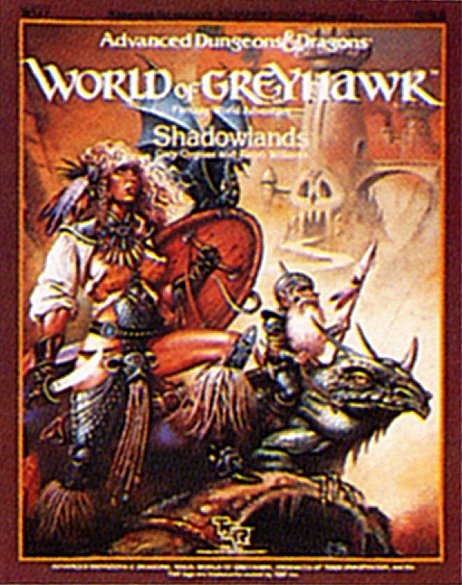
    Shadowland was actually solicited by TSR at one point, and I had preordered it and later received a refund.  From The Acaeum's Ongoing Research page:

    WG7 Shadowlands.  From the Summer 1986 Mail Order Hobby Shop catalog:  "A high-level module set in the World of Greyhawk.  Journey to the perilous Plane of Shadow to rescue Princess Esterilla and confront the master of the plane... where you find yourself an unexpected guest at a wedding where the guests include a lizardman, a catlord, and a mistress of illusion!".  Assigned TSR stock #9184.  Gary Gygax and Skip Williams were collaborating on the project, but it was shelved due to Gygax's lawsuit with TSR.  Gygax has since stated that while Wizards of the Coast has given permission to have the module published, the fact that it will be produced "on spec" (no contract nor advance payment), makes it unlikely that he or Skip will be undertaking the project anytime soon.  The original mention of it is in Dragon Magazine #37, page 10, where it's called "Shadowland".  The mock-up cover scan of this module, featuring the cover artwork from Dragon #58, is here.  Thanks to Christian R. for the scan.  This research item is closed, but will remain here for trivia purposes.


    WG7 Shadowlands - unpublished 
    cover artwork by Clyde Caldwell

    The WG7 product code was recycled in 1988 for the "joke" version of Castle Greyhawk.

  11. June 1980 TSR memo from Gary to Steve Marsh (with a cc: to Lawrence Schick) that talks to the size of various non-infinite planes, as well as naming some of the planar projects planned at that time, including Steve's Starstrands and Old Shards adventures, and Skip Williams' Shadowland, alas all unpublished:


    June 1980 TSR memo on planar adventures being developed by Steve Marsh with Gary Gygax
    June 1980 TSR memo on planar adventures
    being developed by Steve Marsh with Gary Gygax


  12. The release of Deities & Demigods in August 1980 at GenCon XIII adds the Para-Elemental Planes and the Plane of Shadow to the planar cosmology, and redraws the Outer Planes as The Great Wheel for the first time: 


    The Great Wheel debuts in
    1980's Deities & Demigods


That’s a lot of moving parts being juggled in planar development work between Gary Gygax, Steve Marsh, Dave Sutherland, and, to a lesser extent, Skip Williams, Frank Mentzer (who helped on the spells and magic items adjustments for Q1 Queen of the Demonweb Pits), and Rob Kuntz (who designed his own elemental planes and Demonworld for play in his Kalibruhn campaign, and incorporated planar and planetary concepts in Greyhawk).

I will examine some of the beginnings of the planar design process prior to 1977 and its continued expansion after 1980 in the next article in this series.


Allan.

22 April 2024

Mega-Dungeon Monday - The Recessive Gallery Level

This is a presently-unfinished map that I designed primarily during the pre-COVID era:


The Recessive Gallery Level -  map by Allan Grohe (grodog)
The Recessive Gallery Level - 
map by Allan Grohe (grodog)

The map is drawn on 8 spi graph paper, so it represents a fairly large level environment---880' east-west by 640' north-south.  That places it solidly among the largest of my dungeon levels, and it's comparable in width to my original design for the first level of my Castle Greyhawk (which has been significantly enlarged more-recently, along with my second level).  

Unlike many of my maps, I didn't sign and date this one, so I'm not sure offhand when I created it during the past decade-ish, but I worked on it last in November 2019, probably as prep for running it as a convention game, but I didn’t get quite that far with the keying. 

As usual with my unfinished maps, various rooms are orphaned until I determine whether access to them will be via doors, archways, secret doors, or other more-esoteric means of entry.  

Some interesting (to me, anyway!) features to note:

  • Entrances are via the 60’ circular shaft just right-of-center, ramps on the right side, a 20' wide corridor to the south, and a 20’ wide secret corridor on the far left
  • The area just above the entry shaft is the levels titular Recessive Gallery---a recessed artwork gallery.  I haven’t decided exactly what type of art is represented in its exhibits, but I’m leaning toward statues and other physical/magical art emplacements (similar in style but not necessarily subject matter to those in my drowic sage of demonology's home in Erelhei Cinlu)
  • You’ll notice some triangular doors drawn on the level, and they are in fact triangular in shape and placed in triangularly-shaped corridors, which complicate movement (the triangles are oriented with the point downward)
  • A few of the rooms are moving, although only one is marked on this version of hte map:  the lower-right 40x40’ room
  • Two multi-level complexes exist:  an octagonally-shaped one in the lower-ish left, and a square-ish shaped one in the lower middle right.  These extend upward and downward from the baseline elevation of the level, and may reach into other adjacent levels (I haven't determined that yet).
  • The large skull/lightbulb-shaped room is likely a temple, perhaps to a god of death---perhaps Nerull or Wee Jas or a previously-slain god of death (two of my players' PCs are interested in the god of death:  one is from the Horned Society and has been actively worshipping Nerull, while another is a fey bard from another plane and is enamored with an aspect of the god of death from that plane, who may or may not also existing within the portfolio of one of Greyhawk's death gods)
  • I placed a few repeating room-door mazes in the level, in the tradition of early Gygaxian and Kuntzian map designs
  • At least two of the large rooms are inhabited by dragons!

More to come as I continue to work through older draft posts and as inspiration strikes! :)

Allan. 

04 December 2023

High-level Adventure Design and Play Considerations

With the No Artpunk 3 contest having just closed submissions, Prince of Nothing outlined his judging principles for some of what distinguishes good high-level adventure designs---and by implication, good high-level play---in his blog post at https://princeofnothingblogs.wordpress.com/2023/11/29/nap-rating-high-level-adventures/ (as well as in the posts clarifying and expanding the NAP3 entrance criteria too).


Gary Gygax's D3 Vault of the Drow - for PCs level 10-14
Gary Gygax's D3 Vault of the Drow -
for PCs level 10-14,
artwork by Erol Otus


In addition to those detailed by Prince, some other criteria rise to the level of "important" in my mind (and Prince never said his list was exhaustive, of course), including:

  • showcasing the strengths of high-level play: where PCs need disintegration to take down a wall of force, need to erase that symbol, and need to research and learn the truename of the demon to be banished (perhaps by any means necessary)

  • non-nerfing environmental challenges high-level modules should not be just the usual trip to the dungeon, cave, or ruin, but should offer distinctive challenges. Examples: aerial/aquatic/undersea environs, active volcanoes, magical/spatial anomalies, demi-planes, and other planes of existence. And while physical challenges are common, social and cultural obstacles can be equally effective:  urban, high-society/courtly, guild/organization based, and religious cultures and faction relationships may not only limit standard combat actions but may also shift the field of combat to influence and politics, and the repercussions of choices made and opportunities lost, rather than simple swordplay

  • knowledge (and perhaps even mastery) of the game system knowing your PCs and the capabilities of their abilities,  spells, and magic (both your own PC and the others in the party), knowing the foes/monsters, knowing the environment and setting, etc. 

  • acting well as a group/team this follows on from knowledge above, but gets into coordinated and effective application of expertise, individually and as a group, at the table and in the moment, as well as looking tactically ahead to medium and long-term goals


What other design principles guide your designs and play in high-level adventures?


I'm curious to hear what criteria drive your sense of high-level design and good play, so please chime in via the comments.  


Some additional discussion and follow-up on reddit at at https://www.reddit.com/r/adnd/s/yPvHskuRje, and Facebook at https://www.facebook.com/groups/40230212669/permalink/10160278890287670/, and Dragonsfoot at https://www.dragonsfoot.org/forums/viewtopic.php?t=91954


In Closing


For the record, I did not submit an adventure for consideration ton NAP again this year:  I didn’t complete the data entry to make my submission electronic and submittable in time (I’m sans PC since September, and have used my son’s while he’s at school, but that wasn’t sufficient time to wrapped it all up by month-end).  It likely needed more time to playtest too, and somewhere along the way I also apparently missed the page count limit, which would have been heartbreaking to have blown had I submitted on time! ;)   


However, I found the contest very inspiring, completed about 90% my adventure design, and I plan to run it (and perhaps my drowic slave market) at GaryCon, the North Texas RPG Con, and Virtual Greyhawk Con next year.


Once I refigured out how to submit files to my web site using the new-to-me admin interface, I will also finally share my expanded tables for Appendix C NPC and PC magic item generation, too.


Allan. 

01 February 2023

Wilderness Random Encounter Table for Hardby - Greyhawk Campaign Prep

Somewhat akin to the missing forest from Darlene's gorgeous maps of The Flanaess, the Glassography from the 1983 World of Greyhawk boxed set doesn't include an encounter table for Hardby.  Unlike the forgotten Folio Forest, however, Hardby is only mentioned in passing in the original Folio and Boxed Set editions for the setting, so it's not terribly surprising that Hardby doesn't merit its own Encounter Table.

Still, my current campaigns have been set in and around the City of Greyhawk, and while the previous group from our Wichita Greyhawk Campaign (RIP due to COVID) did visit the city of Hardby for training and some resupplies during their explorations of the DMG Monastery dungeon, the current Castle-Greyhawk-based crew has not trod its hallowest streets quite yet.  But they are planning a trip to Hardby in the near-future, to be followed by a trip to Dyvers (perhaps directly from Hardby, perhaps via Greyhawk City---we'll see!). 

World of Greyhawk campaign prep - a DM's fun is never done!
World of Greyhawk campaign prep -
a DM's fun is never done!


Since the PCs are still relatively lower-level, and the path between the two settlements is along well-trod roads, the journey from Greyhawk City to Hardby will likely be conducted by the PCs afoot, unless they decide to hire a local ship or a Rhenne barge to speed their trip.  

In any event, travel afoot, mounted, or via riverine transport will require several days, which will entail some random encounters.  One of the aspects about the design and detailing of Greyhawk that I love is its use of setting-specific regional encounter charts, which include local patrols details too.  However, Hardby lacks an existing table for such roaming monsters.... 

That didn't stop me from creating a table, of course, but I did check and recheck to make sure I hadn't missed its entry, sure that it should be there (it wasn't).  I built the list of possible encounters using a mixture drawn from other nearby encounter tables' entries, including the Abbor-Alz, Cairn Hills, the City of Greyhawk, and the Wild Coast.  

Here's the final result:


Hardby Wilderness Encounters Table 

d100 Roll   Hardby Encounter
 01-04   Demi-Humans
 05-06   Dwarves (1d6: 1-4 hill, 5-6 mountain)
 07   Elves, Sylvan
 08
  Gnomes
 09-10   Halflings (1d6: 1-4 Hairfeet, 5-6 Stout)
 11   Hill Giants (raiding)
 12-15   Humanoids (raiding)
 16-18   Men, Amazon Patrol - Light
 19-20
  Men, Amazon Patrol - Medium
 21   Men, Amazon Patrol - Heavy
 22-25   Men, Bandits
 26-27   Men, Brigands
 28-29   Men, Buccaneers (on or near water)
 30-32
  Men, Characters
 33-45   Men, Merchants
 46-47   Men, Pilgrims
 48-52   Men, Pirates (on or near water)
 53   Men, Raiders (slavers or otherwise)
 54-59
  Men, Rhenne (on or near water, or Attloi inland)
 60-62
  Men, Tribesmen (hill- or marshmen + 20-80)
 63-64   Ogres (Merrows if on or near water)
 65-66   Trolls (Scrags if on or near water)
 67-100   Use Standard Encounter Tables


20% of riverine encounters will be with Rhenne, with the remaining 80% using the standard tables.  

I still need to detail Hardby's Amazon Patrols (and the Amazon Marines that ward the Selintan River and Wooly Bay coastal waters), but that'll come together quickly I'm sure.

Allan.