Showing posts with label grodog's castle greyhawk. Show all posts

18 November 2026

Unreleased Greyhawk Products

Jay Scott, Anna Meyer, and Mike Bridges plan to showcase unreleased/unpublished Greyhawk adventures in their Legends & Lore episode #368 on Wednesday night, 18 November 2206:


In the show, the crew plans to discuss various features about the various yet-to-be-published adventures, including:
  • Title:  name of the adventure
  • Location:  where in the World of Greyhawk is it set
  • Proposed levels:  what is the challenge rating of this adventure in any particular edition
  • Goal of the Adventure:  what is trying to be accomplished
  • What makes it cool?:  why is this adventure one of coolest unwritten GH Adventures
  • Special Considerations:  any connections or taking off points to other things

I won't dig into these details in depth on all of my classic selections below, but will touch on them more explicitly when it comes to my own scenarios!

Classic Greyhawk Vaporware

Perhaps unsurprisingly, I have some thoughts on classic vaporware Greyhawk products, some of which have been in queue for longer than TSR existed!:

  1. Castle Greyhawk
  2. City of Greyhawk
  3. Stoink: The Wasp's Nest
  4. Starstrands and ten or more additional outer planar modules, of which TSR published only Q1 in 1980
  5. WG7 Shadowlands

We'll tackle each in turn:

1.  Castle Greyhawk


Castle Greyhawk
by Gary Gygax and Rob Kuntz heads the top of this list (in fact, it's on it's own list, all by itself!), but I've already written quite extensively about this recently, so we'll hold off on further commentary for the nonce---although expect more soon, as levels from the two Castle Zagyg campaigns being to see the light of day!  

2.  City of Greyhawk


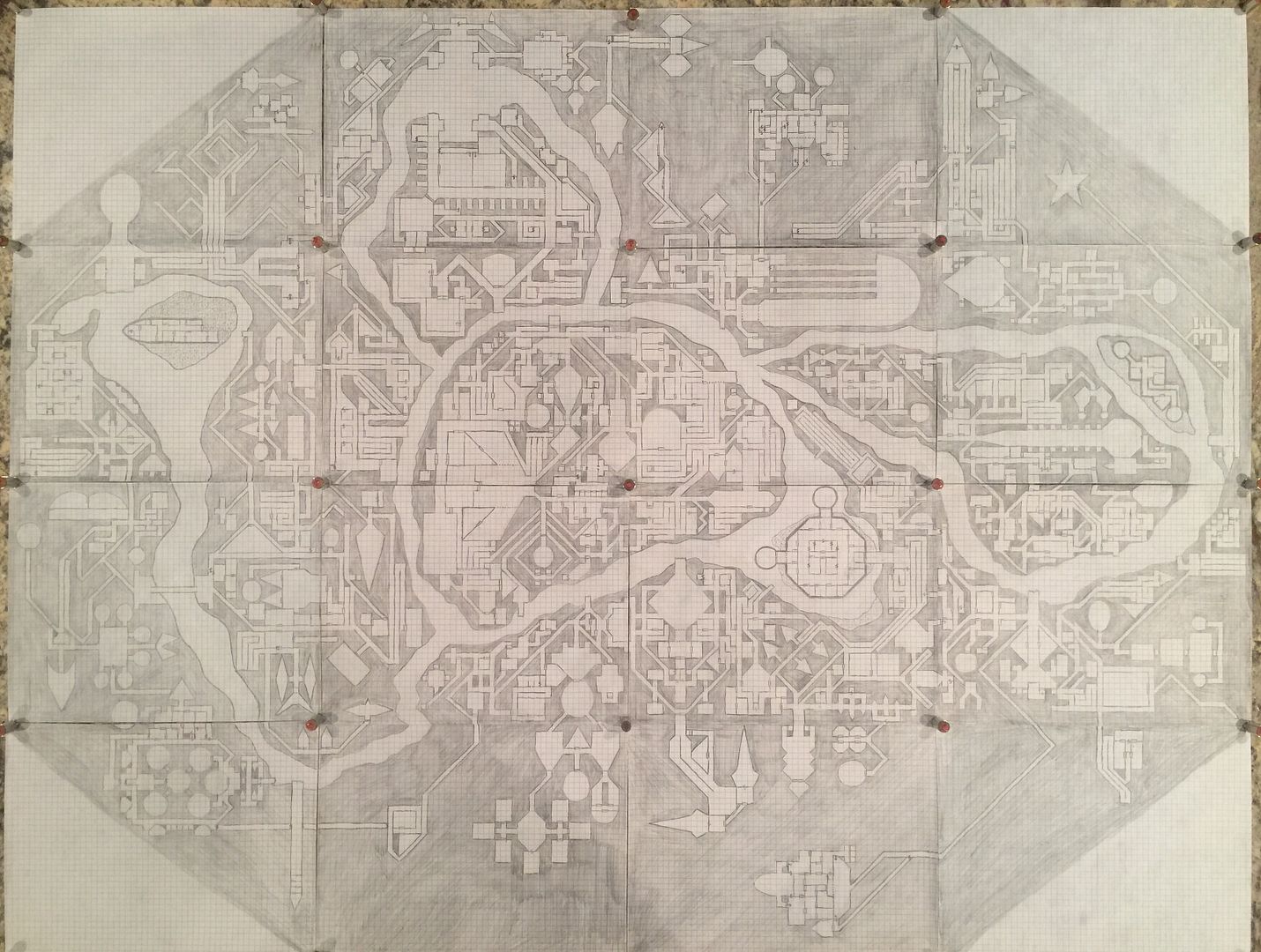
The City of Greyhawk gazetteer and giant map by Gary Gygax and Rob Kuntz,follows, as summarized by Gary in “Greyhawk: the Shape of the World” article from The Dragon #37 (May 1980):   
Much of the original activity in the Greyhawk Campaign came in the huge City of Greyhawk. My initial map was only an 81⁄2” x 11” sheet of graph paper, but this was soon enlarged to a four-times size. Even that was too small, so extra, large-scale sections were done up to supplement the main map. I have now gone to what amounts to about four-game-maps size to show the whole of the place in fair detail. The mapping isn’t complete, and only a few of the most outstanding places are noted, as there is yet many months of work left before the design will be in shape to submit to TSR’s Product Development Department. Sometime in 1981 or 1982, though, you should see a giant map and gazetteer for the City of Greyhawk being offered for sale. The gazetteer will detail the deities of the place not otherwise dealt with in modules or the like, by the way, and readers will learn more about “Old Iuz,” the current menace from the state of that name, as well as know who Ralishaz is, why Hextor is bad news in combat, and so on.

3.  Stoink


Stoink: The Wasp's Nest by Gary Gygax and Rob Kuntz:  Best-known from the chapters in Saga of Old City in which Gord meets first meets the bard Gellor, this was a completed probject turned in to TSR around the time of Gary's ouster, and a few small portions of this manuscript survive. 

I'm well-overdue to write about this mystery in more depth, so here's a teaser from an old post by Doug Behringer on the long-gone Necromancer Games forums: 
Jan 15, 2002 22:03

Stoink- The Wasp's Nest is the city-state of Stoink located in the Bandit Kingdoms of the World of Greyhawk. Readers familiar with EGG's Gord the Rogue novels will know the city well. It was a city of thieves run by thieves.

The module was designed by Gary Gygax and Rob Kuntz. Rob did mainly the areas outside the city and the cults (with the assistance of Erik Shook, I believe).

When I interned at TSR, Stoink and L-3 "Deep Dwaven Delve" were both sitting in boxes on a filing cabinet, next to the photocopy machine. Through the years of turmoil at TSR, both were lost.

A few years back I told Roger Moore about both manuscripts and he searched TSR for them. He found the module L-3, but not Stoink. L-3 was later published in TSR's 25th Anniversary boxed set as the last 1ed module to be published by TSR/WOTC.

Since that time, a map of Stoink has been found. Both EGG and RJK confirm that it is a copy of Gary's map of Stoink. The map most likely predates the work ont he manuscript of Stoink, since it is very rough and contains few map locations.

Neither EGG nor RJK have a copy of the Stoink manuscript and its location is still subject to speculation.

The map of Stoink will most likely appear on Grodogs website in the future, once I convert it into CC2.

4.  Starstrands and Outer Planar Modules


The panoply of ten (or more!) planned TSR planar modules include Steve Marsh's Starstrands, as mentioned in TD#37:
Steve Marsh sent me a wealth of material on various planes, just as I was getting my own creative processes going. At first I envisioned a long-distance ex- change with manuscripts eventually going back and forth between us. Now Steve will be coming to work for TSR this summer for a couple of months or so, and I have hope that he and I can work up general outlines and hammer out details, so that only one exchange of materials will be needed for each piece.  

Because of this, there might be as many as ten World of Greyhawk modules based on the planes by the end of 1981 or mid-82.
Steve went on to write and design a lot of material for Starstrands, which I touch upon in A Brief History on the Development and Design of the Planar Cosmology in AD&D.


5.  WG7 Shadowland

In the same issue, Skip Williams' Shadowland is also mentioned, although we know  significantly less about it:
While that project is yet a ways off, modules of the World of Greyhawk are currently in the works. Skip Williams is working on my original outline for Shadowland, and from what I’ve seen so far, we should be able to have a final product out this year. The module will be an adventure on the Plane of Shadow—perhaps that should be Quasi-plane of Shadow. Other such modules are also in the hopper.
The Acaeum summarizes what we know about the adventure as, "A high-level module set in the World of Greyhawk.  Journey to the perilous Plane of Shadow to rescue Princess Esterilla and confront the master of the plane... where you find yourself an unexpected guest at a wedding where the guests include a lizardman, a catlord, and a mistress of illusion!". 

I wrote to Skip about this adventure in years past (and had ordered a copy from TSR, in fact!), and will try todig up my notes from that discussion.


grodog's Greyhawk Vaporware


Now, lest it seem like unreleased Greyhawk products are only the result of TSR's unrealized imagination, here are a bunch of the levels from my version of Castle Greyhawk that I've run at conventions since 2009, and that have yet to appear in print---despite two announcement on the back cover of our Black Blade Publishing reprint of Tower of Blood in 2015.  Sigh ;)

  1. GC-01 Iounic Caverns
  2. GC-02 Enchanted Orchards of the Arimoi
  3. Halls of the Iron Golems
  4. The Heretical Temple of Wee Jas
  5. Escape from Level 14, or, The First Landings Level, or Drawing Under the Influence of Gygax and Kuntz
  6. Diamonds in the Rough
  7. The Black Reservoir; based on Gary's short story, rather than Rob's level
Probably the most-playtested among my Castle levels, those are most-ready for publication from a design POV. Plenty more sit in binders in my office as this list attests:


A glut of grodog Castle Levels, perhaps?


We'll tackle each in turn:


1.  GC-01 Iounic Caverns 


  • Location:  in grodog's Castle Greyhawk 
  • Proposed levels:  6th to 10th level PCs for AD&D 1e/OSRIC
  • Goal of the Adventure:  find things, kill them, take their stuff, live to tell about it
  • What makes it cool?:  my homage to the idea of a Greek level in Castle Greyhawk, as well as the source for ioun stones in my campaign
  • Special Considerations:  several gates connect to other planes including GC02 (see below), and connects to nearby levels like Halls of the Iron Golems; also features a temple to Dalt, oracles that may provide useful divine and infernal insights, and some quarter-eating video game/pinball arcades

Here's my marketing blurb from the back cover of Tower of Blood (of the six books listed, only Tales of Peril was released, in 2017, at least 2 years late if note quite a few more!):
Iounic Caverns is a deeper level extracted from grodog's castle mega-dungeon.  Greek-themed monsters abound amidst its strange temples and oracles.  Explore all while seeking the Iounic Caverns and the fabled Iounic Loop---rumored to rest somewhere beyond the magical laboratories where ioun stones are mined, refined, and enchanted. Iounic Caverns is a stand-alone dungeon level designed for PCs of levels 6-10.

2. GC-02 Enchanted Orchards of the Arimoi


  • Location:  in grodog's Castle Greyhawk 
  • Proposed levels:  7th to 12th level PCs for AD&D 1e/OSRIC
  • Goal of the Adventure:  find things, kill them, take their stuff, live to tell about it
  • What makes it cool?:  a demi-planar add-on to my Greek level in Castle Greyhawk that also leverages my version of Echinda, based on Roger E. Moore's wonderful "The Blood of Medusa" article in Dragon Magazine #58 (February 1982)
  • Special Considerations:  also intended to provide more oracular opportunities, and to broaden the footprint of medusa-like monsters 

From the back cover of Tower of Blood:
Enchanted Orchards of the Arimoi is an extra-planar sub-level accessible from GC-01 Iounic Caverns.  Also Greek-themed, this adventure details a mountainous wilderness coastline in which the enchanted orchards and gardens of the Arimoi are located.  Seek the wisdom of the Arimoi--a race of ophidian oracles ruled by their beatific and hideous queen, Echidna--at their temple; barter for their magical elixirs, ambrosias, nectars; or descend into and loot their dungeon lair, if you dare!  Enchanted Orchards of the Arimoi is a wilderness micro-setting and dungeon that can be inserted into any campaign, and is designed for PCs of levels 7-12.

3.  Halls of the Iron Golems


  • Location:  in grodog's Castle Greyhawk 
  • Proposed levels:  8th to 14th level PCs for AD&D 1e/OSRIC
  • Goal of the Adventure:  find things, kill them, take their stuff, live to tell about it
  • What makes it cool?:  home for the artifact Heward's Mystical Organ in my campaign, it also features a factory that creates and assembles iron golems, which are then loosed into the warren of levels (or even the surface countryside at times!)
  • Special Considerations:  many secret doors (even for one of my levels!) and some long corridors/stairwells section this level into almost sub-levels within its own level, resulting in some hard-to-find areas; and also contains an entrance to the Leaden Cathedral sub-level too (more on that below)

The Swedish Chef iron golem was quite fun, along with various other lower-level versions of such classic monsters.

4.  The Heretical Temple of Wee Jas


  • Location:  in grodog's Castle Greyhawk 
  • Proposed levels:  6th to 9th level up to 14th to 19th level PCs for AD&D 1e/OSRIC
  • Goal of the Adventure:  find things, kill them, take their stuff, live to tell about it
  • What makes it cool?:  I have three variant keys for this level, based on different heresies anethema to the Ruby Queen, each with differing level ranges:  1/ a group who worship Set (a male version of Wee Jas?!?), 2/ a group who worship snakes/medusae/Echidna (less bad than Set, since at least they're female!), and another group who are actually devout Wee Jas worshippers but get a bad rep from townies
  • Special Considerations:  also connects to the Leaden Cathedral (another demi-planar level which is a vault for magic items deemed too dangerous to remain loose in the world; staffed by an order of monks and clerics of Boccob and Wee Jas), and features several areas in the level with mini-levels above/below the base-floor level (similar to D2)

Some additional info in my blog post:  grodog's Mega-Dungeon Maps - The Heretical Temple of Wee Jas.

5.  Escape from Level 14, or, The First Landings Level, or Drawing under the influence of Gygax and Kuntz


  • Location:  in grodog's Castle Greyhawk 
  • Proposed levels:  6th to 9th level PCs for AD&D 1e/OSRIC
  • Goal of the Adventure:  escape and live to tell about it!
  • What makes it cool?:  PCs are thrown in over their heads when they get shunted to a deeper level they've never visited and need to find their way out 
  • Special Considerations:  very tough monster encounters including a mated pair of beholders, a psionic sentient yellow mold, a lich or two, 

The first level I added to my Castle Greyhawk in the early OSR mega-dungeon craze, drawn in December 2008 and first playtested at North Texas RPGCon #1 in June 2009, followed by GaryCon 2 in 2010.  More info in my blog post at grodog's Mega-Dungeon Maps - The Landings Level.

6.  Diamonds in the Rough


  • Location:  in grodog's Castle Greyhawk 
  • Proposed levels:  7th to 10th level PCs for AD&D 1e/OSRIC
  • Goal of the Adventure:  find things, kill them, take their stuff, live to tell about it
  • What makes it cool?:  features several dragons and their hoards, including at least one gem dragon from TD#37, and the DMG artifacts Crystal of the Ebon Flame and the Jacinth of Inestimable Beauty
  • Special Considerations:  a giant wasps nest makes entry into the level difficult (and WM wasps a general nuisance until PCs enter the main section of the level), while the wasp demons may cause further headaches....

7.  The Black Reservoir; based on Gary's short story, rather than Rob's level


  • Location:  in grodog's Castle Greyhawk 
  • Proposed levels:  6th to 10th level PCs for AD&D 1e/OSRIC
  • Goal of the Adventure:  find things, kill them, take their stuff, live to tell about it
  • What makes it cool?:  this aquatic level is bisected by a huge set of basaltic hexagonal columns, which PCs can navigate around if swimming but not using the raft/boats available in the level....
  • Special Considerations:  my homage to Gary's and Rob's creation from the original Castle Greyahwk, based on Gary's short story (I designed the level before Rob's version was published in the El Raja Key Archive), the central nemesis monster varies based on a setup die roll, and the starting placement of rafts or boats varies too, which increases its replay value (for me as DM, at least)

Thanks for the fun, more to come soon!

Allan.

09 March 2026

grodog's Approach to Designing Mega-Dungeons - Part 2: the Function of Size

 ...or, a Meditation and Reflection on What grodog Likes Best about Playing in AD&D Mega-Dungeons


Boromir on the futility of mapping all of Castle Greyhawk
Sean Bean on the futility of finishing
Castle Greyhawk


If you've not read it, you may want to visit part one in this series first:  grodog's Approach to Designing Mega-Dungeons - Part 1: the Maps.   If you already read it, I revised it a bit while writing this article, since I'd left a sentence fragment dangling in the middle of discussing the "Best Presentation in Print" and "Pulls It All Together" criterial for my favorite mega-dungeons.

Drafting this follow-up post has taken me two weeks rather than one since life's remained pretty busy of late.  That will probably continue through the remainder of March, so follow-up posts may also appear a bit more slowly than I'd originally thought (surprise, surprise ;) ).  

Size Matters

In Part 1: The Maps, I wrote a bit about designing maps for mega-dungeons, with the explicit assertion that mega-dungeons and their levels should be large, and by large I mean a few different things:

  1. Size as Coolness
  2. Size as Options
  3. Size as Really Freaking Huge
Let's tackle them one at a time.

Size as Coolness

The classic mega-dungeons have immense gravitas, so here size helps to deliver on the potential, the rumor, and the legend of Castle Greyhawk---Undermountain, or Caverns of Thracia, or Maure Castle, or [insert your favorite mega-dungeon name instead].  Bringing that legend to life at the table may be challenging, but the rest of the attributes I call out below help to support that mythic sense of awe---hopefully!

Implicit is my assertion that a mega-dungeon is cooler when it's bigger, which definitely (and coincidentally ;) ) aligns with my aesthetic preferences, but here are some thoughts on how larger levels actually make for cooler game play, using one of my designs as an example.

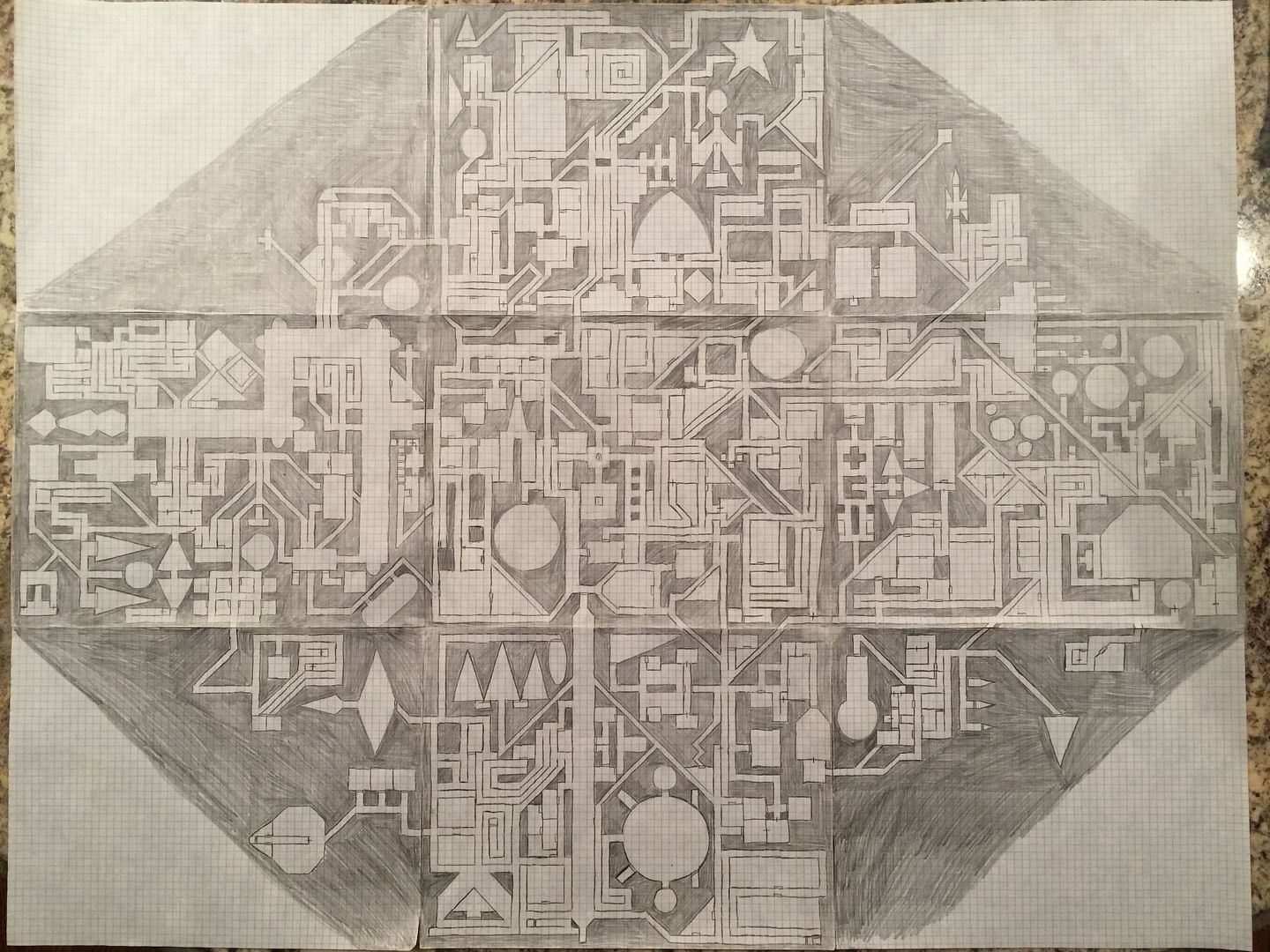
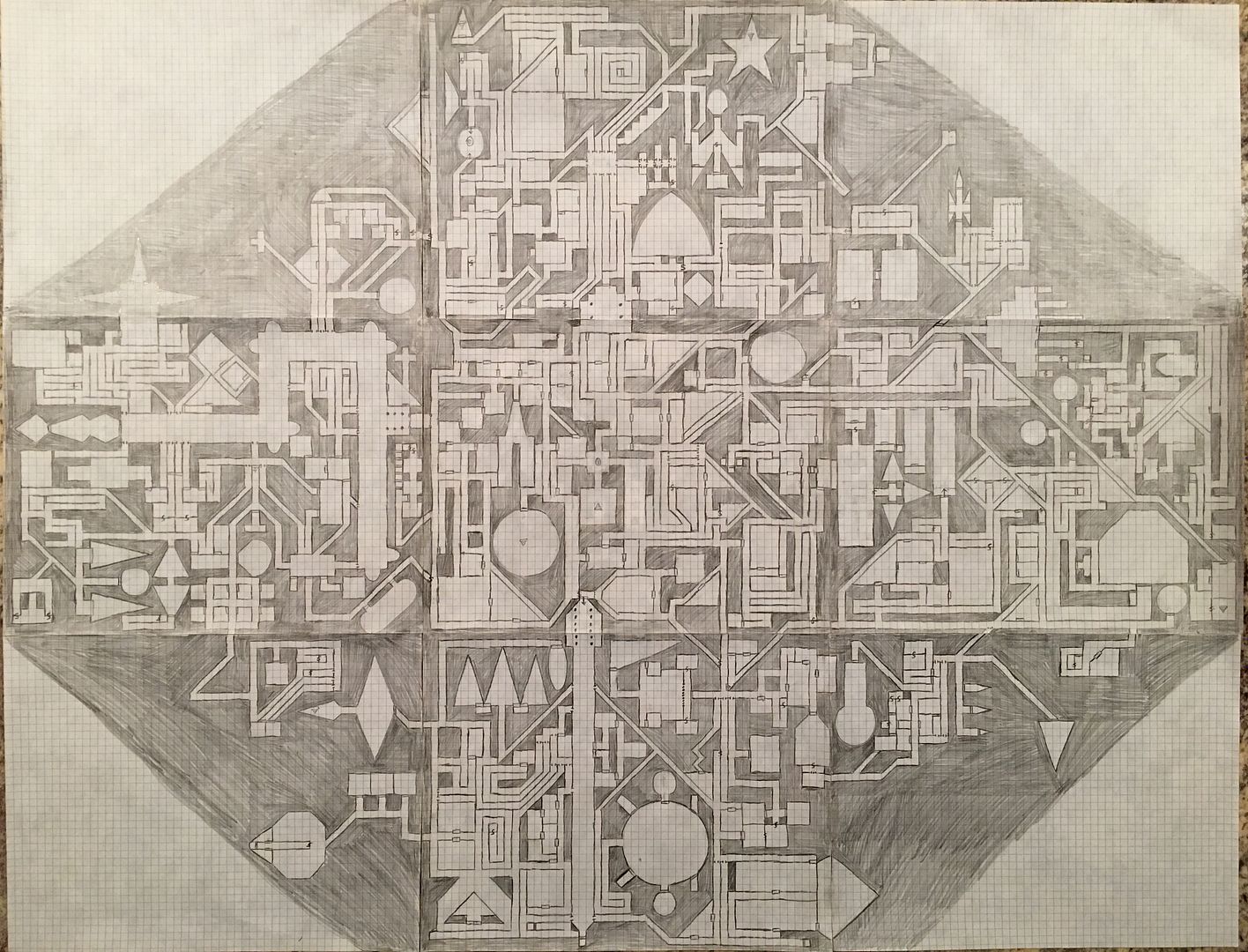
grodog's Recessive Gallery Level


grodog's Recessive Gallery Level


Recently reprinted in Fight On! Magazine #15 (Spring 2024), I'd forgotten that I'd previously shared this map on my grodog's Castle Greyhawk page, too---I had thought it was a "newly revealed" level when I offered it to Iggy to include in the zine.  So much for exclusivity, and my memory....  The full-sized version is at https://www.greyhawkonline.com/grodog/gh_castle_grodog_level_07-filled.jpg if you're curious.  

The map is unfinished, and incomplete:  many encounter areas drawn don't currently allow ingress, save by digging, passwall, or etherealness; there's not much added for intra-level stairways yet; ramps, trapdoors, and stairs up/down to adjacent levels aren't much present yet either (although placeholder spaces for these are present); pits are mostly unmarked (although the central double-T trap at the corner of the 30' wide cooridor where it turns N from E is a pit that opens into a holding/monster chamber below); etc.  That's pretty normal for how I work my maps up---some areas that are currently shown as inaccessible rooms may be filled in during the final version, or may have standard or secret doors added.  Or may remain inaccessible, and require digging or magic to enter---although I tend not to do that a whole lot, overall.  

This level is drawn on an 8.5x11" sheet of graph paper, gridded at 8 spi, making it pretty big:  64 squares N-S (~640') x 88 squares E-W (~840').  In this level, I placed several large chambers, intended in part as lairs for competing dragons.  When I redraw this to finish it, I'll likely use two of our Black Blade 11x17" sheets, for 17x22" dimensions drawn on the 6 spi side, so that'll allow 102 squares x 132 squares, which will let me fill out the rest of the level's edges that currently run off the sheet---I did this with the "Iounic Caverns" level maps, as well as my original Level 1 map too (if you click on the images in that blog post, they'll still load, but they don't display in the blog post due to Cloudflare).  The level will likely enlarge a bit further, similar to my process on Level 1, with some additional sub-level areas being added (or perhaps being relocated.  I may also connect the large southern chamber to one on my "Diamonds in the Rough" level, which has a very similar vibe with draconic presences; to do that, however, just might require a third sheet....).   

The larger encounter areas include, starting at top-right and moving clockwise:
  • overlapping encounter areas at different elevations along the 3- to 5-o'clock arcs
  • temple chamber in the southern 6-o'clock area, via the skull/lightbulb shaped room and the multi-level complex to it's immediate NE
  • large off-edge chamber at the south 7-o'clock, possibly a dragon lair; this is accessed via a Gygaxian room maze of octagons joined by squares that likely has teleports protecting the lair
  • upside-down coffin-shaped hexagonal chamber at the confluence of several large and/or long corridors, at the 10- to 11-o'clock positions in the NW corner; I think this is the primary dragon on the level
  • top N at 12-o'clock is another room maze of regular hexagons
  • central N at 12-o'clock to 12:30-o'clock is where the titular Recessed Gallery resides
The use of different sized sheets and grid-sizes for the levels in a mega-dungeon help to hide the edges of each level, so that the players won't automatically be able to find an edge and then circumnavigate the level's periphery:  it makes exploration less predictable, and each level more distinctly unique, and keeps the players guessing "just how large is this level?" which is definitely a good thing!  Both room mazes and the long corridors along the left/W similarly blur that edge, breaking it in the case of the room mazes and the 7-o'clock S large chamber.  The ragged right-hand E edge similarly leaves gaps, which should suggest searching for some of the secreat areas too.

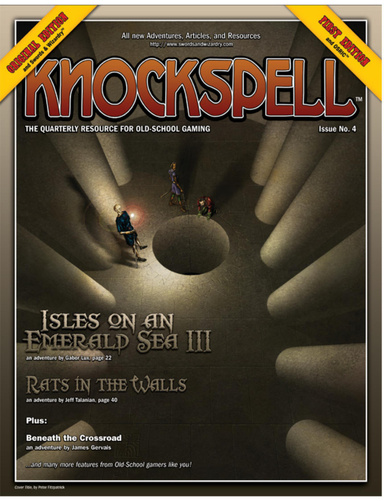
The large size of the level helps to support these kinds of larger, cyclopean (to HPL for a moment) corridors and chambers, which increase that sense of awe and immensity that I want players to experience have when they're exploring Castle Greyhawk.  Large spaces and long corridors that extend well-beyond the range of visible light sources, including continual light at 6"radius and bullseye lanterns at 8" range, increase player paranoid and build that sense of scope, or vastness, in particular when that extends above (and sometimes below!) your current walking surface---PCs are moving through an ocean of darkness, in their tiny island bubble of illumination.  Peter Fitzpatrick's cover art for Knockspell #4 amply illustrates this concept nicely:


Knockspell #4 cover art by Peter Fitzpatrick
Knockspell #4 cover art
by Peter Fitzpatrick


The scenes of Thorin's company marching through Erebor while Smaug is "not at home" also convey this sense of cyclopean immensity too:


Erebor, The Lonely Mountain from The Battle of Five Armies (2014)
The dwarves exploring Erebor, The Lonely Mountain,
from "The Battle of Five Armies" (2014)


Very large levels also provide additional options during game play, as I detail next.

Size as Options

In many ways, the mega-dungeon offers the most concentrated essentials available for playing AD&D---AD&D in its most "pure" form, if you will.  Within its boundary walls, the mega-dungeon encapsulates the essence of AD&D play, and challenges the players in all aspects of the game:  all classes, monsters, spells, magic items, encounters, and treasures are on the table.  All PC classes have equal opportunity to rise in glory, or to die trying in the agony of defeat.  All DM encounters may be mowed down in the player pursuit of XP, or may mature into recurring villains like Obmi or Eclavdra.  

Showcasing the breadth of possibility for the whole of AD&D does not mean that simple and  "anything goes" funhouse environs are the required format for mega-dungeons---whether built by Zagig Yragerne, Halaster Blackcloak, or the scions of Uncle from Maure Castle---but that in gaming there, all tools are available to the players and the DM.  All PC classes should have equal opportunity to shine, including druids, assassins, barbarians, and bards, among all the remaining PC and NPC classes (well, maybe not cavaliers.... ;) ).  All PC races should be able to flex their detection muscles too---dwarves finding stonework traps and elevators, gnomes determining sloping passages and direction of travel, elves and half-elves finding secret doors, and half-orcs acting as intermediaries with humanoids, and gnomes and hobbits entering small spaces.  

A related aspect that larger mega-dungeon levels support is expandable capacity:  the mega-dungeon keeps inspiration and creativity flowing by offering plenty of room for sub-levels, side levels, split levels, demi-planes, and other pet projects.  This keeps the players and the DM creatively intrigued and engaged, since formerly-explored areas can be enriched with new encounter areas, perhaps even via variable features, and allows the creation of distinctly unique challenges and areas to support less-common and non-standard classes, monsters, and encounter types.  

I group these two together under their own heading since I see them both as closely-related but different approaches to supporting options.  The breadth of possibility focuses on the wide expanse of core rules and their supplemental additions and expansions, while expandable capacity focuses on the actual dungeon level, its architecture, and environs, rather than the rules that govern what encounters occur within the level.  

Size as Really Freaking Huge

These attributes drill down into the above two, but still stand-out in my mind as important criteria that merit their own focus and discussion.

Verticality as Large and Open Spaces:  Large monsters like dragons and rocs, elementals and purple worms need wide and spacious areas to operate within, so dungeon level designs need to provide room for such creatures , and to accommodate the tactical selection of encounter terrain being brought to bear in combat and flight by both mega-dungeon inhabitants and invaders.  

This is where the the 20' to 50' wide corridors from the DMG's Appendix A come into play, along with the chambers and rooms of unusual shape and size (CaRoUSSs, perhaps ;) ).  However, long or wide corridors that connect to central plazas, squares, or parade grounds can serve similar functions, too, as can numbers of 10' wide corridors converging into hubs, with their long lines of sight.

Verticality as Depth Within and Between Levels:  Verticality is highly-valued in the mega-dungeon design ethos, and is generally credited to Jennell Jaquays' Caverns of Thracia and Dark Tower, which feature movement up and down within levels, across and between levels, and vertical features spanning multiple levels like chasms and wells, balconies and overlooks, and interconnected cavern systems.

Verticality within a level is, in my mind, nearly as important as verticality between levels, but both are essential to good mega-dungeon play.  The levels need room to breathe, to provide the space required for those large encounter areas, and that means that they probably need 50 to 100 feet of depth per level (those pits that don't fall through into a new level below need to fit within the level's depth, along with the headroom for those 30 to 50' ceilings.  

To give room for those spaces, the depth between levels should likely be 50 or more feet.  That also allows room for smaller clusters of rooms at landings, or off of stairs.  It also helps to keep players guessing about the depth that they're going down between levels---if each level is only 10 feet down from the previous one, they'll have an easier time guessing where their PCs are, and the challenges that their PCs will face.  


Multi-Level Dungeon Features, from The Dungeon Architect Part 2
Multi-Level Dungeon Features
from Roger Musson's "The Dungeon Architect, Part 2"
Artwork by Iain McCaig


Verticality as Total Depth:  As the space within and between levels increases, the mega-dungeon grows downward, deeper into the depths.  First DM'd at GaryCon II and North Texas RPGCon #2, my "Escape from Level 14" scenario thrust the PCs from the level 10 dungeon challenge they were expecting and dumped them lost into level 14.  They needed to find their way up and out, if possible.  

For that scenario, built using my old Castle Greyhawk elevations, they were ~4200 feet below the surface, which is about 8/10th of a mile.  Earth's deepest mines are ~2 1/2 miles down, so as I build my new elevation maps, I'll allocate the necessary room for each level's footprint (as a placeholder I only used 50 feet per level, for the most part, in the original versions), which will increase the depths for the lower dungeon levels even further.  That should also enable connections to the drowic underworld for some of the deepest levels, perhaps.

Big and complex enough that players and their PCs can get lost:  For reasons to get the PCs lost in the first place, see Roger Musson's "Dungeon Architect" articles, referenced in the first article of this series.    

Getting lost is a design function of the mega-dungeon's size, interconnectedness within and across levels, and its external connections to other environments ("extraconnectedness" perhaps?).  Teleporters---with or without similarly-designed areas of levels---are not the main reasons that PCs get lost in mega-dungeons.  Flight from encounters is why PCs get lost.  Players can't map while fleeing at , and if they end up going up/down a level, fall into a pit or a chute to another level, wander down a sloping passage, etc., then they're well and truly lost, and the entire tenor of the evening changes to finding a path back to familiar ground.  

When PCs are lost, strange actions may be taken, like:  
  • players desperately consulting the mappers, trying to guesstimate distances and turn counts travelled 
  • gnome, dwarf, and stout halfling PCs being consulted for GPS coordinates
  • characters asking for directions, or bribing (or charming) dungeon denizens for the same
  • divination spells suddenly being memorized
...to say nothing about the possibility of the party running into other encounters as they flee blindly hither and yon ;)

Sufficiently vast in scope that the players and their characters will never completely explore the largest levels, much less the entirety of the mega-dungeon itself.  Always will some monsters  remain undiscovered and undefeated, traps unsprung, enigmas unsolved, and treasures unlooted.


Boromir on the futility of mapping all of Castle Greyhawk
Sean Bean on the futility of finishing
Castle Greyhawk


As Boromir asserts, one does not beat Castle Greyhawk by exploring its every nook and cranny, and then move onto the next checkbox in the AD&D gaming experience ;)

Next Up?

For part three, I will examine how I key mega-dungeon levels, including the types of paper/sheets I use, and some volume-based keying strategies, unless I tangentialize on other topics first---such as traps, a dungeon encounter type that I hold great love for.   We'll see! 

Thanks for reading and your comments!

Allan.

23 February 2026

grodog's Approach to Designing Mega-Dungeons - Part 1: the Maps

...or, a Meditation and Reflection on What grodog Likes Best about Playing in AD&D Mega-Dungeons


Introduction

This post is my response to a recent discussion of my mapping style and inspirations over on reddit, begun by user SydLonreiro, who asked

For my first AD&D dungeon, I would like to map it like Grodog, but I don’t know how to do it. I’m not sure whether he developed a specific method for doing so, or whether some of you map large dungeon levels in this way. I want to create a dungeon the way Kuntz would, and map it in this style, because it seems like the right approach for preparing my sessions — and I love this type of map. 


I was quite tickled to discover the thread after Heather and I returned from dinner celebrating St. Valentine's Day (we never go out on a Valentine's date on the actual day/weekend when it's usually so crazy-busy), and I spent some time this weekend noodling a bit in response to SydLonreiro and also to user chaoticneutral262, who raised some Qs/concerns about mapping style relative to encounter keys that I plan to tackle a bit later.

And, as it turns out, SydLonreiro is building his own mega-dungeon for use among his friends, and plans to run it in a very "Gygax 75" manner using OD&D, which is quite cool.

grodog's Inspirations and Design Sources

To begin to answer some of SydLonreiro's questions on the mapping front, I tend to wear my key inspirations on my (tie-dyed) sleeves, including:

  • The original mega-dungeon levels of Castle Greyhawk and Castle El Raja Key designed by Gary Gygax and Rob Kuntz in particular, alongside a variety of other old-school designers like Jennell Jaquays (Caverns of Thracia) and Phil Barker (Empire of the Petal Throne's Jakallan Underworld)
  • In the OSR/contemporary era, I particularly favor works large-scale dungeon designs by Richard Barton, Chainsaw, Anthony Huso, Gabor Lux, Tony Rosten, Keith Sloan, and Trent Smith, among others
  • Architectural artwork including M. C. Escher's non-Euclidean optical-illusions, Piranesi's Imaginary Prisons which echo with a vastness that definitely catches my eye, and Philippe Druillet's Elric Le Necromancien--first published in the year I was born!

Some of my favorite dungeon design articles include these pieces:

  • "Hints of D&D Judges - Part 3: The Dungeons" by Joe Fisher in The Dragon #2 (August 1976) - another excellent example of early dungeon design advice that stands the test of time; I particularly like Fisher's active and imaginative example treasures, use of watery areas, and recounting of Castle Greyhawk lore
  • Gygax's various early 1970s articles about D&D play and design, mostly-summarized on my web site at https://www.greyhawkonline.com/grodog/gh_castle_sources.html 
  • The Players Handbook's section on "Successful Adventures" in pages 107-109
  • "The Dungeon Architect"--Roger Musson's classic from White Dwarf 25 (June 1981), 26 (August 1981), and 27 (October 1981) is an excellent three-part series that covers dungeon origins, NPCs (creators, raiders, inhabitants), and dungeon construction (architecture, traps/tricks/teleporters/etc.), and dungeon design models (silly, ecological, etc.).  Reprinted in Best of White Dwarf Articles Volume 2 (complied in 1983), where I first read it.  I'd still love to reprint this someday (along with some of Paul Vernon's WD articles too)!
  • Gabor Lux's "Dungeon layout, map flow and old school game design" originally published on ENWorld 15 July 2006 and reprinted at K&KA on 12 July 2011
  • Matt Finch's "Megadungeon Tactics: Mission-Based Adventuring" in Knockspell #4 (Spring 2010)
  • Trent Smith's essays on adventure design in his Heroic Legendarium pages 97-118

We've enjoyed some good discussions about design theory articles like the above over on ODD74 at essential references for dungeon designers and K&KA at megadungeon resources.

grodog's Mega-Dungeon Design Aspirations and Touchstones

The design approaches exemplified through the works created by our past and present masters come together as a set of internal tendencies and design northstars that I aspire while working on my mega-dungeon levels.

These lurk behind the scenes in my Favorite Mega-Dungeons post as well as some of my favorite adventures too:  both the original list, and my expanded and revised lists.  The qualities I called out as key to my favorite designers' levels were:

  1. Best Environments to Explore and Map
  2. Most-Fun Encounters
  3. Most-Fun Puzzles, Enigmas, and Centerpiece Encounters
  4. Coolest Maps
I listed a fifth and sixth pair of attributes too (Best Presentation in Print and Pulls It All Together), but at the time I'd not felt that any in-print products did a mega-dungeon justice, and that few published ones managed to pull it all together as a complete product.  Tomb of Abysthor (Necromancer Games, 2001) and Maure Castle (Paizo Publishing, 2004-2006) come closest, with ToA at 7 levels with 2 sub-levels and MC published 4 levels with 3 sub-levels (including the free "The Warlock's Walk" level on the now-defunct Pied Piper Publishing discussion boards and in The Oerth Journal #23).  Rob outlined a vision defining 18 total levels for Maure Castle, but Paizo lost the licenses for Dungeon and Dragon, so the series ended, incomplete.  Caverns of Thracia (Necromancer Games, 2004) and Foolsgrave are runners up,  at 4 levels with 2 sub-levels and 3 very very large levels, respectively.  CoT is about the same size as The Temple of Elemental Evil, but is significantly more complex and interesting as a dungeon, so I don't consider ToEE a mega-dungeon and generally consider Thracia as the minimum viable footprint to be a "true" multi-level mega-dungeon.  Foolsgrave, however, counters that since it's levels are substantially larger than the three other published mega-dungeons combined:  its three levels are built from 29 levels worth of footprint—the other mega-dungeons' levels were drawn at one sheet per level, and total only 18 sheets worth of dungeons.  It captures that majesty and scope that's so essential to the mega-dungeon exploration experience.  

I'm sure you've already noticed that #1 and #4 both focus on the maps, and that's a huge factor in my design approach:  I almost-always begin with drawing a map then keying it, rather than building the keys and designing the map to fit them (which really is something I should try sometime...).  And #2 and #3 are really both two sides of the same coin on the encounter keys—I just emphasize the puzzles, enigmas, and centerpieces a bit more by calling them out specifically over the dungeon dressing, monsters, treasures, traps, hazards, and riddles encounter types.

In thinking about these while working on a recent article about Anthony Huso's OSR designs, I revised and expanded those first four precepts to six:

  1. Compelling and Imaginative Creativity
  2. Inspiring Environments to Explore and Map
  3. Fun and Challenging Encounters
  4. Great Layout and Information Presentation
  5. Modular but Filled with Inspirational Expandability
  6. Tempered in the Crucible of Campaign Playtesting

And while they track to my general adventure design sensibilities, my favorite mega-dungeon design preferences remain fairly rooted in the idea that bigger = better.  In a 2016 discussion on putting the "mega" back in the mega-dungeon, I wrote:


My sense is that mega-dungeons are driven by both focus and size.
 

In terms of focus, a mega-dungeon that grounds an entire campaign is a campaign dungeon—and IIRC Trent Smith coined that term some years ago. In my mind "mega-dungeon" and "campaign dungeon" are related but not synonymous terms. I have placed several mega-dungeons in my Greyhawk campaigns—Castle Greyhawk, Blackmoor Castle, Maure Castle, a series of inter-related ruined Suloise dungeon complexes below the Sea of Dust, a great dungeon carved out of the glacial Black Ice, etc., etc. Other than Castle Greyhawk and Maure Castle, however, none of the others are campaign dungeons in my games, since they're not the focus of my players' activity. Castle Greyhawk provides that primary focus (with some interleaving with Maure Castle from time to time), so it is the campaign dungeon in most of my Greyhawk campaigns. 

In terms of size, a mega-dungeon is sufficiently large that it cannot be completed during game play. That size can be accomplished in a variety of ways, depending on how the DM approaches their dungeon design: 

  • very large individual levels: I try to vary the sizes of my dungeon levels by creating them using differently-sized graph sheets, and I have 8.5x11 sheets that are 4, 5, 6, 8, 10, and 20 squares per inch, 11x17 sheets that are 5, 6, 8, and 10 spi, and 1 big pad of 17x22 sheets at 4 spi. You can fit a LOT of dungeon onto an 8 spi 8.5x11 sheet, much less an 11x17 one, let me tell you! The gigantic poster maps of Undermountain, Mammoth Dungeons, and Armaron are probably the best examples of this style of dungeon that have been published (that I'm aware of). Barrowmaze's poster maps from the KS also fall into this scale (although I'm not sure whether poster maps were done for Barrowmaze Complete or not??), and the large and inter-related cavern levels in Castle of the Mad Archmage do as well. Phil Barker's Jakallan Underworld from EPT also falls into this category, along with Arden Vul. 

  • lots and lots of levels and sub-levels: the levels can be in physical proximity, and thus attached to the dungeon, or adjacent at the planetary or planar levels, and potentially exist physically in another multiverse. Rappan Athuk features many small levels, as do the Mines of Khunmar. 

  • connections to other large dungeons: Scott Casper created teleporters between Castle Greyhawk and Maure Castle in his Castle Greyhawk webcomic, for example, which intertwines both of those mega-dungeons, effectively doubling their already prodigious sizes, with the added complexity that you could be teleporting within a level, across levels within the same mega-dungeon, or across mega-dungeons! 

  • vastness of the environs: think of Erebor or Moria in terms of simply how huge they are, regardless of whether they're really mappable as levels at all; Holmes' "Underworld" in his Boinger and Zereth fictions is said to delve the entire planet: "What race or races built the maze, no one knew. In the opinion of the sages of Caladan, many layers of dungeons and underworld were laid down, one atop the other, as the world crust was formed, so that now no one knew or even guessed how many levels extended below the surface" (Maze of Peril back cover text).  This also suggests another scope of "mega"—that of depth below the surface, which naturally brings to mind the G-D modules and drowic underworld, Verne's Journey to the Center of the Earth, Pellucidar, etc., etc.


For related discussion, see putting the "mega" back in the mega-dungeon at K&KA and Megadungeon Definition? at Dragonsfoot.


Foolsgrave - Chainsaw's Ultimate Mega-Dungeon

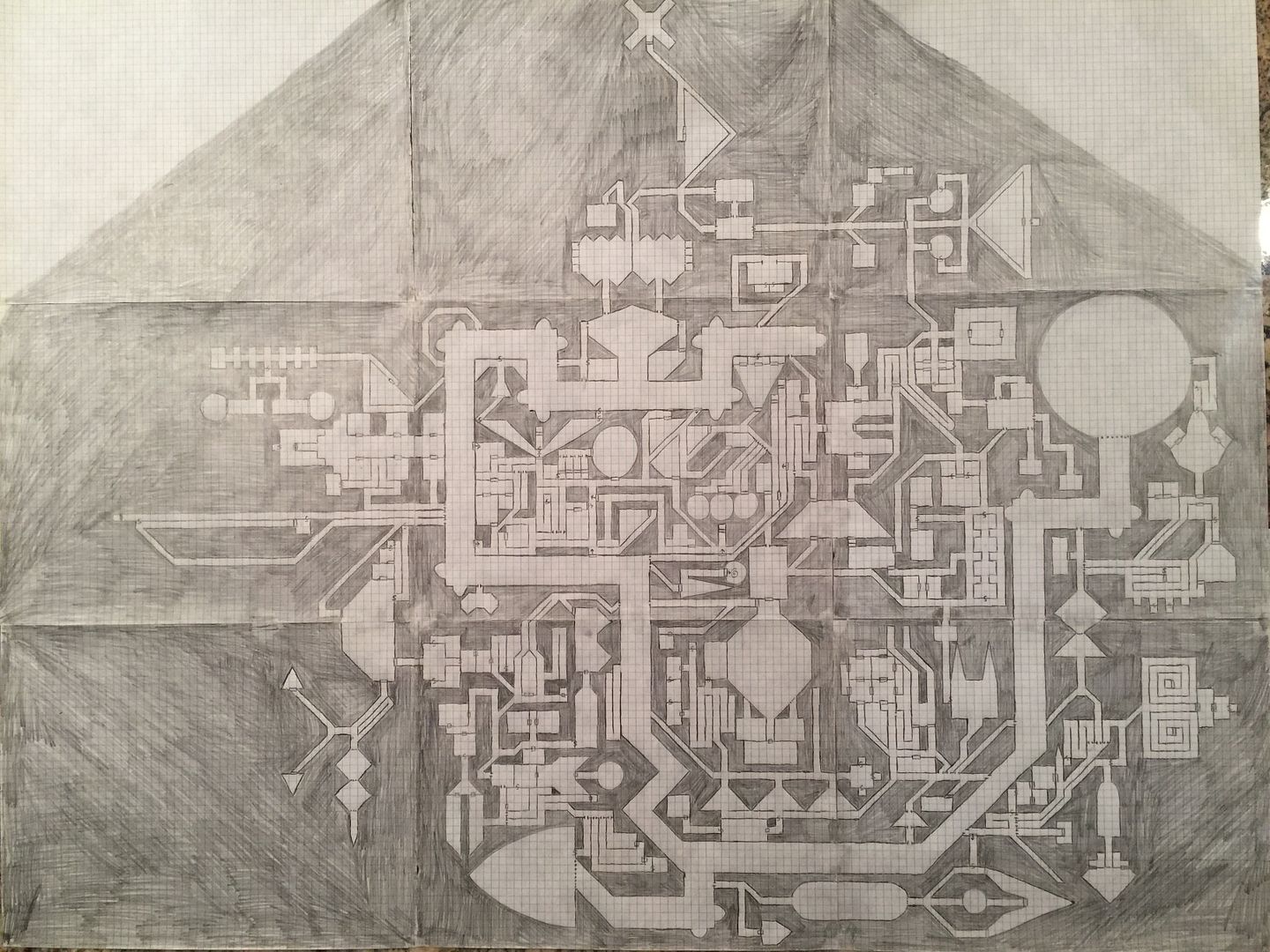
I still don't think that anyone has topped Chainsaw's brilliant Foolsgrave levels, which are vast and beautiful and visible from inception through conclusion in his Foolsgrave (development thread, spoilers) at K&KA, with the finished maps shown below at https://knights-n-knaves.com/phpbb3/viewtopic.php?p=225505#p225505:

Old Level 1


New Level 1


Level 2


Level 3


More to follow, later in the week!

Allan.

30 January 2026

The Rime of Descending Ascent - Why to Plumb the Depths of Castle Greyhawk's Dungeon Levels

In the original version of the Castle Greyhawk dungeons designed by Gary Gygax, he placed a set of runes that provided hidden guidance for the PCs in why they should delve deeper--- the raison d'etre in the call to adventure.  Tenser decrypted the runic clue using read magic---perhaps the first spell cast in play in OD&D.

I've been, alas, unable to refind the quotation I thought I had read many moons ago, and found merely summary phrases expressing the essence and meaning of those magic words, rather than their exact phrase: 

  • Gary's Castle Greyhawk essays and stories---where I was sure that this quotation originated!---don't even mention the entrance runes in passing in "Founding Greyhawk" (in Dragon Annual #2: 1997), "To Forge a Fantasy World: Greyhawk's Creation" (in Horsemen of the Apocalypse: Jolly Roger Games, 2000), or "Penny for Your Thoughts" (in his "Up on a Soapbox" column in Dragon Magazine #302: December 2002), much less their actual text....

  • Scott Casper's and Mike Bridges' brilliant Castle Greyhawk web comic does not allude to the runes, although it paints a wonderful picture of the opening entry into the castle dungeons!:


    Castle Greyhawk web comic Chapter 1 Page 21
    Castle Greyhawk web comic Chapter 1 Page 21, 
    by Scott Casper and Mike Bridges


  • The Castle Zagyg boxed set states that at the beginning of the stairway down to The Storerooms level, "The archway is graven with the words:  The Path to Adventure Begins Here, Seekers" (Castle Zagyg 2: The Upper Works, booklet 4 Castle Fortress, page 42).  Unfortunately, there is no mention of the runes requiring read magic to be read, nor of descending deeper to find richer rewards, as I recalled....

  • Querying some other Greyhawk stalwarts yielded confirmation, but no specifics beyond Scott Gregg's memories from his long-ago discussions with Ernie Gygax:  "I will have to see if I can find the exact quote. It was a warning about the danger increasing the deeper you went, but the treasures get better.  It may have been deleted when I deleted my original boards."

    That was more-profitably followed-up later with a quote from Ernie: "Tenser was the first magic user ever in Greyhawk. No books or previous experience existed. The first spell I took was a Read Magic and I used it to read the glyphs above a stairway leading down (level 1 to 2). It told us (Rob, Terry and I) that as you descend into the depths of the Dungeon the encounters will be more difficult but the rewards far grander."

    Scott's original interviews with Ernie Gygax are almost definitely what I had been remembering and seeking, which was wonderful corroboration, but still left me without Gary's words.  


So, unable to find the original text, I've created my own version of that phrase, as a crazy poem penned by Zagig himself.  

Enjoy! :D


The Rime of Descending Ascent 


Explore!  Delve deeper, discover grander treasures:
     jewels and riches abound in droves,
     dweomers and artifacts---each allures!

Beware!:  As you descend, fiercer monsters guard lairs. 
     Traps confound and wound, maim and slay.
     Subtle tricks delude.  Enigmas befuddle!

Tempt fate!  Test your mettle!  Ill-gotten gains yield gold,
     Infinite apotheosis---
     or it all ends in an early demise....

                    --- presumably wrought by Zagig Yragerne and/or Zagyg the Mad Archmage


My text helps to highlight some of the focus of my dungeon level designs---traps and tricks, monsters and mysteries---and also ties back to the current campaign's lore about Zagyg and his testings.  

It also lays foundational hints and groundwork for exploration of some of the setting lore lurking behind Zagig's rise to demigodhood, which has always intrigued me.  These ideas crept into several abandoned level designs I themed around tests of the nine alignments, which I'm dusting some off to see what may be salvaged.  Perhaps some may find play at the table and/or in wend their way into the planar correspondences of alignments too.  We'll see....

Allan.

29 June 2025

Sneak Preview for Return to Perinthos - a Fundraiser Tribute to Jennell Jaquays

On Friday, 27 June 2025, my copy of Return to Perinthos: A Memorial Dungeon for Jennell Jaquays arrived on my doorstep, the output from the Return to Perinthos: A Memorial Book Fundraiser in the Memory of Jennell Jaquays crowdfundr campaign. 


Return to Perinthos
cover art by Curious Friend


Jennell Jaquays portrait
artwork by Curious Friend


Jennell sadly passed away due to unexpected complications from Guillain–Barré syndrome in Dallas, Texas, on 10 January 2024, at the age of 67.  You can read her full obituary at https://www.dignitymemorial.com/obituaries/dallas-tx/jennell-jaquays-11623534.  

Return to Perinthos is a collection of one-, two-, and several-page dungeons put together by the gaming community as a fundraiser to help defray the costs of Jennell's medical care and funeral expenses.  

The most-recent project update from 18 June 2025 mentions, in part:


We'll be working on getting Return to Perinthos fully live on our web store, Itch.io, and DriveThruRPG, so we are able to sell the rest of the books ordered to benefit Trans Lifeline. We will be distributing the digital version to everyone via DriveThruRPG once we have this up as well, and I will send one last update this week or next, so you know to expect an email from DTRPG. Trans rights and health care are even under stronger attack than when we started this project, so I'm very happy that we can do our part now.


Here's a sneak preview for some of the full Table of Contents and some dungeons that caught my eye during my initial flip throughs thus far:


Return to Perinthos
Table of Contents - 1 of 3


Return to Perinthos
Table of Contents - 2 of 3


Return to Perinthos
Table of Contents - 3 of 3

Halls of the Honored Dead
two-page dungeon by amarquis


Halls of Virdian Mist 
two-page dungeon by Attronarch, map by IdleDoodler


Map to Allan Grohe's Roundabout Level
a five-page dungeon


I met Jennell and gamed with her several times at the North Texas RPG Con in Dallas each year, as both a player and a DM, and she graciously participated in an early panel on mega-dungeon design that we organized at NTX#2.  

We've also supported her works at Black Blade Publishing over the years, and miss her kindness, humor, and brilliance.  

Allan.

14 April 2025

Enter Stage Left - Agutha, the Glimmering Sister of Pholtus

I am pleased to report that Tony "Wheggi" Rosten has rejoined our Castle Greyhawk campaign, as he's a good friend.  A well-known name among old-school gaming communities, Tony's also my publishing partner in The Twisting Stair, our mega-dungeon design zine, and is the author of the award-winning "Blocks of Quox" puzzle-dungeon adventure published in Fight On Magazine #6 (Summer 2009).  He has several other excellent adventures that I hope to see published one day, too!

Sister Agutha

Since Tony wasn't able to find the character sheet for his old PC cleric, Moraine (a level 2 Cleric of St. Cuthbert), he created a new one---The Glimmering Sister, Agutha.  A redoubtable 4th level cleric of Pholtus, Agutha joined the campaign the the deus ex machina of divine intervention (a slightly-classier replacement of our now-standard "chump gate" option that we learned about from friends at GaryCon many years ago):

Agutha, the Glimmering Sister of Pholtus --
artwork by Tony Rosten for his PC

Last night, Haj and Sister Agutha encountered a greater shedu via the agency of the WM charts!---a roll of 31 on the 1e DMG's Temperate Forest/Wilderness tables results in an airborne ki-rin, lammasu, or shedu, which I then selected via a die roll extrapolated to allow the possibility that the encounter might add other powerhouse do-gooders to the mix---a greater lammasu or greater shedu, along with creatures like the foo dog/lion, hollyphant, or phoenix.  In the end, the dice indicated they met a greater shedu:


Shedu, by David C. Sutherland III, from 
the 1e Monster Manual (TSR, 1977)

The greater shedu looked like that picture, just bigger.  Standing 12' tall at the shoulder, the size of a minivan with a 30-40' wingspan.  

On a Mission from God

Named Zabbukhani, Herald of the Sun Resplendent, the greater shedu was specifically searching for Sister Agutha, in order to deliver to her (and as it turns out, Haj too, since he was in her company) a divine message from Pholtus:


Greetings!  Fear not, sister in Law!
Attend:  absorb Revelation.
Accept:  reflect Illumination.

Gaze sunward, above:
Protect the rays. 

Trees open, spread wide gates—eclipse looms.
Will and power words dispel the dark.
Searing light can stem Woe’s flood tide.


This new message (and the PC accompanying it!) represents an escalation, perhaps, in the activity in the campaign after the rescue and revelation of The Prophecy of the Six and the Twelve from a couple of years ago (in real-life; in-game, only XX months have passed).  The PCs discovered some additional information about it while seeking divine guidance from Wee Jas in Hardby, but with Agutha's introduction, this is (in my view, at least) stepping up the divine engagement.   We'll see what the party thinks soon, since Agutha hasn't yet met the rest of the PCs yet, just Haj. 

And of course it's curious and interesting and that it's Haj that Agutha met first, since he's one of the two assassins in the party, actively worships Nerull, the Reaper (but don't fear him ;) ), and serves the Horned Socitety....  Helps keep things interesting! :D


Pholtus - Some Ponderings from grodog

Tony's creation of Agutha introduces the second PC associated with Pholtus into our campaign---the first was a female paladin played back at the dawn of the game by Anthony Huso and named Vivien Asquith.  She was a hard-drinking paladin of The Blinding Light. 

Now Pholtus is not a god who I've played with a lot, so he's remained a bit of a caricatured blank slate to date.  I always liked Jim Holloway's depiction of Pholtus from Dragon Magazine #68 (December 1982), but the god itself---for better or for worse---hadn't particularly engaged my attention or creativity over the years*:

Pholtus, from Dragon Magazine #68
(December 1982) by Jim Holloway


Tony's decision to place Agutha's faith in Pholtus offered an opportunity to ratchet up some of the focus in the campaign, and for me to explore a bit into Pholtus.  We had some recent discussions at Canonfire! that in turn inspired my design noodlings.  

The Illumine, A Divine Envoy Sacred to Pholtus

Through her doctrinal training, Agutha recognized the form of the message as divinely-inspired, an illumine (sometimes called an octillum or an octiveal):

  • its eight lines represent a number sacred to Pholtus; eight is the number of syllables in the first and third stanza's lines, as well the number of syllables in their lines
    • the first line is a traditional greeting, to set the worshipper at ease with the divine messenger and attention being visited upon them
    • the second and third lines offer guidance and/or imperatives from Pholtus, that tie to the message's purpose and focus, and will help its recipient to understand how to unravel its meaning
  • the central two-line envoy represents the heart of the divine message, which receives special emphasis through more-direct communication:  
    • its lines are four syllables each; together they total eight 
    • they divide the message into two halves:  the fourth line applies with emphasis to the first stanza, while the fifth line applies to the second
    • together both lines embody the divine heart and command of the message, and provide the key that unlocks the meaning of the whole
  • the third stanza warns of complications, threats, and dangers that the envoy and first stanza are intended to address; they are the obstacles that must be discerned through reflection and revelation, revealed by exposure to the light, and overcome through the application of faith, light, obedience, and hewing to the straight and inflexible rigor of order and goodness
The numerology of the message will gain additional significance based on its form:  here the message is divided into three stanzas of 3, 2, and 3 lines each.  So the numbers 2 and 3 are part of Pholtus' mysteries, along with 8.   (And note that 2^3 = 8 too!).   There are five known "wandering stars" in Oerth's cosmology, so 5 will likely be a component in this celestial schema too.  

Other messages may be delivered as a single eight-line stanza, and some may feature rhyme regular schemes or repetitions of words---perhaps to be modelled on the troilet form; we'll see.... 

Noodling on the Faiths and Mechanics for Pholtine Clerics

Prior to writing Agutha's message, I began brainstorming some developmental ideas for Pholtine clerics, thinking through options inspired from the Canonfire! discussions as well as the areas of focus for the campaign around twins, light/darkness/shadow, prophecy/divination/revelation, etc.:

The Tenets of Pholtine Faiths


Holloway's Pholtus illustration always appeared somewhat androgynous to my eye, so I like the idea of the god being more nebulous in gender, or both genders perhaps
  • this then paired with the idea of splitting the god's roles up between sun vs. moon among the faithful, and perhaps flipping their traditional genderings, like Tolkien did with the Maiar who guide them in The Silmarillion:  sun = female, moon = male
  • perhaps many Pholtine sects emphasize the larger, monthly moon Luna vs. the smaller quarterly moon, Celene; while later editions changed his focus to moons in plural, as originally published he was the god of the sun and the moon (which also makes me wonder if adding a second moon in the mix was a late-stage addition to the setting, perhaps)
I've also begun to toy with the idea that Pholtus absorbed/merged the sun goddess and moon god when one of them was all-but slain in the past, which accounts in part for there being no dedicated moon god among Greyhawk’s core pantheons. Perhaps they were in love/lovers, perhaps they were brother and sister, or even twins.  That may also account for the androgyny vibe in Holloway’s illustration. 

Other noodlings on spheres of influence for Pholtus include:  
  • the concept of Light in general vs. the heavenly bodies as the source of light; this would be Holloway‘s traditional androgynously male illustration of Pholtus from Dragon #68; options include the Blinding Light, the Resolute Light, the Light of Revelation, or whatever 
  • the concept of cosmic law and order in particular as it applies to the movements of the heavenly bodies and the inner planes (as well as the Astral, as the bridging plane between inner and outer, also tied to the moons and silver), emphasizing the Positive Martial Plane as the ultimate source of light for the multiverse; think akin to Moorcock’s Law vs. Chaos; 
    • this would likely put such sects into conflict with Celestian's clergy
    • this would also espouse a heliocentric view of Oerth’s solar system, which is deemed a radical concept among all good-thinking peoples of the world ;)

Greyhawk's Pholtus Clerics and AD&D Mechanics


Pholtine 4th level clerics gain access to an additional spell usable 1/day, which per the boxed set is dispel darkness.  I might tweak that spell based on faith/deital flavor selections above, but it fits well with the general themes for Pholtus (and the campaign).  

At 8th level, they gain glow, and I can see other spells like starshine, moonbeam, sunray, and perhaps faerie fire, infravision, and ultravision being added to their spell lists (or the class  gaining these at higher levels as permanent abilities).  

At 12th level, high priests and priestesses access reflect.  As part of the "blinding light" idea, I like the focus of this spell but I've also considered stripping the 11th level power from clerics of Heironeous---their energy bolt drawn from the Positive Material Plane---and providing it to Pholtine clerics instead, which seems apt, and perhaps combining it with the reflect power (or making it a fourth power).  We'll see....

Allan.

* For a particularly interesting look at a higher-level Pholtite** high priest, I recommend reading about Henri, from Jason Zavoda's "Nosnra's Saga" serial novella set in Greyhawk, and more specifically in Gary Gygax's G1 Steading of the Hill Giant Chief.  The link takes you to his 2020 revisions to that story, and leads with the most-recent post which is its ending, but it's a fun read, particularly if you're familiar with the original adventure.  

** While I generally prefer Pholtine as the adjectival form of Pholtus, I'm sure there are sects of Pholtus that use Pholtite (and perhaps Pholtusian, too)!