05 October 2018

Kellri's 18 Module Challenge - Day 7: X2 Castle Amber by Tom Moldvay

Day 7 - A Module I Wish I Had Written: X2 Castle Amber by Tom Moldvay


Several somewhat-conflicting interpretations of Kellri's Day 7 module topic immediately came to mind when thinking through the question of which module I wish that I had written:

  1. What published adventure is so cool that I wish that I'd written it?
  2. What adventure that I've written do I wish had been published by TSR?---the snarky rejoinder is, of course, "NONE" since then I wouldn't own my adventure anymore ;)
  3. What unpublished-but-known TSR manuscript/adventure idea do really I wish I had written so that it was, in fact, published?
  4. What module do I wish that I had written so that the flaws I see in it would have been fixed (i.e., I think I would have done a better job than the original author)? 
  5. What module do I wish that I had written that I haven't written yet?
For the most part, I assume that folks responding to this topic are answering Question #1.  Question #2 is an interesting one worth thinking a bit more about, but I think my snarky answer remains on-target for the most part (although I had planned to submit my old "Valley of Pain" wilderness adventure to the RPGA for consideration as a high-level tournament at some point in the early 1980s...).  Question #3, while somewhat convoluted and strange, is the most interesting iteration to me, and I'll return to that concept later after the challenge concludes.  Question #4 overlaps with Day 10's topic, so I'll address it there rather than here, and while Question #5 might be somewhat interesting-ish, it seems rather self-serving, as well as lazy, so it's right out!

So, for the purpose of answering Question #1, I think that I'll go with WG4 Forgotten Temple of Tharizdun, since it add so much interesting lore to Greyhawk (despite it being the bald-faced "you must buy the Fiend Folio to run this adventure" con that it is), and has a fabulous atmosphere that is the culmination of the various lost and forgotten temples to Chaos and/or the Elder Elemental God in Gary's other works.  However, WG4 is not the answer to the question for the module that I'm addressing in today's topic, it is...:

Why I Love X2 Castle Amber by Tom Moldvay


The short answer is that don't, in fact, love X2, but I do love several of the pieces within X2, in particular:

  • The Wilderness of Averoigne:  Averoigne is probably my favorite Clark Ashton Smith setting (although I'm also very fond of Hyperborea and Zothique too), and I wish that Tom's entire module was devoted to Averoigne's environs.  Some quick resources if you're interested in designing this on your own:
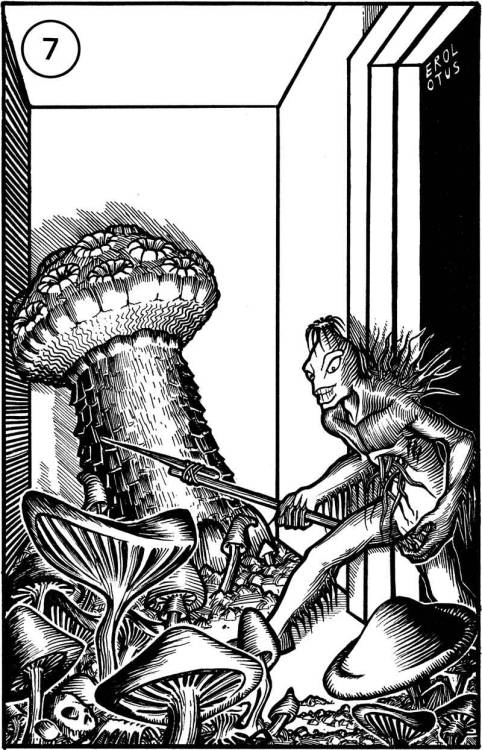
  • The Indoor Forest encounter:  I'm not sure why, but this always reminded me of A1's Cemetery encounter on level 1  (key #8), even thought they're nothing alike.  In any event, I like the various new monsters, as well as Moldvay's usual touch to provide a broader palette of encounter types than just combat-solved ones.  (Some of the other encounters remind me of ones from Moldvay's Seren Ironhand module series, so I'll need to go back to re-read them later).  
  • The Puzzle-Riddle-Prophecy To Those Who Would be Free:  recovering the four proper magic items to escape Averoigne is fun, and I have a soft spot for multi-part artifact/magic item sets
  •  The Wild Hunt:  In this case, Harry Quinn's frontispiece beats out the front- and back cover art by Erol Otus and Jim Roslof:

    The Wild Hunt, by Harry Quinn (from X2 Castle Amber, TSR 1982)
    The Wild Hunt by Harry Quinn


  • The Map of Averoigne:

    Averoigne Across the Planes

    The right-third of the above image is the work of Thorfin Tait, and both versions of his high-resolution, colorized renderings of Averoigne are worth downloading!

I considered listing X2 under Day 10's topic, but decided that other modules contained much greater problems, and just because Moldvay didn't write the all-Averoigne-wilderness adventure that I wish he had written doesn't put X2 into the same category as other, much more flawed modules!


Three Runners Up


I think I sketched out more possible ideas for this day's topic than any other day during the challenge, with the possible exception of Day 10's Module with Big Problems theme; in any event, here are three other worthies you should give due consideration to:

  • Broken Covenant of Calebais by Jonathan Tweet and Mark Rein-Hagen (Lion Rampant, 1991; for Ars Magica):  a nine-level dungeon (the levels are smaller than those in Rappan Athuk, so don't get too excited) haunted by the ghosts of powerful wizards, and their surviving magical minions; a dungeon that beckons the PCs to solve its mystery
  • "The Garden of Nefaron" by Howard de Wied (TSR, September 1981 in Dragon Magazine #53):  a two-level dungeon for PCs of level 7-10 to explore; also introduces psychogems, a new psionic magic item (they also later appear in Spells with a Twist from Spellbinder Games)
  • WG4 Forgotten Temple of Tharizdun by Gary Gygax (TSR, 1982):  what's not to love about the end of the known multiverse should Tharizdun escape his ebon slumbers?  I wish there had been more about Tharizdun and his cult in the adventure, which is how I would have written this Lovecraftian classic, inspired by Rob Kuntz's concepts!


My other posts in Kellri's 18 Day Module Challenge:

  1. Day 6: DMG Monastery Dungeon by Gary Gygax
  2. Day 5: S3 Expedition to the Barrier Peaks by Gary Gygax
  3. Day 4: "Deep Shit" by Jeff Barber
  4. Day 3: A Fabled City of Brass by Anthony Huso
  5. Day 2: Masks of Nyarlathotep by Larry DiTillio
  6. Day 1: Empire of the Ghouls by Wolfgang Baur
  7. Day 0: These are a Few of My Favorite Things...

04 October 2018

Kellri's 18 Module Challenge - Day 6: DMG Monastery Dungeon by Gary Gygax

Day 6 - A Module You Can Play with Children: DMG Monastery Dungeon by Gary Gygax

 
The DMG Monastery Dungeon map by Gary Gygax
The Monastery Dungeon, 1979


Why I Love the Monastery Dungeon

  • It's iconic design not only represents the one and only map in the Dungeon Masters Guide, but it is also central to the Example of Play
  • Like all good dungeon designs, the monastery map is extensible, and built-in hooks help to coach a fledgling Dungeon Master how to further refine its contents:
    • hints about additional monsters types from the Wandering Monster table:  goblins in 7-8, bandits in 4-5, fire beetles in 12-13, ghouls from 24, evil cleric and hobgoblins from 35-37, skeletons from 27
    • references from early keys to further ones yet-to-be-designed:  the map's description in 2 mentions the secret door 28, the treasury at 29, and the caverns below this level; a secret entrance/exit is also mentioned in passing on page 96, in the description of the DMG's "three" maps (the other two sadly non-existent), and while not identified specifically, the stairs at 39 are suggestive of such a portal
  • Despite being a pretty small dungeon (although it's still bigger than some levels of Rappan Athuk...), the map design offers a variety of challenges and tactical options for players (and monsters!) to leverage in play, including looping corridors, several secret and concealed doors, and a number of potentially-deadly dead-ends.
If you're looking for some additional inspiration, you should check out Timrod's excellent and intertwined blog pieces on the relationships between the DMG Monastery Dungeon, T1's Moathouse dungeon level, and the wilderness environs of B2 Keep on the Borderlands.  Jonathan Tweet also wrote the ready-made "Dungeon of the Fire Opal" adventure for this dungeon map in Dungeon Magazine #84 (Jan/Feb 2001; you will, however, need to convert it from 3.0 back to AD&D....).

I have in fact followed-up on the suggestions to expand the monastery dungeon with my own second level caverns map, as well as modifications and expansion to the first level map, and the keying of both.  More will follow on that front, later!

Three Runners Up

There are many good candidates here to choose from, but I've focused on rookie/neophyte players as my target audience for the child players for today's challenge.  Gygax's B2 Keep on the Borderlands and T1 Village of Hommlet are fan-favorite campaign starters for a reason, but they're also not good modules for novice players, since both require levels of both strategic and tactical acumen lacking in most children.

I'm limiting myself to three, otherwise I'll just end up recreating my favorites list each day:
  • B1 In Search of the Unknown by Mike Carr (TSR, 1978):  more forgiving that B2 or T1, the first level's design in particular does an excellent job of teaching new players how to play the game
  • L1 The Secret of Bone Hill by Lenard Lakofka (TSR, 1981):  an excellent bridging scenario that teaches new players the ropes of the first wilderness explorations (B10 Night's Dark Terror also does this well), and also details the Bone Hill ruined castle and dungeon, the town and inhabitants of Restenford, and outlying locations in the surrounding wilds
  •  "Trouble at Grog's" by Grant and David Boucher (TSR, March/April 1987 in Dungeon Magazine #4):  a good introductory scenario for players with a more dramatic bent, perhaps: the PCs must solve the mystery of who's framing the local half-ogre tavern owner for a local crime spree

My other posts in Kellri's 18 Day Module Challenge:

  1. Day 5: S3 Expedition to the Barrier Peaks by Gary Gygax
  2. Day 4: "Deep Shit" by Jeff Barber
  3. Day 3: A Fabled City of Brass by Anthony Huso
  4. Day 2: Masks of Nyarlathotep by Larry DiTillio
  5. Day 1: Empire of the Ghouls by Wolfgang Baur
  6. Day 0: These are a Few of My Favorite Things...

03 October 2018

Kellri's 18 Module Challenge - Day 5: S3 Expedition to the Barrier Peaks by Gary Gygax

Day 5 - A Module that Needs to be Played by a BIG Party: _S3 Expedition to the Barrier Peaks_ by Gary Gygax


Like its predecessor S1 Tomb of Horrors (TSR, 1978), S3 Expedition to the Barrier Peaks was first published to support TSR's "D&D for Prizes" tourney at Origins II in 1976.  The module we know and love wasn't formally printed until 1980:

 
S3 Expedition to the Barrier Peaks: 1976 Origins II tournament version, above a copy of TSR's 1980 first printing module.
S3 Expedition to the Barrier Peaks:
1976 Origins II tournament version,
above a copy of TSR's 1980 first printing module.


Why I Love S3 Expedition to the Barrier Peaks

  • S3 is one of the most highly-lethal adventures I've run, and probably surpasses S1 Tomb of Horrors for the droves of PCs sent to early graves beneath its chromium lights
  • High-tech lasers, grenades, power armor, robots, and androids abound that will (appropriately) perplex and befuddle the players while folding-spindling-and-mutilating their PCs with with efficiency!
  • Introduces oodles of new and unique monsters (both flora, fauna, fungi, and more!), including some personal favorites---aurumvorax, froghemoth, gas bats, russet mold---as well as rarely-encountered iconic monsters like the eye of the deep, intellect devourer, and the iconic illustration-booklet-cover mind flayer!
  • Features some of Rob Kuntz's best design work:  Expedition to the Barrier Peaks builds upon materials from the Expanded Castle Greyhawk, including from Kuntz's Garden of the Plant Master/Garden of Tharizdun level, as well as the infamous Machine Level 
  • The 1980 publication of S3 was TSR's only adventure to include color interior artwork all rendered by the incomparable Erol Otus, who's fabulous pieces feature throughout the art-heavy book as well:


    Cover art of S3 Expedition to the Barrier Peaks, TSR 1980, by Erol Otus
    S3 Expedition to the Barrier Peaks, TSR 1980


Three Runners Up


The lethality-factor isn't the only criteria that requires a large party of PCs to tackle an adventure---extended forays without the ability to reprovision require more redundancy in a party as well as a higher-reliance on clerics and druids to create/purify food and water, too.  Many classic adventures feature such extended expeditions, including the G-D modules, X1 and WG6 for their rapacious and dinosaur-infested wilds, and the unforgiving deserts of X4-X5-X10, but in the end, I settled on the following three:
  • "The Dancing Hut" by Roger E. Moore (TSR, March 1984 in Dragon Magazine #83):  what's not to love about the scariest witch in the world and her multi-planar tesseractian, self-defending, and senient mansion-turned-death trap?  If you want to add some further twists to the adventure, you can leverage David Nalle's "The Bogatyrs of Old Kiev" article from Dragon #53 and/or Lisa Smedman's 1995 Dancing Hut of Baba Yaga (TSR, 1985), in addition to its original artifact entries in Eldritch Wizardry and the Dungeon Masters Guide.
  •  S1 Tomb of Horrors by Gary Gygax (TSR, 1975, 1978, 1981):  the classic PC shredder---its provides 20 pregens for a reason!
  • WG5 Mordenkainen's Fantastic Adventure by Rob Kuntz (TSR, 1985):  Kuntz's classic 3-level dungeon, later expanded through the Maure Castle series of levels via Dungeon Magazine


My other posts in Kellri's 18 Day Module Challenge:

  1. Day 4: "Deep Shit" by Jeff Barber
  2. Day 3: A Fabled City of Brass by Anthony Huso
  3. Day 2: Masks of Nyarlathotep by Larry DiTillio
  4. Day 1: Empire of the Ghouls by Wolfgang Baur
  5. Day 0: These are a Few of My Favorite Things...

02 October 2018

Kellri's 18 Module Challenge - Day 4: Deep Shit by Jeff Barber

Day 4 - A Module That Takes Place Underwater or in the Air: "Deep Shit" by Jeff Barber


"Deep Shit" is a Blue Planet 1st edition convention scenario set on the water world of Poseidon:

A secret underwater lab on the exoplanet Poseidon has gone silent. The last transmission indicates the on site security chief went mad and began to slaughter everyone on the station. A team of commandos from Global Ecology Organization (GEO) has been sent in to investigate why. They will have to deal with storms, the station’s defenses, and a renegade genetically enhanced super soldier.

Written by Jeff Barber of Biohazard Games (also previously a founder of Pagan Publishing), "Deep Shit" is somewhat analogous to Jeff's previous Pagan underwater scenario, "Grace Under Pressure" (co-written with John Tynes in The Unspeakable Oath #2 from 1991), but differs from its predecessor in some significant ways.  Run many times throughout the 1990s, Jeff also ran "Deep Shit" in April 2017 for the Role-Playing Public Radio crew; the podcast presents the entire four-hour scenario, from start to finish.    


Why I Love "Deep Shit"


This four-hour, timed convention scenario is full of action and suspense, and somewhat mimics the structures of the films Aliens and The Abyss.  The PCs are GEO super soldiers who drop planet-side through a brutal storm (a la , and, like the Colonial Marines, must determine the nature of the silence from the scientific research station.   

Unlike Aliens, the PCs have no advance intelligence about what could be causing the radio silence, and the entire facility sits on the ocean floor (like GUP).  The super troopers are probably a bit more powerful than Colonial Marines, too, but as they explore the research stations to determine what's happened to its scientists, the mystery of what happened only deepens when some of the PCs begin to succumb to the madness that infected the security chief....

Jeff runs a tight convention game:  he gets the game up and running and done within four hours, all the while leveraging sound effects and music, props and lighting to ratchet up the tension throughout the scenario.  Even in what appears to be a conventional bug-hunt-meets-Cthulhu set-up, Jeff also manages to surprise the players with unexpected twists and turns in the development of the PCs' mission. 

I don't want to spoil the scenario further, so feel free to check out the RPPR podcast if you'd like to learn more.


Three Runners Up


I'm limiting myself to three, otherwise I'll just end up recreating my favorites list with each day's entry:


  •  "Can Seapoint be Saved?" by Bob Waldbauer (TSR, July 1983 in Dragon Magazine #75):  a short adventure for 4th-7th level PCs tasked to vanquish the pirates threatening the town of Seapoint for their sea-caves lair
  • "Grace Under Pressure" by John Tynes and Jeff Barber (Pagan Publishing, 1991 in The Unspeakable Oath #2; reprinted in The Resurrected, Volume 1: Grace Under Pressure in 1993):  a fabulous underwater scenario, GUP would have been my #1 choice for this today if I hadn't played "Deep Shit" too
  • "The Plight of Cirria" by Grant and David Boucher (Dungeon Magazine #9, Jan/Feb 1988):  an 8th-12th AD&D adventure in which a female cloud dragon hires a group the PCs to discover and recover her male mate, who, as it turns out, was imprisoned on a cloud fortress by an evil archmage....

My other posts in Kellri's 18 Day Module Challenge:


  1. Day 3: A Fabled City of Brass by Anthony Huso
  2. Day 2: Masks of Nyarlathotep by Larry DiTillio
  3. Day 1: Empire of the Ghouls by Wolfgang Baur
  4. Day 0: These are a Few of My Favorite Things...


01 October 2018

Kellri's 18 Module Challenge - Day 3: A Fabled City of Brass by Anthony Huso

Day 3 - A Module You Like with a Place in the Title: _A Fabled City of Brass_ by Anthony Huso


Unlike yesterday's choices, which felt very limited to me, today's selections very-much span a cornucopia of good adventuring options!  Choosing what place-based titles to eliminate meant making some tough choices:
  • I decided to exclude Castle Greyhawk since I've not played it as a published adventure, and it's not really been published yet (although I have DM'd several of the levels extracted from it, and have designed my own version too)
  • I also disqualified other unpublished module manuscripts that I've played or run, like Kuntz's Lost City of the Elders and Castle El Raja Key, Barker's Jakallan Underworld, Chainsaw's Foolsgrave, etc., since they've not yet been printed or made generally available
  • Other favorite adventures unfortunately lack place names in their titles (or fit later categories better than this one, in some cases):  WG5 Mordenkainen's Fantastic Adventure (although I could squeak by using "Maure Castle" I imagine...), Yellow Clearance Black Box Blues, 
After much deliberation, I finally settled in on a more-recent OSRIC title for today's module---Anthony Huso's A Fabled City of Brass:

A Fabled City of Brass map - by Anthony Huso


Anthony's take on the storied home of the efreet returns to the origins of its mythology via Scheherazade's Tales of A Thousand and One Nights, and is a two-volume set:


A Fabled City of Brass - the books, by Anthony Huso
A Fabled City of Brass -
the books, by Anthony Huso


Why I Love A Fabled City of Brass

There are many reasons why any gamer could love Huso's take on the City of Brass, given it's wonderful skill in leveraging the OSRIC/1e rules set, but here are mine:

  • Huso's high-level (12th+), extra-planar version of the City of Brass offers a fitting capstone for any AD&D campaign 
  • It evokes the feel of both the Arabian Nights stories as well as Dave Sutherland's iconic Dungeon Masters Guide cover illustration:
    David C. Sutherland III's 1979 Dungeon Masters Guide cover artwork
    David C. Sutherland III's 1979 Dungeon Masters Guide cover artwork
  • Huso leverages AD&D's own lore like a pro---he even goes a step further, recommending Rob Kuntz's "(To the) City of Brass" 1987 RPGA tournament module as an introduction to the setting
  •  The Appendicies book contains random encounter tables, new flora, 29 new monsters, 6 new spells, 40 new or expanded magic items (including artifacts like the Codex of the Infinite Planes, Ehlissa Amooyan's Bejeweled Nighingale, and the Jacinth of Inestimable Beauty), 5 pregen/playtest PCs, and a 4+ page comprehensive index

Three Runners Up


I'm limiting myself to three, otherwise I'll just end up recreating my favorites list with each entry, and in today's case, the limitation is imperative:  there are just too many good adventures with evocative place names in their titles!

So, my somewhat-angst-ridden, winnowed-down listing of merely three runners-up includes:
  • The Original Bottle City by Robert J. Kuntz (Pied Piper Publishing 2008; Black Blade Publishing 2014):  the only true dungeon level published from Gygax and Kuntz's Castle Greyhawk
  • Caverns of Thracia by Jennell Jaquays (Judges Guild 1978; Goodman Games, 2016):  Jaquay's classic mega-dungeon!
  • D1 Tomb of Abysthor by Clark Peterson and Bill Webb (Necromancer Games, 2002):  an OOP and under-appreciated 3.0-era classic that, while not as large as a true mega-dungeon, offers a compellingly-designed and large dungeon environment, with ties back to Necromancer Games' best early products---Crucible of Freya, Bard's Gate, Demons & Devils, and Rappan Athuk

My other posts in Kellri's 18 Day Module Challenge:

  1. Day 2: Masks of Nyarlathotep by Larry DiTillio
  2. Day 1: Empire of the Ghouls by Wolfgang Baur
  3. Day 0: These are a Few of My Favorite Things...