11 May 2025

grodog's Top 10 Favorite Greyhawk Adventures

On tonight's Gabbin #353 "The Top Published Greyhawk Adventures!" show, Jay Scott, Anna Meyer, and Mike Bridges feature Erik Mona, Carlos Lising, and Joe Bloch as guests (with others to be announced during the show) to discuss their favorite Greyhawk modules of all time.*  


My favorites rankings have slowly evolved over time (two different links there), as I've revisited various classics and my assessments of them:  D3 and L1 rose through such reconsiderations, while G3, WG4, and S4 lost some ground when considered as adventures first and sine qua non, rather than for their introductions of seminal new monsters or magic items, etc.

For my top favorite Greyhawk modules lists below, I've limited myself to adventures set in Greyhawk (whether explicitly or with the serial numbers filed off), rather than those that can (or perhaps should) be adapted to Greyhawk:

grodog's 10 Favorite Gryehawk adventures, ranked, with some quick notes about what appeals to me about each:

  1. D3 Vault of the Drow by Gary Gygax:  D3 has dethroned G3 as my favorite adventure of all time; it is the quintessential AD&D scenario---a high-level sandbox of doom that will snuff out your PCs if they're not as capable diplomatically as they are in combat; combining the best of dungeon play alongside factions and city play, D3 is the ultimate test of a DM and a play group!

  2. WG5 Mordenkainen's Fantastic Adventure by Rob Kuntz:  WG5 continually remains a favorite, but it is difficult for me to choose between these three levels vs. others in Rob's Maure Castle (in my head, I group the three levels here with the three from Dungeon alongside "Warlock's Walk"), but for the moment it remains at the top among his designs, in my eye:  it's hard to beat the Kuntzian expansiveness of The Lost City of the Elders, the octych stars before the Unopenable Doors, the imaginative Eli Tomorast and his unique familiar Rel, Kerzit and his stewardship of The Tome of the Black Heart, and the fabulous set-pieces throughout the first level

  3. MoZ4 The Eight Kings by Rob Kuntz:  like WG5 it's hard for me to rank MoZ4 vs. others in the series, but this one edges the others out since it presents a 32nd-level archmage's magical lab demi-plane, invaded and taken over by Xaene after Zydilec (its original proprietor) fell victim to one of his own experiments; it also offers a wonderful conclusion to the series, and the opportunity for the PCs to restore the good-and-just Ivid V to the throne of the Great Kingdom (as opposed to his evil clone, controlled by Xaene)

  4. T1 The Village of Hommlet by Gary Gygax:  the quintessential challenge for expert players---new 1st level PCs thrown into a powderkeg of local politics and regional-spanning machinations that involve gods and demon princes!; the fact that Lareth is beloved by Lolth (or Zuggtmoy, or whoever you decide to replace his patron with) also demonstrates the importance of actively-engaged deities in the setting (St. Cuthbert and the Old Faith druids and bards, among others), something I have certainly taken to heart in our current campaign

  5. L1 The Secret of Bone Hill by Lenard Lakofka:  another wonderful introductory sandbox, this one uniquely providing local wilderness exploration accessible to lower-level PCs (2nd to 4th), alongside fun dungeon exploration, and the introduction of local politics later exploited and developed further in L2 The Assassin's Knot

  6. G3 Hall of the Fire Giant King by Gary Gygax:  While I've slipped my ranking of this adventure as I've reconsidered it over time (for many many years it was my #1 module), that's only because I've grown to appreciate the other scenarios above even more-deeply; I still love the drow, the interplay of the factions throughout the adventure (in particular when you consider any previously-surviving giant thanes from G1 and G2 making their last-stands here after fleeing the PCs earlier in the series!), the temple to the Elder Elemental Gods, the wall of tentacles and tentacle rods, and the subtly-suggestive interplays among the evil forces (Queen Frupy's occasional magical control of her husband, the suggestion of an affair between Eclavdra and the king, the illithid spying upon everyone, etc.)

  7. A1 Slave Pits of the Undercity by David Cook:  perhaps my only pick still on the list influenced in part by nostalgia (A1 was the first module I ever bought for myself, using monies saved up from paper routes and/or lining Little League baseball fields), I still find this scenario quite compelling---the introduction of the Slave Lords and their foul depredations throughout the communities of the Sea of Gernant, our first introduction to the ruined-but-still-living city of Highport, my first exposure to tribal shamans and witchdoctors in play, and the vision offered for how to flesh out a four-hour convention tournament (with scoring details, and now-iconic pregen PCs) into a campaign scenario; A1 inspired me to design other buildings in Highport, and to build out its sewer system that the dungeon level would naturally connect to, as well

  8. "Chambers of Antiquities" by Rob Kuntz and Paizo in Dungeon Magazine #124 (July 2005):  my favorite of the three levels published in Dungeon, and only eclipsing #112's "The Statuary" because I still dislike the ideas of the Id Core and its minions (I haven't reimagined these concepts in my head yet for deployment at the table) enough that they outweigh my love of The Statuary's map (one of my favorite designs by Kuntz); that said, the set-piece encounters of "Chambers of Antiquities" are brilliant, and I love the concept of the Maure family maintaining vault of "stuff to dangerous for us to mess with yet," and the hints at the wider world of the setting (the Dragonmasters of Lynn, Arodnap/Pandora, and the many artifacts and relics Kuntz introduces).  

  9. "COR1-03 River of Blood" by Erik Mona, an introductory and core Living Greyhawk scenario from the campaign's launch in 2000:  Mona's brilliant introductory scenario stands right up there with T1, L1, and T1 as an excellent introductory campaign starter; it leverages xvarts (an under-used goblinoid monster unique to Greyhawk), and as the first in his "Absolute Power" series of planned LG scenarios ties into the Maures, the octyches from Maure Castle, S2 White Plume Mountain, and the ancient powers of the Suloise archmages; Mona followed-up on this adventure in "COR2-01: As He Lay Dying" and I hope that he returns to the series in the future, as it's an excellent premise

  10. Return of the Eight by Roger Moore:  Despite it's railroady introduction---which, in truth, is not much worse than others in classic modules; the advantage of such starting premises is that they can a) be easily jettisoned, and b) take up little space in the module's text---I love this module for its creation of Greyhawk lore (oerthblood and the Fortress of Unknown Depths itself), its exploration of a high-level wizard's demesne (only Kuntz's MoZ4 surpasses it as such!), and a continuation and homage to Iggwilv's ongoing machinations in the setting, building from S4, WG6, and later scenarios (like "The Ravage of Ghorkai" from the d20 freebie download for Slayers Guide to Dragons, and perhaps most-notably in Carlos Lising's use of the character in his C11 and G2 modules)

10 Honorable Mentions (in alphabetical order by title, rather than ranked):

  • "Fiend's Embrace" by Stephen S. Greer in Dungeon Magazine #121 (April 2005)
  • G1 Steading of the Hill Giant Chief by Gary Gygax
  • G2 The Witch Queen's Lament by Carlos A. S. Lising 
  • LGCC-1 The Original Bottle City by Rob Kuntz
  • "Kingdom of the Ghouls" by Wolfgang Baur in Dungeon Magazine #70 (September/October 1998)
  • "Quest for the Golden Orb" tournament from Origins in 1984 by Elaine Walquist
  • S4 Lost Caverns of Tsojcanth by Gary Gygax
  • "The Whispering Cairn" by Erik Mona in Dungeon Magazine #124 (July 2005)
  • WG4 The Forgotten Temple of Tharizdun by Gary Gygax 
  • WGR6 City of Skulls by Carl Sargent

I'm sure the discussion tonight will be well-worthwhile, so check it out live on Twitch or as a rerun on YouTube!  (I'll update these links once it's posted).  

The discussion piggybacks on "The 30 Greatest D&D Adventures of All Time" listing published in Dungeon Magazine #116 (compiled by Mona, James Jacobs, and the Dungeon Design Panel and published in November 2004).

For reference, here is that list, but note that a) it's not Greyhawk-specific, and b) it cheats by grouping multiple modules in a series as a single line item, which doesn't force hard choices like G1 vs. G3, for example ;)

  1. GDQ1-7 Queen of Spiders 
  2. I6 Ravenloft 
  3. S1 Tomb of Horrors 
  4. T1-4 The Temple of Elemental Evil 
  5. S3 Expedition to the Barrier Peaks 
  6. I3-5 The Desert of Desolation 
  7. B2 The Keep on the Borderlands 
  8. Return to the Temple of Elemental Evil 
  9. S2 White Plume Mountain 
  10. Return to the Tomb of Horrors 
  11. The Gates of Firestorm Peak 
  12. The Forge of Fury 
  13. I1 Dwellers of the Forbidden City 
  14. Dead Gods 
  15. X2 Castle Amber 
  16. X1 The Isle of Dread 
  17. The Ruins of Undermountain 
  18. C1 The Hidden Shrine of Tamoachan 
  19. N1 Against the Cult of the Reptile God 
  20. A1-4 Scourge of the Slave Lords 
  21. Dark Tower 
  22. S4 The Lost Caverns of Tsojcanth 
  23. WG4 The Forgotten Temple of Tharizdun 
  24. City of the Spider Queen 
  25. DL1 Dragons of Despair 
  26. WGR6 City of Skulls 
  27. U1 The Sinister Secret of Saltmarsh 
  28. B4 The Lost City 
  29. L2 The Assassin's Knot 
  30. C2 The Ghost Tower of Inverness
...with some analysis by Glyfair in 2004 ENWorld discussion:
  • OD&D: 0 
  • 1st Edition: 18 
  • Basic D&D: 4 
  • 2nd Edition: 5 
  • 3rd Edition: 3
  • Non-TSR/Wotc products: 1 

Allan.

22 April 2025

A Brief History on the Development and Design of the Planar Cosmology in AD&D

I was reading a good discussion a couple of months ago (in February 2025) about the nomenclature for the power levels of different types of demons over on Dragonsfoot, when the topic veered a bit more planar in focus.  This proved interesting, since it highlighted some inconsistencies between lower-planar monsters' alignments and the planes that they were assigned to within their descriptions in the Monster Manual.

This made me ponder and reflect a bit, after which I realized just how much planar content development in AD&D was compressed into the three-year span from July 1977 to August 1980's release of Deities & Demigods.  There's a little development before, and significant additions afterward, as my planar bibliography demonstrates, but that three-year window is very significant!


Planar Development Timeline, 1977-1980

  1. 1977:  Gary Gygax’s first article on the planes appears in "Planes" in The Dragon #8 (July 1977). It introduces the first visual of what will become the Great Wheel, and calls out the new spell Vanish as a means to enter the Ethereal (also spelled as the Etherial in the article, a spelling employed by Tramp in his "Wormy" comic stories).


    The Great Rectangle?? - D&D's first planar schematic, from The Dragon #8 (July 1977)
    The Great Rectangle?? - D&D's first planar schematic,
    from The Dragon #8 (July 1977)


    This planar diagram isn't oriented as we've grown used to seeing it---here, the lower planes are on the left side of the diagram, with The Abyss occupying the traditional location of the Nine Hells, while the devils reside in the traditional location for the Seven Heavens.

    As Gary states at the end of that piece, “This writer has used only parts of the system in a limited fashion. It should be tried and tested before adoption.”—so, the planar concepts were in the process of being developed while the Monster Manual was being finalized.  Gary returns to this playtesting focus a few times during this planar development spurt.

  2. The Monster Manual is published in December 1977, and vastly expands the planar monsters without really codifying the planes much at all (as its five-point alignment system demonstrates).  

    The five vs. nine alignments is somewhat telling, since one of the aspects that Gary mentioned in the TD#8 article on page 28 is that, "As of this writing I foresee a number of important things arising from the adoption of this system. First, it will cause a careful rethinking of much of the justification for the happenings in the majority of D&D campaigns.... Third, and worst from this writer’s point of view, it will mean that I must revise the whole of D&D to conform to this new notion."

    Those revisions were not yet finalized, and clearly not fully-introduced in the MM either,  despite Gary sketching out some of their architectural outlines six months earlier.  

    (Aside:  I wonder if the amount of work required to introduce the new planar underpinnings into the system is part of why Gary felt justified to declare AD&D to be a new game significantly different from OD&D).  

  3. 1978 sees some of Steve Marsh's first public writings about the planes in D&D, in his  zine series "Elaikaises' Tower #2" and "Elaikaises' Tower #3" articles in Lords of Chaos #4 (Spring 1978) and #5 (May 1978).

    I'll follow-up on these soon, after I reread them in depth and compare them to the material I have from Steve's player characters folder, and to the 1980 TSR memo below.

  4. The Players Handbook reiterate (and reorient!) the Great Wheel with its release in June 1978.  Here, the planes are reoriented to match the positions of the alignments in the original graph from The Strategic Review #6 (February 1976) and in the PHB itself:


    Revised planar architecture for AD&D,
    Players Handbook (1978)


  5. "Elementals and the Philosopher's Stone" by Jeff Swycaffer in The Dragon #27 in July 1978 is directly commented upon by Gary in TD#32 (see below), and begins the wider community-based discussions about the planes in response to Gary's initial outlay of them in TD#8.

  6. D3 Vault of the Drow introduces mezzodaemons and nycadaemons as new creatures---and by implication, daemons as a new type of denizen of the lower planes---at GenCon XI in August 1978.  

  7. 1979:  While the barghest wasn’t widely known until its publication with the release of Monster Manual 2 in 1983, it first appeared in The Dragon #26 in June 1979 (and its text remains notably unchanged in MM2), and speaks to Gehenna's inhabitants in a manner consistent with other entries in the MM.

  8. The Dungeon Masters Guide's release at GenCon XII in August 1979 provides some suggestions and guidance on planar matters, but spends far more words on how to convert characters back and forth from AD&D to Boot Hill and Gamma World rather than focusing on the planes themselves, unfortunately.  

  9. Gary’s "Playing On the Other Planes of Existence" in The Dragon #32 in December 1979 talks to night hags, nightmares, daemons, and larva as known dwellers in Hades, codifies the 1979’s DMG guidance on converting BH and GW as parallel worlds in AD&D, and follows up on the ideas of the Greyhawk campaign's short-lived subway excursion into the real world of Earth mentioned in TD#30 (October 1979).

    But going forward very little of OD&D's wild and wooly days of "Sturmgeschutz and Sorcery" in The Strategic Review #5 (December 1975) or "Faceless Men & Clockwork Monsters" in The Dragon #17 (August 1978) remains in AD&D's planar conceptions.

    Gary also responds directly to Jeff Swycaffer's article in TD#27, and concludes with another appeal to the fan base:  "If you have opinions which you wish to share with us, please drop me a line.   Better still, if you have what you believe is an outstanding treatment of one of the planes, why not submit it to TSR's design department?" (page 13).  

  10. 1980:  Ed Greenwood's seminal article, “From the City of Brass… …to Dead Orc Pass… In One Small Step: The Theory and Use of Gates” in The Dragon #37 (May 1980) details  the use of gates as a travel device in the fantasy and science fiction of the 1960s and 1970s, focusing on the works of Michael Moorcock, Roger Zelazny, and Philip Jose Farmer, James H. Schmitz, and C. J. Cherryh.  

    In that same issue's “Greyhawk: the Shape of the World” article, Gary updates us on the development of the ten elemental planar modules with Steve Marsh---and these are in addition to Skip William’s unpublished Shadowland module set in the Plane of Shadow (Gary opines that “perhaps that should be Quasi-plane of Shadow”) as being outlined in the development department , and Queen of the Demonweb Pits, to be set in the Abyss.  (Gary also provides troop details and notes about high-level PCs and followers from the Greyhawk campaign, and talks to other doomed Greyhawk projects like Castle Greyhawk and the City of Greyhawk).  

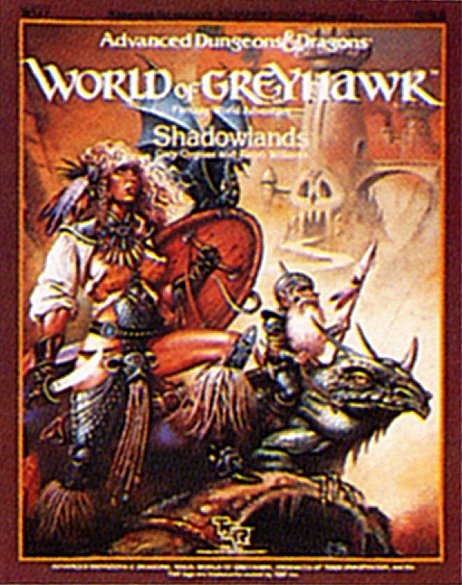
    Shadowland was actually solicited by TSR at one point, and I had preordered it and later received a refund.  From The Acaeum's Ongoing Research page:

    WG7 Shadowlands.  From the Summer 1986 Mail Order Hobby Shop catalog:  "A high-level module set in the World of Greyhawk.  Journey to the perilous Plane of Shadow to rescue Princess Esterilla and confront the master of the plane... where you find yourself an unexpected guest at a wedding where the guests include a lizardman, a catlord, and a mistress of illusion!".  Assigned TSR stock #9184.  Gary Gygax and Skip Williams were collaborating on the project, but it was shelved due to Gygax's lawsuit with TSR.  Gygax has since stated that while Wizards of the Coast has given permission to have the module published, the fact that it will be produced "on spec" (no contract nor advance payment), makes it unlikely that he or Skip will be undertaking the project anytime soon.  The original mention of it is in Dragon Magazine #37, page 10, where it's called "Shadowland".  The mock-up cover scan of this module, featuring the cover artwork from Dragon #58, is here.  Thanks to Christian R. for the scan.  This research item is closed, but will remain here for trivia purposes.


    WG7 Shadowlands - unpublished 
    cover artwork by Clyde Caldwell

    The WG7 product code was recycled in 1988 for the "joke" version of Castle Greyhawk.

  11. June 1980 TSR memo from Gary to Steve Marsh (with a cc: to Lawrence Schick) that talks to the size of various non-infinite planes, as well as naming some of the planar projects planned at that time, including Steve's Starstrands and Old Shards adventures, and Skip Williams' Shadowland, alas all unpublished:


    June 1980 TSR memo on planar adventures being developed by Steve Marsh with Gary Gygax
    June 1980 TSR memo on planar adventures
    being developed by Steve Marsh with Gary Gygax


  12. The release of Deities & Demigods in August 1980 at GenCon XIII adds the Para-Elemental Planes and the Plane of Shadow to the planar cosmology, and redraws the Outer Planes as The Great Wheel for the first time: 


    The Great Wheel debuts in
    1980's Deities & Demigods


That’s a lot of moving parts being juggled in planar development work between Gary Gygax, Steve Marsh, Dave Sutherland, and, to a lesser extent, Skip Williams, Frank Mentzer (who helped on the spells and magic items adjustments for Q1 Queen of the Demonweb Pits), and Rob Kuntz (who designed his own elemental planes and Demonworld for play in his Kalibruhn campaign, and incorporated planar and planetary concepts in Greyhawk).

I will examine some of the beginnings of the planar design process prior to 1977 and its continued expansion after 1980 in the next article in this series.


Allan.

17 April 2025

The grodog Thither and Hither and Points Between

While the blog and I have languished together in torpid stupor for quite some time now, the blog's silence did not originate in or from wordslessness, but for good reasons that I will delve into soon.  And in case you missed it, this is not in fact my first post in the past ten months ;)

In the meanwhile, we have some catching up to do!

The Recent Past and Near Future

GaryCon XVII - 18 to 24 March 2025

GaryCon was, as always, a mixture of a lot of work and lot of fun.  The fun, as usual, overweighted the work, which is always a good thing and helps me know that it continues to be worth the effort to attend while juggling our Black Blade Publishing booth, playing games, and catching up with friends:  the balance still tilts the fun to the positive for all three, which is a very good thing indeed.  

GaryCon 17 badge and pins


As always, we appreciate the assistance from Rich Franks and Victor Raymond while running the booth, and from fellow gamers and volunteers in setting it up and tearing it down too.  This year, Gilbert Ganse, and Joe Mac helped us set up and tear down in record time!

This year, I played West End Games' Star Wars d6 game for the first time (and using its first edition, in case that matters):  


Star Wars d6 (West End Games) - 1987 original edition
Star Wars d6 (West End Games) -
1987 original edition

Star Wars d6 (West End Games) - 1996 revised & expanded 2nd edition
Star Wars d6 (West End Games) -
1996 revised & expanded 2nd edition

While I own both the 1987 original edition and the 1996 Revised & Expanded 2nd edition (which is, I admit, the default I see in my mind's eye), I've never had the pleasure of playing either version before, and I've never played on the same of the screen in the esteemed company of Handy Haversack and his NYC crew---Ross Peabody, Rob Skarbek, Manny, (and maybe Iain too?), along with Chris Kusel, Jim Lohman, Richard Keene---and the rest of the table of diehard gamers on Saturday night at GaryCon in Bluegnoll's "Star Wars: I Got a Bad Feeling About This" event:

Rumors are quietly circulating of an Imperial admiral wanting to defect, but their identity is a well guarded secret. Alliance Intelligence has sent your group to infiltrate an outer rim Imperial base where an unusual meeting of Imperial Navy, Army and Intelligence officials is under way. A local Hutt Cartel smuggler, receptive to Alliance overtures for assistance, has made for strange bedfellows.

My character---anagrammished from my names as Nallorg Godor---was an outlaw (I didn't fix his name on the PC sheet until after snapping the picture, seemingly, and I didn't think to shoot the PC sheet again at the end of the session either, alas:

grodog's first Star Wars character---
an Outlaw named not-Amos!


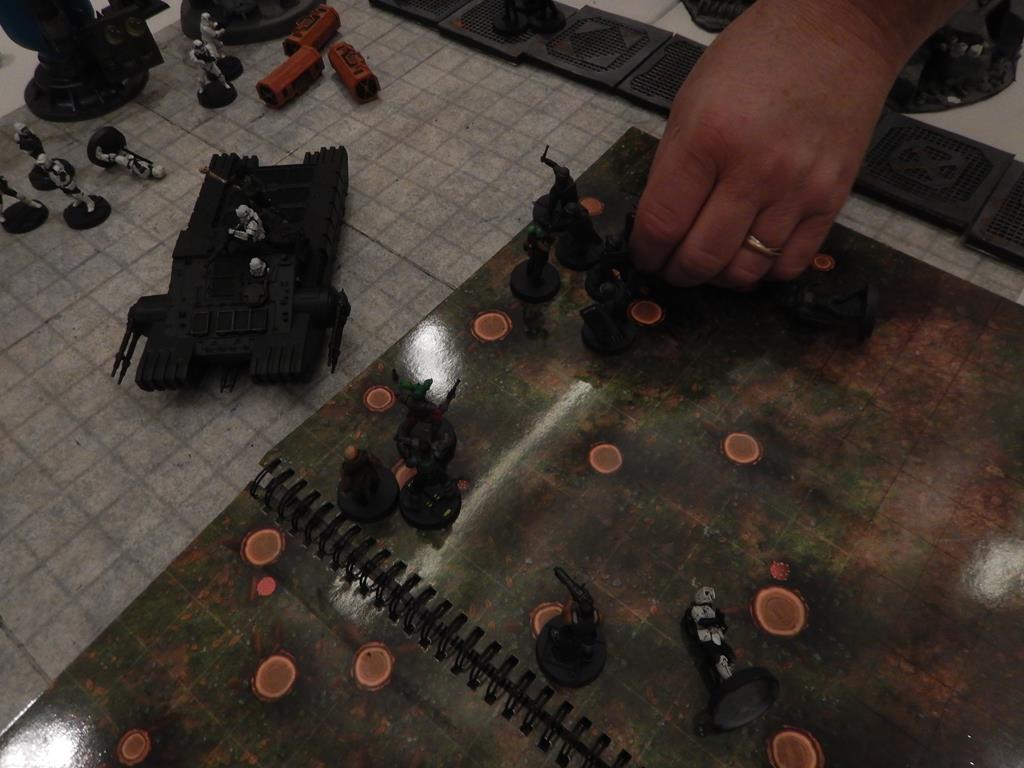
David used miniatures and scatter terrain with a 1950s road-atlas-sized-, comb-bound book of SF battlemats that admirably set the scene:


The grodog's first Star Wars game!---
our finale battle!

With three additional pics graciously provided by Handy Haversack:


We had a great time, and many thanks to David for finding room for me in the game, and to Handy and crew for letting me crash their party, quite literally!

In addition to playing Star Warson Wednesday night I also returned to Greyhawk's Perrenland in Carlos Lising's ongoing The Wolves of St. Cuthbert campaign, which was fun as always.  I really enjoy gaming with this crew, which features a fun mix of heady role-playing, tactical chaos, and Greyhawk shenanigans.

On Friday night, I helped to DM Paul Stormberg's Friday night Legends of Rolepaying tournament.  This year's scenario was a sequel to Allen Hammack's C2 Ghost Tower of Inverness, and was, as usual, quite fun to DM.  The crew at my table (one of 16 tables, for a total count of about 144 players this year) included several folks new to playing AD&D 1e, which is always a treat :D


grodog hard at work,
DMing "Dungeons of the Ghost Tower"


On Sunday night, my business partner Jon Hershberger ran Paul Reiche III's "The Temple of Poseidon" from Dragon Magazine #46 (February 1981) for our Legio V crew of miscreants, which was also fun.  Jon's not only an excellent DM, but he wrangles the Legio crew like a pro!

Jon Hershberger DMing Sunday night's 
Legio V game, "The Temple of Poseidon"

North Texas RPG Con 17 - 4 to 9 June 2025

NTX17 is---from my point-of-view, at least---just around the corner, in particular since free event  registration opens on 15 April 2025 at , a mere 11 days from when I've begun typing these words.  (And it's now one day after registration as I'm reviewing the above words.  So much for timely ;) ).  

Due to the chaos of being of late, I only completed my NTX events submissions very early  on Thursday morning, 3 April 2025.  I'll run three sessions of a new scenario set in my drowic Dark Markets setting:

LEGIO V – Operation: Prism Shards and Unbound Chains

Explore Kiradúvi Mancalënómirond – The Dark Markets, grodog’s new Greyhawk underworld setting:  a flourishing drowic trading hub at the conjunction of subterranean, riverine, and planar travel routes.  In Operation: Prism Shards and Unbound Chains, you are an allied crew of drow minor clan merchants scouring The Undersell—the Dark Markets’ annual secrets auction—to find and rescue a Tormtor turncoat on the run before assassins slay the renegade, or she sells her secrets to the highest bidder.  If you succeed, you will elevate yourselves and your clans in power, and perhaps rise to head new noble houses, while aiding the downfall of the reviled Eilservs-Tormtor coalition; should you fail, your souls will pounded from your bodies by Abyssal goristroi—or worse!
 
 
Bring your hex and graph paper, dice, and a Machiavellian dose of paranoid courage!  3rd-5th level pregen drowic PCs will be provided. 

Content Warning:  Gary Gygax’s seminal introduction of the drow to Advanced Dungeons & Dragons portrays their culture and society as chaotic and evil—drow are demon-worshipping villains who actively engage in slavery, torture, and human sacrifice.  The setting in this scenario leverages and extends that baseline depiction into the underworld markets that support and slake their lusts to demonstrate that drow are the antithesis for all that is good in the world:  in both our—real—world, as well as in the World of Greyhawk fantasy game setting.  This includes the pregen PCs and their masters. 

== 

The Lake Geneva Legio V began as a handful of gamers who have attended Gary Con and North Texas RPG Con since their inceptions. We have grown over the past few years to include like-minded individuals united by a respect of Gary Gygax and his legacy. We are the dedicated attendees who love NTX for the camaraderie it establishes, the Game Masters who run games from across the decades, and the committed gamers who spend these four days in a fervor of dice rolling and old-school good times. Although events run as LEGIO V Presents will use a variety of rule systems, our focus is on games authored by Gary and his contemporaries as well as those systems whose designers pay homage to these pioneers. 

My three events run on Thursday, Friday, and Saturday nights from 7pm to midnight.  I will likely reprise them at Virtual Greyhawk Con #6 in the fall, as well, in case you missed out on them this time around.  

New Toys and Reviews

A detailed run-down on these must await another follow-up post, but that should also land sooner vs. later.  (I do discuss the Greyhawk-related titles a bit below).  

In the meanwhile, here's my loot-fan from the convention to help tide you over!:

Loot captured at GaryCon by the grodog---
did he level up yet??


This includes a host of excellent tomes and wondrous sundries, including:

  • A cornucopia of Greyhawk- and Blackmoor-related riches from Rob Kuntz, Lenard Lakofka, Carlos Lising, Will Dvorak, Michael Mossbarger's reproduction of Eric Shook's rendered Castle Greyhawk level 1 map (which he DM'd this year and provided with as a historical handout), Paul Stormberg's tournament (I worked for this one ;) ), and a pile of seven new-to-me, 3e-era Greyhawk novels gifted to me by David "diaglo" Temporado
  • New fiction!  From the Goodman Games booth across the aisle, I bought two Gardner Fox novels one of which I didn't already own (One Sword for Love), and grabbed of copy of Kurt "thank you for killing my clone" Winter's debut novel, The Hero's Fall.  
  • The latest and greatest from Alex Bates and Shayla Sackinger:  new miniatures (these two resin pieces accompany the huge John Dennet dragon turtle I bought previously, but I apparently forgot to include the new metal goblins I bought too---rats!), the new adventures The Twin Heads of Avarice (a great title!; this is a full module) and The Awful Amber Doom (a one-sheet dungeon|folder-adventure|thingy), and some very yummy birch caramels (which my wife and boys also enjoyed, thanks Alex!)
  • And some other curious sundries:
    • A nearly-pristine Shure SM57 microphone from David Prata for my older son Ethan, the musician
    • On Tyrrany, an all-too-timely gift from Victor Raymond
    • A new zine from Noah Davidson, in two different formats; "Welcome to Halishaft" may the title of the zine, or of its introduction, but it looks like a fun project either way!
    • A flyer for a new D&D museum being planned by Jim and Debbie Hunton:  see https://museumofdnd.com/ for more information

Greyhawk News, Both New and Old

I fully intend to catch up on my curated Greyhawk news postings, which by now will be quite out-of-date in most instances, but those that still make the cut will confirm that they were well-worth awaiting:

In the short-term, though, the following news items are definitely worthy of mention:
  • The Lenard Lakofka Archive published two new modules at GaryCon:  LAB1 The Lanthorn of Velzarkis (Dan Boggs finished the adventure from Lenard's notes) and RL1 The Ravages of the Mind

    I've not had a chance to dig into LAB1 yet, but I playtested RL1 when Josh Popp ran it  at Virtual GaryCon #3, in 2002.  

    Many thanks to Troy Alleman of Caanibaal Publishing for kindly gifting me a print copy of RL1 at the show!

  • Rob Kuntz's new adventure, Into the Wild Blue Yonder: A Journey Through Blackmoor’s Dark Realm, which he designed for and ran at DaveCon 2 back in the fall of 2024, was published by Griff and Chris, The Fellowship of the Thing crew behind the excellent Secrets of Blackmoor documentary.  

    Unfortunately I missed Rob's first visit to the USA since his departure a decade ago, but I hope to catch up with him when he returns next :D

  • Trent "TFoster" Smith just published his new campaign, Brink of Calamity via his Storm Fetish Productions publishing imprint.  (My print copy arrived finally on 16 April 2025!).  

    In the sandbox style of Griffin Mountain, Brink of Calamity is set in and around Warnell (Narwell in the Wild Coast of Greyhawk).  I'd hoped to playtest some of its scenarios in my current Greyhawk campaign, but the PCs' excursions to Dyvers didn't lead to entanglements I expected, so that opportunity didn't arise quite yet!  

    Trent also has the new campaign book available in a bundle with his Heroic Legendarium book, which we've been using for a few years now in the current campaign:  we have both a single-classed bard and a savant among the PCs.  

  • I finally met William “Giantstomp” Dvorak, and he graciously gave me a copy of his Wicked StudiosRavensrook sourcebook, and provided several copies to share with other Greyhawk fans who came by the booth, too!

    I love helping other Greyhawk fans find books and resources for their games, and several of the folks who walked off with Will's book hadn't been aware of his work yet :D 

  • Vince Garcia continues to publish his monthly zine Gary World in the files section of the First Edition AD&D (Gygaxian AD&D) Facebook group.  The group is private, so you'll need to request membership to join, and Vince publishes the zine PDFs to the files section for a week or so, then removes them.  But they're worth the wait!

The Crews:  They Keep Me Going

The gatherings of friends and my immediate and extended "gamer family" at GaryCon remind me of how much I love the company of fellow gamers.  I had planned to take more pictures while wandering around the con, the exhibitor hall, in my games, and of games that caught my eye, but I did little photoging, as seems usual these past few years....

I enjoyed wonderful, but always too-short, conversations this year with Doug Waltman, Erik Mona, John O'Neill, Jon Peterson, Matt Finch and Suzy Moseby (including the almost-conversation on Monday morning, had we only known!), and Jay Scott:  they refract among my memories throughout the con.  Longer and deeper ones with Victor Raymond, Paul Stormberg and Doug Behringer, Carlos Lising and Jeremy Breazeale, and Kit at GreyhawkOnline rise above the haze, demanding follow-up....


L to R:  Keith Sloan, grodog, and
Tony "Wheggi" Rosten

I was an unexpected delight to discover and meet Rick Meints at the Chaosium booth---we've corresponded together on YSDC, The Acaeum, and Facebook for years, but this was the first time we met.  I was somewhat dazed from my walk through the hall at the time, but we managed through that.  Rick graciously gifted me a Chaosium 50th anniversary pin, which will I will proudly add to my badge lanyard for North Texas in June :D

Thank You!

My thanks to Luke and Bouchura Gygax, Josh Popp, Dave Conant, Gilbert Ganse, and the innumerable volunteers who bring GaryCon to life each year.  You're keeping the flame alive, and the con vibrant and filled with fun! 

To Rich Franks and Victor Raymond for helping out in the booth so that Jon and I could step away from it, and Joe Mac and [another kind person I've lost track of in my hazy memory :( ] for their help in packing up the booth on Sunday.

To the many friends from online forums, discords servers, publishers, communities, previous  conventions, and the games I've played in and DM'd who I look forward to catching up with each year:  you are why I keep coming back!

Allan.

14 April 2025

Enter Stage Left - Agutha, the Glimmering Sister of Pholtus

I am pleased to report that Tony "Wheggi" Rosten has rejoined our Castle Greyhawk campaign, as he's a good friend.  A well-known name among old-school gaming communities, Tony's also my publishing partner in The Twisting Stair, our mega-dungeon design zine, and is the author of the award-winning "Blocks of Quox" puzzle-dungeon adventure published in Fight On Magazine #6 (Summer 2009).  He has several other excellent adventures that I hope to see published one day, too!

Sister Agutha

Since Tony wasn't able to find the character sheet for his old PC cleric, Moraine (a level 2 Cleric of St. Cuthbert), he created a new one---The Glimmering Sister, Agutha.  A redoubtable 4th level cleric of Pholtus, Agutha joined the campaign the the deus ex machina of divine intervention (a slightly-classier replacement of our now-standard "chump gate" option that we learned about from friends at GaryCon many years ago):

Agutha, the Glimmering Sister of Pholtus --
artwork by Tony Rosten for his PC

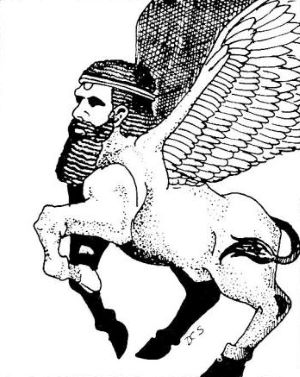
Last night, Haj and Sister Agutha encountered a greater shedu via the agency of the WM charts!---a roll of 31 on the 1e DMG's Temperate Forest/Wilderness tables results in an airborne ki-rin, lammasu, or shedu, which I then selected via a die roll extrapolated to allow the possibility that the encounter might add other powerhouse do-gooders to the mix---a greater lammasu or greater shedu, along with creatures like the foo dog/lion, hollyphant, or phoenix.  In the end, the dice indicated they met a greater shedu:


Shedu, by David C. Sutherland III, from 
the 1e Monster Manual (TSR, 1977)

The greater shedu looked like that picture, just bigger.  Standing 12' tall at the shoulder, the size of a minivan with a 30-40' wingspan.  

On a Mission from God

Named Zabbukhani, Herald of the Sun Resplendent, the greater shedu was specifically searching for Sister Agutha, in order to deliver to her (and as it turns out, Haj too, since he was in her company) a divine message from Pholtus:


Greetings!  Fear not, sister in Law!
Attend:  absorb Revelation.
Accept:  reflect Illumination.

Gaze sunward, above:
Protect the rays. 

Trees open, spread wide gates—eclipse looms.
Will and power words dispel the dark.
Searing light can stem Woe’s flood tide.


This new message (and the PC accompanying it!) represents an escalation, perhaps, in the activity in the campaign after the rescue and revelation of The Prophecy of the Six and the Twelve from a couple of years ago (in real-life; in-game, only XX months have passed).  The PCs discovered some additional information about it while seeking divine guidance from Wee Jas in Hardby, but with Agutha's introduction, this is (in my view, at least) stepping up the divine engagement.   We'll see what the party thinks soon, since Agutha hasn't yet met the rest of the PCs yet, just Haj. 

And of course it's curious and interesting and that it's Haj that Agutha met first, since he's one of the two assassins in the party, actively worships Nerull, the Reaper (but don't fear him ;) ), and serves the Horned Socitety....  Helps keep things interesting! :D


Pholtus - Some Ponderings from grodog

Tony's creation of Agutha introduces the second PC associated with Pholtus into our campaign---the first was a female paladin played back at the dawn of the game by Anthony Huso and named Vivien Asquith.  She was a hard-drinking paladin of The Blinding Light. 

Now Pholtus is not a god who I've played with a lot, so he's remained a bit of a caricatured blank slate to date.  I always liked Jim Holloway's depiction of Pholtus from Dragon Magazine #68 (December 1982), but the god itself---for better or for worse---hadn't particularly engaged my attention or creativity over the years*:

Pholtus, from Dragon Magazine #68
(December 1982) by Jim Holloway


Tony's decision to place Agutha's faith in Pholtus offered an opportunity to ratchet up some of the focus in the campaign, and for me to explore a bit into Pholtus.  We had some recent discussions at Canonfire! that in turn inspired my design noodlings.  

The Illumine, A Divine Envoy Sacred to Pholtus

Through her doctrinal training, Agutha recognized the form of the message as divinely-inspired, an illumine (sometimes called an octillum or an octiveal):

  • its eight lines represent a number sacred to Pholtus; eight is the number of syllables in the first and third stanza's lines, as well the number of syllables in their lines
    • the first line is a traditional greeting, to set the worshipper at ease with the divine messenger and attention being visited upon them
    • the second and third lines offer guidance and/or imperatives from Pholtus, that tie to the message's purpose and focus, and will help its recipient to understand how to unravel its meaning
  • the central two-line envoy represents the heart of the divine message, which receives special emphasis through more-direct communication:  
    • its lines are four syllables each; together they total eight 
    • they divide the message into two halves:  the fourth line applies with emphasis to the first stanza, while the fifth line applies to the second
    • together both lines embody the divine heart and command of the message, and provide the key that unlocks the meaning of the whole
  • the third stanza warns of complications, threats, and dangers that the envoy and first stanza are intended to address; they are the obstacles that must be discerned through reflection and revelation, revealed by exposure to the light, and overcome through the application of faith, light, obedience, and hewing to the straight and inflexible rigor of order and goodness
The numerology of the message will gain additional significance based on its form:  here the message is divided into three stanzas of 3, 2, and 3 lines each.  So the numbers 2 and 3 are part of Pholtus' mysteries, along with 8.   (And note that 2^3 = 8 too!).   There are five known "wandering stars" in Oerth's cosmology, so 5 will likely be a component in this celestial schema too.  

Other messages may be delivered as a single eight-line stanza, and some may feature rhyme regular schemes or repetitions of words---perhaps to be modelled on the troilet form; we'll see.... 

Noodling on the Faiths and Mechanics for Pholtine Clerics

Prior to writing Agutha's message, I began brainstorming some developmental ideas for Pholtine clerics, thinking through options inspired from the Canonfire! discussions as well as the areas of focus for the campaign around twins, light/darkness/shadow, prophecy/divination/revelation, etc.:

The Tenets of Pholtine Faiths


Holloway's Pholtus illustration always appeared somewhat androgynous to my eye, so I like the idea of the god being more nebulous in gender, or both genders perhaps
  • this then paired with the idea of splitting the god's roles up between sun vs. moon among the faithful, and perhaps flipping their traditional genderings, like Tolkien did with the Maiar who guide them in The Silmarillion:  sun = female, moon = male
  • perhaps many Pholtine sects emphasize the larger, monthly moon Luna vs. the smaller quarterly moon, Celene; while later editions changed his focus to moons in plural, as originally published he was the god of the sun and the moon (which also makes me wonder if adding a second moon in the mix was a late-stage addition to the setting, perhaps)
I've also begun to toy with the idea that Pholtus absorbed/merged the sun goddess and moon god when one of them was all-but slain in the past, which accounts in part for there being no dedicated moon god among Greyhawk’s core pantheons. Perhaps they were in love/lovers, perhaps they were brother and sister, or even twins.  That may also account for the androgyny vibe in Holloway’s illustration. 

Other noodlings on spheres of influence for Pholtus include:  
  • the concept of Light in general vs. the heavenly bodies as the source of light; this would be Holloway‘s traditional androgynously male illustration of Pholtus from Dragon #68; options include the Blinding Light, the Resolute Light, the Light of Revelation, or whatever 
  • the concept of cosmic law and order in particular as it applies to the movements of the heavenly bodies and the inner planes (as well as the Astral, as the bridging plane between inner and outer, also tied to the moons and silver), emphasizing the Positive Martial Plane as the ultimate source of light for the multiverse; think akin to Moorcock’s Law vs. Chaos; 
    • this would likely put such sects into conflict with Celestian's clergy
    • this would also espouse a heliocentric view of Oerth’s solar system, which is deemed a radical concept among all good-thinking peoples of the world ;)

Greyhawk's Pholtus Clerics and AD&D Mechanics


Pholtine 4th level clerics gain access to an additional spell usable 1/day, which per the boxed set is dispel darkness.  I might tweak that spell based on faith/deital flavor selections above, but it fits well with the general themes for Pholtus (and the campaign).  

At 8th level, they gain glow, and I can see other spells like starshine, moonbeam, sunray, and perhaps faerie fireinfravision, and ultravision being added to their spell lists (or the class  gaining these at higher levels as permanent abilities).  

At 12th level, high priests and priestesses access reflect.  As part of the "blinding light" idea, I like the focus of this spell but I've also considered stripping the 11th level power from clerics of Heironeous---their energy bolt drawn from the Positive Material Plane---and providing it to Pholtine clerics instead, which seems apt, and perhaps combining it with the reflect power (or making it a fourth power).  We'll see....

Allan.

* For a particularly interesting look at a higher-level Pholtite** high priest, I recommend reading about Henri, from Jason Zavoda's "Nosnra's Saga" serial novella set in Greyhawk, and more specifically in Gary Gygax's G1 Steading of the Hill Giant Chief.  The link takes you to his 2020 revisions to that story, and leads with the most-recent post which is its ending, but it's a fun read, particularly if you're familiar with the original adventure.  

** While I generally prefer Pholtine as the adjectival form of Pholtus, I'm sure there are sects of Pholtus that use Pholtite (and perhaps Pholtusian, too)!


24 June 2024

New Planar Magic Items - Hellsguard, Mephrytis, Ring of Planar Vision, and Four New Potions

I've been busily working away on various projects since the end of April, including attending the North Texas RPG Con in Dallas from 5-10 June 2024 (and for which I will draft a recap soon!).

In the meanwhile, here are some new planar-related magic items (and a couple that aren't, but are related at least thematically, if not topically) that have seen use in my Greyhawk campaigns over the decades.  The two hellish items were wielded by one of my brother's PCs back in the 1980s and '90s in our planes-spanning Greyhawk/Mendenein campaigns, while the ring and potions are from my current pre-and post-COVID Greyhawk campaigns.


The bibliophage Rhodrar of _____ is no more.  Neither culminations nor agonies nor threats of her eternal demise would bend her to reveal the secrets sourced from her nullurë.  She even dared to mock me---her fonkin song will change when I call, bind, and wrack her!---flaying her soul layer by layer until the fragment echoes of her broken truename are all that remain, which I will scatter in ire across the Astral Wastes.  After ransacking her estate, all I find are ciphers and allusions---hints and references to contexts predefined and known, but unwrit, unexplained.  Neither keys nor resonances nor vorends did she yield.  Yet.

--- The Witch of Perrenland, The Demonomicon


Hellsguard, Armor of the Champion of Each of the Nine Hells

Physical Description:  A suit of iridescent and reflective platemail, beautifully-crafted of a dull ruby-red hue.  The plates are etched with fine detail, and depict scenes from The Rebellion, The Fall, the architecture and landscapes of the Nine Hells, and other Infernal designs and devices.  Each is also emblazoned with the standard of its arch-devil creator, while none bear the device of the Infernal Standard itself.  

Magical Description and Lore:  Hellsguard is a creation of the Dukes of Hell as a part of the Regalia of Hell (q.v.).  Each duke crafted one suit of Hellsguard to give to his or her chosen mortal champion; Hellsguard is bestowed only upon the most-high servant of the Nine Hells---each wielder is powerful, influential, competent, and trusted by their arch-devil.  Twenty mortals are known to have donned one of the nine suits.  

As one might expect from a devil's device, the nomenclature of Hellsguard is fraught with grammatical complexities:  some sages name it as Hells'guard (or Hell's Guard or Hells Guard), Hellsgard (Hell's Gard, Hells Gard), or Hellsgird (Hell's Gird, Hells Gird).  It is also known as The Champion's Gard or Garb or Gird, and sometimes named for its plane of origin, as "Nessus Guard" for example.  Sages who specialize in the Infernal Realms and devildom do know of some lore that curiously speaks of Hellsguard as The Hells' Garden, and speculates that it was forged before the founding of the Hells and before the Fall, by the Morningstar itself.  Such speculation is largely discredited as not only unlikely, but vastly improbable given the assumed power of the Twelve, relative to the bestowed powers of the armor.  A minority of sages (often among those who lend credence to the previous theories) also believe that a tenth suit was created, perhaps by by The Morningstar, Astaroth, or other of the past Overlords of Hell.  If such a suit exists, it is presumed to be bound to and represent the cross-planar Citadel of Hell.  

Magical Properties and Gameplay Notes:  

Forged from an arjale-tantulhor-Disiron alloy, Hellsguard is multi-planar platemail +4 that provides a base movement rate of 12".  It is incredibly strong and never nicks, dents, or scratches.  

When first donned, the armor flows in a liquid/molten state to conform to the body shape of its wielder, from pixie- to titan-sized.  It can accommodate tails, wings, gills, multiple limbs, et al, as required by its wielder's body type.  

When its powers are activated, its metallic iridescence brightens into a glow of ruby brilliance that can be seen clearly from hundreds of yards away at its brightest, when its greatest powers are invoked.  

While each suit of Hellsguard provides the following powers and abilities, common across all nine suits.  Each is usable at will, as long as the wielder is in contact with the suit (even if they are not wearing it, but are touching it):

  1. Affect Normal Fires:  2/day
  2. Burning Hands:  9 hp damage, 2/day
  3. Heat Metal (Caina's suit provides Chill Metal):  2/ week, up to 1/day
  4. Incendiary Cloud:  1/month
  5. Plane Shift:  alone or with up to three others (by linking hands), once per day.  The planar transfer requires 9 segments.  The traveller(s) will always arrive safely anywhere within the suit's native plane of Hell that the wielder has personally visited before in person, while wearing the armor.  They can also plane shift to any plane in the multiverse if it is known to them by name, even if they have not previously visited it, although safe arrival outside the bounds of Hell is not guaranteed.
  6. Produce Flame:  6/day
  7. Protection from Fire:  90 hp damage or 9 turns of protection, whichever comes first; 2/month, up to 1/week
  8. Pyrotechnics:  3/day
Hellsguard common abilities operate at 9th level or the minimum level required to cast the spell, with some exceptions noted below.

In addition, each suit of armor has special abilities imbued by its creator arch-devil, who dictated its unique designs and emblazons with the help and guidance of one of the Infernal Muses, and perhaps the Arch-Mage of the Hells.  The ninth power (or set of powers) for each suit are detailed below:
  1. Avernus:  Forged by the now-deceased arch-devil Iranor, the historical powers of the Avernus suit were known to be tied to , but it will be reforged upon the promotion and appointment of a new arch-devil for the plane.  
  2. Dis:  Created by Dispater, Secretary and Scribe of Hell, this armor commands the following defensive and divinatory powers:
    • Blinking:  controlled within a 9" radius, 9 blinks/2 weeks, no more than 3/day
    • Displacement:  3/week, 9 rounds/use, no more than 2/day
    • Minor Globe of Invulnerability, 1/month for 9 turns
    • the defensive capabilities of a Helm of Telepathy (only, no other functions)
    • In addition, the Dis suit confers the abilities of a Helm of Comprehending Languages and Reading Magic, and provides the ability to read the written contents of a document protected by Secret Page or Encrypt (see "Pages from the Mages III" in Dragon #92 or the DM Sourcebook from the FR boxed set)
  3. Minauros:  Enchanted by Mammon, this suit of Hellsguard confers immunity to poisons (from monsters, insinuative/contact, ingestive, gaseous), and allows the wearer to use:
    • Fire Shield:  hot version only, up to 2/week and 1/day only, 9 round duration
    • Possession:  as per magic jar, up to 3/year, but only 1/month
  4. Phlethegos:  Created by Belial, this suit confers double-strength fire resistance to its wearer, but no protection from fire.  In addition, the wearer can:
    • Fireball:  40 HD/month, up to 9 HD/day
    • Illusion:  as devil, 1/month
  5. Stygia:  Geryon crafted this suit for his prime servant, Lethólgon, who still wears it to this day.  It has these properties:
    • Frost Giant Strength:  Strength 20 at all times while worn
    • Produce Cold Fire:  range 5", affects up to 1-5 designated targets within 5" radius (roll d6, on 6 usage of the power is wasted), inflicts 0-10 damage/round for 0-5 rounds (roll d6, on 6 usage of power is wasted; use same type of roll for 2d5 damage)
    • Resistance to Cold/Frost:  as fire resistance ring, and at all times while worn
  6. Malbolge:  Among the least-powerful suits of Hellsguard, Moloch's confers these powers:
    • Cloudkill:  2/month, up to 1/2 weeks
    • Smoke Cloud:  as fog cloud, up to 2/day
    • Stinking Cloud:  2/week, up to 1/day
  7. Maladonimi:  Baalzebul's suit was recently destroyed, along with its wearer, Trillgar of the 17 Slayings, and another is being fashioned.  The old suit's powers were:
    • Fire Resistance:  3/month, for 7 rounds per use, as ring
    • Flame Shape or Stone Shape:  3/month, no more than 1/week each
    • Stoneskin (on self only):  2/month, no more than 1/week
    • Meteor Swarm:  2/year, no more than 1/3 months
  8. Caina:  Mephistopheles enchanted a suite of vast power, breaking the guideline specifications as set forth by Asmoedus.  His suit's powers perform at 12th (not 9th) level, and allow these abilities:
    • Cone of Cold:  12 HD, 2/month, but not more often than1/2 weeks
    • Frost Resistance:  double strength
    • Frost Shield:  1/week
    • Frostweb:  1/day (see my Wand of Black Ice on Canonfire!)
    • Ice Storm:  2/week, 1/day
    • Wall of Ice:  not usable as an ice storm, 1/day
  9. Nessus:  Also known as the Suit of the Overlord, The Overlord's 'Guard, and similar epithets, Asmodeus' Hellsguard suit confers:
    • Azure Flame:  1/month (but not blue in hue)
    • Fire Resistance:  triple strength; continuous while worn
    • Fireball:  90 HD/month, but only up to 1/day at 9HD maximum
    • Firestorm:  1/3 months
    • Flameshroud:  1/2 weeks
    • Serten's Spell Immunity:  continuous while worn
    • Wall of Fire:  triple strength, as druid spell, 1/9 days
XP Value:  9999
GP Value:  200,000
 

Mephrytis, The Runes-Graven Blade of the Champion of the Nine Hells   

The Red Sword is the Champion's Sword 
The Word of the Sword is the Champion's Law
The Blade of the Sword  bears the Runes of The Fall
The Dance of the Sword and the Hand are All

-- after Michael Moorcock, Phoenix in Obsidian (1970; published in the USA as The Silver Warriors) 


Physical Description
:  Mephrytis is a longsword forged from a pale red metal, and inscribed or inset with with nine relief-raised runes that transfix the blade and are visible from each side.  Its design is otherwise plain, with a standard quillons guard, a grip of black and silver hide, and no ornamentation in the guard or 
pommel.  

Magical Description and Lore:  Sagely or bardic examination can determine that the hide is from a bulette (difficulty Specific), but the metal will resist easy identification without lower-planar expertise, as the metal is tantulhor, mined from within the Nine Hells (see Ed Greenwood's articles from Dragon Magazine # 74, 75, and 91).  Mephrytis detects as magic (intense conjuration/summoning and evocation, very strong alteration and invocation), evil (overwhelming), and lawful (overwhelming).  

Mephrytis and Hellsguard (q.v.) were forged together, with similar histories.  While they have most-often been wielded together, they have at times been employed singly, but not within recent memory.  

Magical Properties and Gameplay Notes:  Mephrytis is a multi-planar, dancing sentient longsword +2:  it's magical capabilities are fixed and do not change whether the blade is wielded in Hell, Greyhawk, or the Deep Ethereal planes.  Its to hit and damage bonuses cycle over nine rounds of continuous battle, increasing from +2 to +6 during rounds one through five (its height at +6) then down again to +2 over rounds six to nine:  1st round +2, 2nd round +3, 3rd round +4, 4th round +5, 5th round +6, 6th round +5, 7th round +4, 8th round +3, 9th round +2.  

Upon command by its wielder (spoken aloud or in thought), the sword can provide three forms of magical illumination, each of an unlimited duration:

  • a baleful, rusty-red illumination in a 2" to 4" radius as dictated by the wielder's wishes; this light blocks usage of infravision, ultravision, x-ray vision, and other non-visible spectrums of light from functioning within its area of effect
  • a bloody-magenta faerie-fire illumination in a 5-foot radius; this light prevents usage of ultravision but not other vision types within its area of effect
  • a translucent ruby illumination in a 1" radis that blocks infravision within its area of effect but not other visual types

The Red Blade is sentient, with an Intelligence of 13 and an Ego of 16.  It is also telepathic, but does not speak aloud in any known manner.  The personality of the sword has never been described by its wielders, but it is known to serve and advance the causes of the Hells and its devilish masters.  

Mephrytis bears the Nine Sigils of Hell, each a symbol devised by one of the Nine Infernal Muses.  The Nine Sigils also appear in the Infernal Standard and other Regalia of Hell artifacts (q.q.v.), although they are not necessarily enchanted with identical effects.  As such, Mephrytis is also known as The Sword of Sigils, The Sword of the Nine Signs, and similar epithets.  

The runic powers of Mephrytis' Nine Sigils are detailed below, using the Common language command word required to invoke each Sigil's effects.  Legends suggest that the effects can be strengthened or otherwise augmented if a Sigil is invoked using the Infernal dialect native to each Sigil's home plane in Hell:

  1. "Flamentine" causes the sword to erupt in hellish flame drawn from the depths of Avernus.  Flametine is usable twice per day, and lasts for 9 rounds, or until quenched.
    • Each successful hit in combat inflicts an additional 1-6 points of fiery damage, which ignores non-Infernal fire protections and immunities.  As a flametongue, this will ignite flammable materials and objects.  
    • While flaming, the wielder is protected from fire as an infernal ring of fire resistance
  2. "Alcyon" causes the pale red hue of the blade's metal to exude a coppery-red aura drawn from Dis.  Alcyon activates the wounding power of Mephrytis, and usable up to four times per week.  It lasts for 1-9 turns per use.  Wounds inflicted by Alcyon can only be healed magically by demi-, lesser-, intermediate, or greater gods of any alignment or their divine agents and emissaries, or by mortal clerics of the various lawful evil gods or archdevils.
  3. "Calamezxi" causes the pale red hue of the blade to deepen and to assume a repulsive, putrescent quality drawn from the fetid reeks of Minauros.  Any target struck in the next 9 swings of the blade must save vs. spells or be diseased with hell-rot, and die in agony over the next 1-9 rounds (1d10-1; a 1 rolled counts as 1 not 0) as their flesh falls from their bones, inflicting 1/x rounds full hit points of proportional damage each round of Calamezxi's duration.  This disease is only curable by 1/ neutralize poison and cure disease from a 9th+ level cleric, 2/ remove curse and cure diseas from an 11th+ level cleric, or 3/ dispel magic from a 16th+ level cleric.  Calamezxi is usable only once per month. 
  4. "Angpheld" summons 1-2 bearded devils from the depths of Phlethegos, which will serve the wielder unquestioningly and exactly, for 9 rounds.  It is usable thrice per month, but no more than once per week.
  5. "Rhynndalath" invokes a personal blessing of Geryon, ruler of Stygia, and raises the wielder's Strength to 19 (or provides a +1 to Strength if the wielder's natural strength is already 19 or higher) for 9 turns.  It is usable nine times per month, but no more than twice per day.
  6. "Excorziastrindinities" is a 3 segment casting time curse, more colloquially known as "Blossoms of The Fall."  Devised personally by Baalzebul, this unique incantation cannot be learned or cast without Mephrytis, which also serves as the material component and focus for the spell (it is naturally not consumed; the somatic component consists of a sharp salute upward toward the Heavens, then pointing the blade downward toward Malbolge to draw the curse into the blade, which glows with a brick-red aura of hatred while holding the curse; then the curse-aura is fired at the victim, with a range of 3").  The target must save vs. spells at -5 or suffer the full effects of the curse, which turns the victim into a devil of appropriate HD (or otherwise transforms them into a fallen state if they are 14 HD/levels or higher).  If the victim Falls, they must make a second saving throw (at normal chances as a devil, and at -130% MR) or they are geased to seek the service of Baalzebul, otherwise they are geased to present themselves to offer service to the nearest enthroned arch-devil (exiles and independents do not count).  "Blossoms of The Fall" is usable up to nine times per millenium, but no more than once per century.  
  7. "Drendipuir" calls forth a roiling cloud of poisonous vapors from Maladomini.  Treat this as a cloudkill+incendiary cloud cast at 21st level, although the vapors of Drendiuir cannot be moved by winds save those that originate from the Heavens or by the Winds of Limbo.  It is usable once per nine weeks.  
  8. "Hellsblades" invokes a mobile arjale blade barrier 9 feet high, wide, and deep.  It moves at 9" at the mental command of its wielder, who may cast other spells and take other actions while Hellsblades do their work.  Creatures contacting the maelstrom suffer 18-63 points of damage per round of contact (9d6+9).  The Sigil  lasts for 9 turns, and is usable once per three months.  
  9. "Noirethithiel" enables the wielder to scribe a symbol in the air, using Mephrytis as a stylus.  Available symbol options include hellfire (usable once per 9 years), hopelessness (once per 9 days), pain (once per 9 weeks), or persuasion (once per 9 months).  
XP Value:  7450
GP Value:  149,000


Ring of Planar Vision


What drove the Lord Mayor mad, in the end?  Was it his study of Yagrax's tome?; or his transvalent scrying of the Seas of Chaos---seeking islets in the Primal beyond The Wall of the Worlds' End?  Or did he follow al-Yasin's hooded footsteps one triptych too far, beyond even Eibon?; or pierce the veiled schalla between the verses with his reading and seeing rings, so that D--- guided him to U------------ or Y----------, or even A-------, at the center of all things?  

To sift these signs for causes or certitudes is seemly folly at best.  Perhaps sufficient portent is this:  Zagig's seeings ringed his learnings with non-sense, leaving Zagyg's insights circling wisdoms in the wondrous lands of the Red Queen and her dragonchess machinations. 

All of these myriad redes contain possible tendril portions of truths.  I quail before an infinity of infinities---can I interpret and navigate their thresholds, retain sanity, and ascend the chords to the higher scales---to a throne!---, or will I like Z. before me, see truths too terrible and stumble through madness and delusions forevermore?   

Experimentation is the only path and answer that I can fathom.

--- The Witch of Perrenland, The Demonomicon


Physical Description:  The ring appears to be a plain, burnished copper band, unadorned with ornamentation or gemstones.  A competent jeweller would value the ring at 3-5 gold pieces.

Magical Description and Lore:  The ring of planar vision is one of several magical rings that were reputedly enchanted by Zagig, as a set of "Rings of Seeing."  According to local lore among the mages of the City of Greyhawk, Zagig fashioned one of each of a ring of x-ray vision, ring of true sight (some believe that it was a ring of witch sight), a ring of far seeing (providing clairvoyance and wizard eye), and this ring.  

Before activation and attunement, detect magic reveals a faint alternation aura on the ring; after activation and attunement, detect magic registers multiple divination auras (very strong, strong, and moderate), and a strong alteration and moderate evocation auras.  Once detected as magical, this plain copper band will resize to fit the hand of its wearer.   

Magical Properties and Gameplay Notes:  This ring appears to be a simple ring of ultravision until its activation and attunement conditions are met.  Activation requires the ring to be worn by a magic-user for a full month, and attunement requires the MU to travel via blink, teleport, gate, or similar magics during that month (at the DM's option, attunement may require entrance into another plane, demi-plane, or extra-dimensional space, or something similar).

Once attuned, the ring confers the following powers to its wielder, all of which require one round of concentration to utilize (scanning in a 60-degree arc; see detect evil):

  • peer beyond the veil (2.5" range) and regard the portal (6" range:  portal type, active/inactive, perm/temp, one-way/bi-directional) from The Multi-Faceted Portal-Penetrating Gaze, my new 4th level MU spell in The Twisting Stair #2.
  • see extra-planar creatures auras as true seeing, at 6" range
  • see ley lines, planar boundaries, etc., at 6" range
  • detect gate, including teleporters, magic pool transporters, etc., at 6" range
In addition to its divinatory capabilities, the ring of planar vision enables its bearer to interact with (including the ability to attack) creatures requiring magical weapons to be hit due to their multi-planar nature.  This follows the same progression as monsters, so a wearer of 2nd level or 2HD can strike creatures that require silver, cold iron, nickel, or other non-magical weapons to be hit, 4th level or 4 HD can strike creatures that require +1 weapons to be hit, 6th level/HD strikes creatures requiring +2 weapons to hit, etc. (see DMG page 75, with the addition that +5 weapons require 12th level or 12+5 HD to hit, and +6 weapons require 14th level or 14+6 HD to hit).    

Lastly, the ring of planar vision also provides planar ubiety to its wearer (see below for potion specifics), granting +50% to base MR against unwilling teleportation or planar travel, and a base saving throw of 20 even if the spell or ability permits no save (q.v., scarab of protection).  

Similar to a gem of seeing, usage of the ring of planar vision taxes its wielder:  there is always an 8% non-cumulative chance when using any power to see/detect reversed conditions or hallucinations.  In addition, if the ring is employed more frequently than once per six turns, the wielder temporarily loses Constitution points (see ring of x-ray vision).  

XP Value:  4000
GP Value:  35,000


Four New Potions

The higher order schemas still elude.  Ubiety and transitions must not fail or all is lost:  without ubiety, summonings may invert; without transition, multichordal travel cannot survive the advent and intervals of passage.  Even girded by latency and mindbar, even augmented by faceted wisdoms, even sealed in contracted oaths, the arcs of passage may fail without surety of ubiety and transition....

--- The Witch of Perrenland, The Demonomicon 


Elixir of Planar Ubiety
:  A variation on the standard potion of stability (q.v.), the elixir of planar ubiety prevents the alteration of its drinker's change in location through the effects of blink, dimension door, teleport, plane shiftgate, and similar travel spells.  It counters the effects of distance distortion and maze.  The potion's planar fixity affects all such spells  and effects, whether the imbiber would willingly accept them or not.  A full potion dose lasts for 5-20 hours, and it may be drunk in halves, or sipped in eighths like a potion of invisibility, with each sip lasting for 4-10 turns.  

XP Value:  650
GP Value:  1800


Potion of Senility:  Drinking this potion (even a sip to sample it) reduces the victim's Int and Wis scores to 4 each.  This change is permanent, but can be healed through the following spells:

  • heal, restoration, alter reality, limited wish, or wish
  • memory map cast by a 12th+ magic-user (see Rob Kuntz's MoZ4 The Eight Kings)
  • remove curse cast by a 14th+ level cleric or magic-user
  • Rary's Mnemonic Enhancer cast by a 16th+ magic-user
XP Value:  ---
GP Value:  400  


Potion of Shadow Form:  This potion transforms its drinker into shadow form (published in my "From Kuroth's Quill" column in Knockspell #6, and reproduced below for quick reference).  This potion must be consumed as a full dose, and is not efficacious when drunk in halves.  

Shadow Form (Alteration)

Level:  4
Range:  0
Duration:  1 turn + 1 round/2 levels
Area of Effect:  Caster only
Components:  S
Casting Time:  1 segment
Saving Throw:  None

This spell transforms the shadow master into a two-dimensional shadow, in a manner similar to both the third level illusions spell wraithform, and the seventh-level magic user spell duo dimension.  The caster may change his or her shape as per the spell distort shadow (q.v.).  Due to the extraplanar nature of the spell, the caster cannot be attacked directly by physical weapons (cold iron, silver, magical, or otherwise).  If attacked by the shadow of the weapon, the caster gains a +2 bonus to armor class and saving throws against such attacks, and if the attack is successful, normal damage and effects apply.  Most attack spells such as magic missile, fireball, lightning bolt, ice storm, cone of cold, etc. are similarly less effective (-2/die of damage rolled against magic missile; against other damaging spells, a successful saving throw reduces damage to one-quarter, while a failed save indicates half damage); non-damaging spells function normally against the caster.

XP Value:  450
GP Value:  1000


Potion of Stability:  This potion allows its imbiber to walk the narrowest of balance beams and tightropes with surety of footing and excellent control whether climbing, running, or otherwise navigating challenging environs.  Frictionless surfaces can be trod without slipping, and a successful saving throw vs. petrification prevents the drinker from falling into pits.  The potion also quells the effects of trip and fumble spells (and oil of fumbling) for the potion's duration, allows a saving throw against snare, and even grants a saving throw of 18-20 against Otto's Irresistible Dance (additional bonuses may improve the base 18 save).  While the potion provides secure movement, the DM's judgement will dictate movement rate; in general, tightropes and similarly-fraught conditions will reduce movement by half (see the Thief-Acrobat in Unearthed Arcana, page 23 for guidance).  The potion lasts for 6-36 turns, and may be consumed in halves.

XP Value:  350
GP Value:  650


Closing Notes

Recent planar discussion in Anthony Huso's new discord server prompted me to dig up my notes on Zagig's ring, while hellish discussion of his recent PDF releases for Avernus, Minauros, and Stygia reminded me of The Regalia of Hell artifacts from one of my college campaigns.  So here they are! :D

A few other notes:

  • The PCs in my current Greyhawk campaign include a Savant (a magic-user sub-class from Trent Smith's Heroic Lengendarium; this PC will eventually be able to learn detect gate and identify gate) and they found the ring of planar vision in my version of Castle Greyhawk.  They sold the ring to Vistrion (my name for The Mage of the Striped Tower in the City of Greyhawk), but as part of the sale terms have access to rent it for use again if needed.
  • The spells Memory Map (from Rob Kuntz's concluding Zayene adventure, The Eight Kings) and The Multi-Faceted Portal-Penetrating Gaze (from The Twisting Stair #2) are, alas, from print-only products (at this time; when we republish TTS#1-4-ish as a collection, we may offer it in PDF format too).  Neither are terribly difficult to find with some googling.
  • The spell Azure Flame and the symbol of hellsfire are (I think) of my own creation, but I'm too tired to dig them up and add them further this post.  Maybe later!
  • I think that Trillgar of the 17 Slayings was an NPC from my brother Phil's campaign, but I could be misremembering.  One of my brother Brian's PCs wielded both Hellsguard and Mephrytis for awhile, which served as a lawful counter-balance to the other PCs in the group serving Orcus, Zuggtmoy, and other demon princes....  
  • I obviously used an alternative structure and hierarchy for the offices and functions of the arch-devils and the planes of the Nine Hells.  I'm not sure, offhand, that the named arch-devils are in fact current, since play has not been directed hellsward in three or more decades of real-life gaming.  Devilish sources of inspiration include Alexander von Thorn's "Politics of Hell" in TD#28, Greenwood's articles, Moorcock's Von Bek family ("Do the Devil's Work" is their crest and motto, while serving the Grail), and Dante and Milton (directly, and filtered through Melville).  Gygax also created an NPC EHP of Asmodeus in one of the Gord short stories in Night Arrant with a tattoo under his tongue indicating his cult status/membership---an interesting detail that always stuck with me, and inspired me during college to detail some revisions to the planar structure of the Nine Hells when I was first redefining and drafting Greyhawk's and Mendenein's planar architecture.  

Enjoy!

Allan.