...or, a Meditation and Reflection on What grodog Likes Best about Playing in AD&D Mega-Dungeons
Introduction
This post is my response to a recent discussion of my mapping style and inspirations over on reddit, begun by user SydLonreiro, who asked
For my first AD&D dungeon, I would like to map it like Grodog, but I don’t know how to do it. I’m not sure whether he developed a specific method for doing so, or whether some of you map large dungeon levels in this way. I want to create a dungeon the way Kuntz would, and map it in this style, because it seems like the right approach for preparing my sessions — and I love this type of map.
I was quite tickled to discover the thread after Heather and I returned from dinner celebrating St. Valentine's Day (we never go out on a Valentine's date on the actual day/weekend when it's usually so crazy-busy), and I spent some time this weekend noodling a bit in response to SydLonreiro and also to user chaoticneutral262, who raised some Qs/concerns about mapping style relative to encounter keys that I plan to tackle a bit later.
And, as it turns out, SydLonreiro is building his own mega-dungeon for use among his friends, and plans to run it in a very "Gygax 75" manner using OD&D, which is quite cool.
grodog's Inspirations and Design Sources
To begin to answer some of SydLonreiro's questions on the mapping front, I tend to wear my key inspirations on my (tie-dyed) sleeves, including:
- The original mega-dungeon levels of Castle Greyhawk and Castle El Raja Key designed by Gary Gygax and Rob Kuntz in particular, alongside a variety of other old-school designers like Jennell Jaquays (Caverns of Thracia) and Phil Barker (Empire of the Petal Throne's Jakallan Underworld)
- In the OSR/contemporary era, I particularly favor works large-scale dungeon designs by Richard Barton, Chainsaw, Anthony Huso, Gabor Lux, Tony Rosten, Keith Sloan, and Trent Smith, among others
- Architectural artwork including M. C. Escher's non-Euclidean optical-illusions, Piranesi's Imaginary Prisons which echo with a vastness that definitely catches my eye, and Philippe Druillet's Elric Le Necromancien--first published in the year I was born!
Some of my favorite dungeon design articles include these pieces:
- "Hints of D&D Judges - Part 3: The Dungeons" by Joe Fisher in The Dragon #2 (August 1976) - another excellent example of early dungeon design advice that stands the test of time; I particularly like Fisher's active and imaginative example treasures, use of watery areas, and recounting of Castle Greyhawk lore
- Gygax's various early 1970s articles about D&D play and design, mostly-summarized on my web site at https://www.greyhawkonline.com/grodog/gh_castle_sources.html
- The Players Handbook's section on "Successful Adventures" in pages 107-109
- "The Dungeon Architect"--Roger Musson's classic from White Dwarf 25 (June 1981), 26 (August 1981), and 27 (October 1981) is an excellent three-part series that covers dungeon origins, NPCs (creators, raiders, inhabitants), and dungeon construction (architecture, traps/tricks/teleporters/etc.), and dungeon design models (silly, ecological, etc.). Reprinted in Best of White Dwarf Articles Volume 2 (complied in 1983), where I first read it. I'd still love to reprint this someday (along with some of Paul Vernon's WD articles too)!
- Gabor Lux's "Dungeon layout, map flow and old school game design" originally published on ENWorld 15 July 2006 and reprinted at K&KA on 12 July 2011
- Matt Finch's "Megadungeon Tactics: Mission-Based Adventuring" in Knockspell #4 (Spring 2010)
- Trent Smith's essays on adventure design in his Heroic Legendarium pages 97-118
grodog's Mega-Dungeon Design Aspirations and Touchstones
The design approaches exemplified through the works created by our past and present masters come together as a set of internal tendencies and design northstars that I aspire while working on my mega-dungeon levels.
These lurk behind the scenes in my Favorite Mega-Dungeons post as well as some of my favorite adventures too: both the original list, and my expanded and revised lists. The qualities I called out as key to my favorite designers' levels were:
- Best Environments to Explore and Map
- Most-Fun Encounters
- Most-Fun Puzzles, Enigmas, and Centerpiece Encounters
- Coolest Maps
I'm sure you've already noticed that #1 and #4 both focus on the maps, and that's a huge factor in my design approach: I almost-always begin with drawing a map then keying it, rather than building the keys and designing the map to fit them (which really is something I should try sometime...). And #2 and #3 are really both two sides of the same coin on the encounter keys—I just emphasize the puzzles, enigmas, and centerpieces a bit more by calling them out specifically over the dungeon dressing, monsters, treasures, traps, hazards, and riddles encounter types.
- Compelling and Imaginative Creativity
- Inspiring Environments to Explore and Map
- Fun and Challenging Encounters
- Great Layout and Information Presentation
- Modular but Filled with Inspirational Expandability
- Tempered in the Crucible of Campaign Playtesting
And while they track to my general adventure design sensibilities, my favorite mega-dungeon design preferences remain fairly rooted in the idea that bigger = better. In a 2016 discussion on putting the "mega" back in the mega-dungeon, I wrote:
My sense is that mega-dungeons are driven by both focus and size.
In terms of focus, a mega-dungeon that grounds an entire campaign is a campaign dungeon—and IIRC Trent Smith coined that term some years ago. In my mind "mega-dungeon" and "campaign dungeon" are related but not synonymous terms. I have placed several mega-dungeons in my Greyhawk campaigns—Castle Greyhawk, Blackmoor Castle, Maure Castle, a series of inter-related ruined Suloise dungeon complexes below the Sea of Dust, a great dungeon carved out of the glacial Black Ice, etc., etc. Other than Castle Greyhawk and Maure Castle, however, none of the others are campaign dungeons in my games, since they're not the focus of my players' activity. Castle Greyhawk provides that primary focus (with some interleaving with Maure Castle from time to time), so it is the campaign dungeon in most of my Greyhawk campaigns.
In terms of size, a mega-dungeon is sufficiently large that it cannot be completed during game play. That size can be accomplished in a variety of ways, depending on how the DM approaches their dungeon design:
- very large individual levels: I try to vary the sizes of my dungeon levels by creating them using differently-sized graph sheets, and I have 8.5x11 sheets that are 4, 5, 6, 8, 10, and 20 squares per inch, 11x17 sheets that are 5, 6, 8, and 10 spi, and 1 big pad of 17x22 sheets at 4 spi. You can fit a LOT of dungeon onto an 8 spi 8.5x11 sheet, much less an 11x17 one, let me tell you! The gigantic poster maps of Undermountain, Mammoth Dungeons, and Armaron are probably the best examples of this style of dungeon that have been published (that I'm aware of). Barrowmaze's poster maps from the KS also fall into this scale (although I'm not sure whether poster maps were done for Barrowmaze Complete or not??), and the large and inter-related cavern levels in Castle of the Mad Archmage do as well. Phil Barker's Jakallan Underworld from EPT also falls into this category, along with Arden Vul.
- lots and lots of levels and sub-levels: the levels can be in physical proximity, and thus attached to the dungeon, or adjacent at the planetary or planar levels, and potentially exist physically in another multiverse. Rappan Athuk features many small levels, as do the Mines of Khunmar.
- connections to other large dungeons: Scott Casper created teleporters between Castle Greyhawk and Maure Castle in his Castle Greyhawk webcomic, for example, which intertwines both of those mega-dungeons, effectively doubling their already prodigious sizes, with the added complexity that you could be teleporting within a level, across levels within the same mega-dungeon, or across mega-dungeons!
- vastness of the environs: think of Erebor or Moria in terms of simply how huge they are, regardless of whether they're really mappable as levels at all; Holmes' "Underworld" in his Boinger and Zereth fictions is said to delve the entire planet: "What race or races built the maze, no one knew. In the opinion of the sages of Caladan, many layers of dungeons and underworld were laid down, one atop the other, as the world crust was formed, so that now no one knew or even guessed how many levels extended below the surface" (Maze of Peril back cover text). This also suggests another scope of "mega"—that of depth below the surface, which naturally brings to mind the G-D modules and drowic underworld, Verne's Journey to the Center of the Earth, Pellucidar, etc., etc.
Foolsgrave - Chainsaw's Ultimate Mega-Dungeon
I still don't think that anyone has topped Chainsaw's brilliant Foolsgrave levels, which are vast and beautiful and visible from inception through conclusion in his Foolsgrave (development thread, spoilers) at K&KA, with the finished maps shown below at https://knights-n-knaves.com/phpbb3/viewtopic.php?p=225505#p225505:
Old Level 1
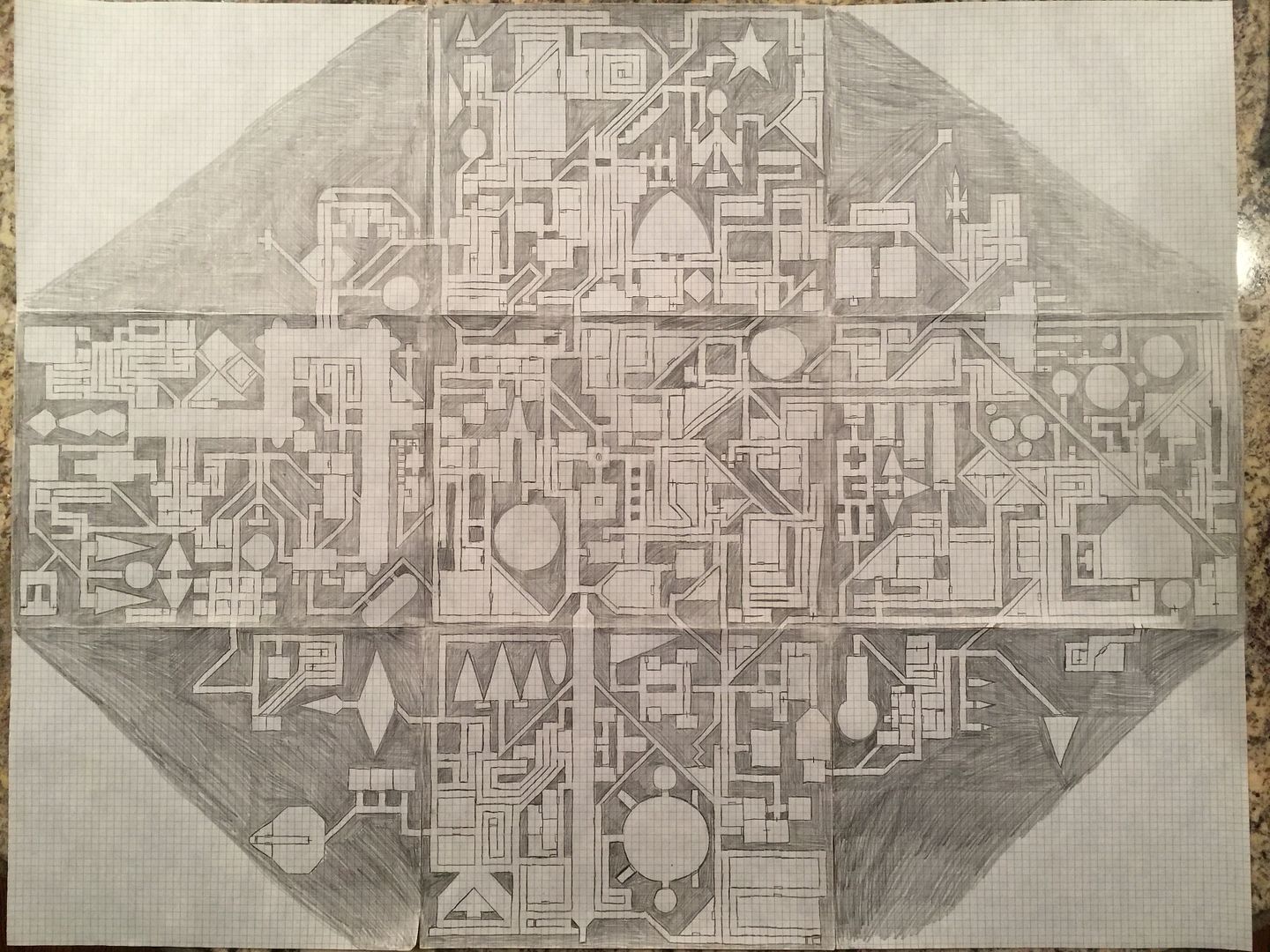
New Level 1
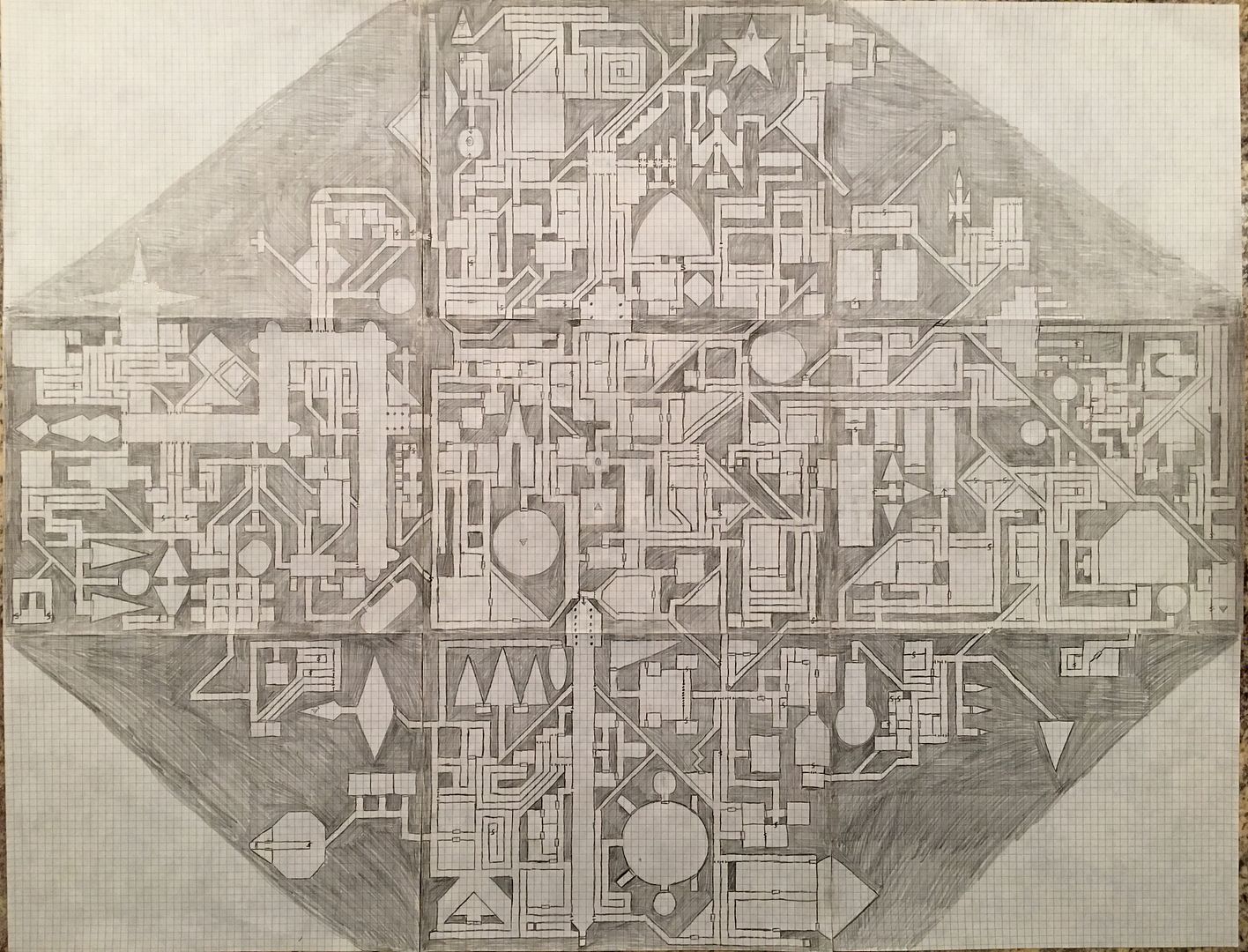
Level 2
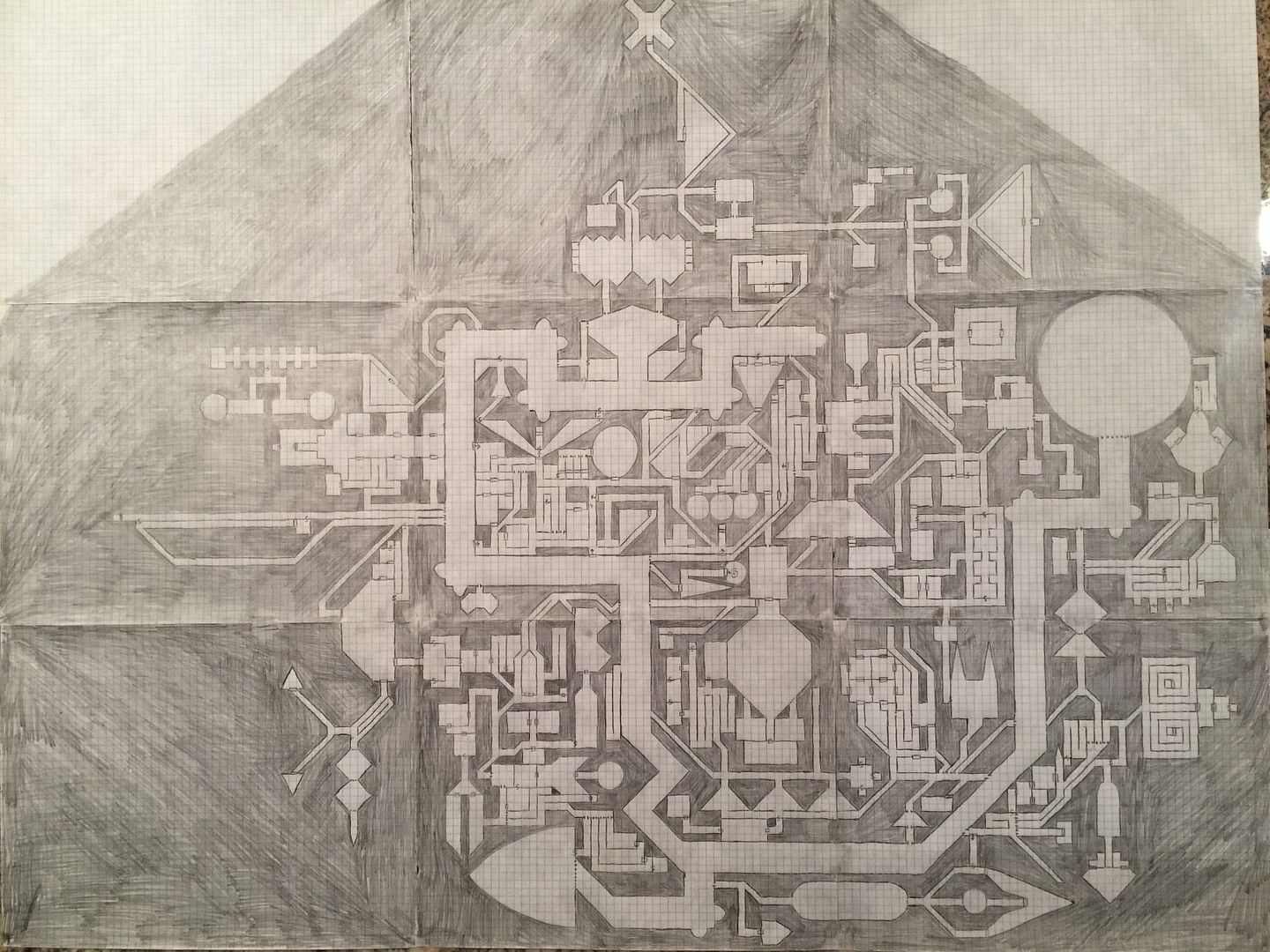
Level 3
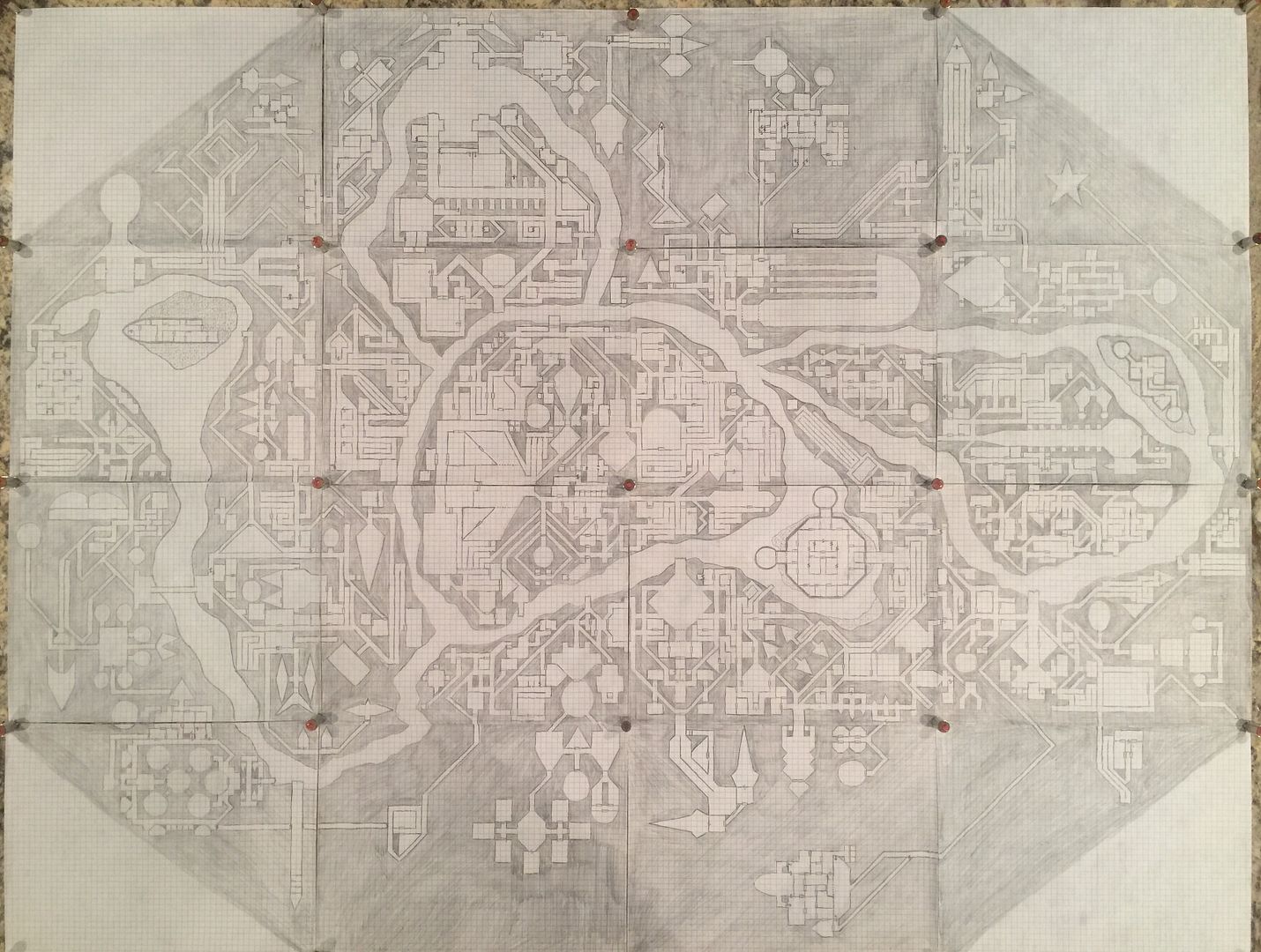
More to follow, later in the week!
Allan.

Goood stuff! I’d be interested to know what sort (and how much) thought you or others give to the third dimension in your levels: floors of varying heights, mezzanines and balconies overlooking large gallery-like spaces, ramps and elevated features, etc. it’s something I often forget to think about, and sometimes I wonder if it’s the complexity of describing/running it that scares me off.
ReplyDeleteI agree, I know I am guilty of forgetting to think in the 3rd dimension as well. And I do agree, it can add to a map's being unique for sure.
DeleteHi KenHR and Daniel---
DeleteYes, verticality is central to my approach to designing dungeon levels. I'll talk to that a bit in the next post in the series. Let me know your thoughts once I post it!
Allan.
Thanks for revisiting this topic! I like to reread the references you give every once in a great while to remind myself of the basic theory and practice of dungeon design. I look forward to more of this!
ReplyDeleteThanks Keith!---always a pleasure to chat dungeons with you :D
DeleteAllan.
Well done. Thank you for the wonderful resources. :-)
ReplyDeleteThank you, Daniel!
DeleteAllan.
from "Bowser" = "Gonyaulax" on ODD74: Grodog, I love Chainsaw's maps and assume that your maps are of a similar size. Now, I know that these things shift depending on the "region" and faction activity, but what would you guess is your overall "average" of keyed to empty rooms? One in four? One in eight? Not that the rooms are completely bare, but how many would you actually "key"? Thanks for reviving this topic.
ReplyDeleteHi Gonyaulax---
DeleteI think that Chainsaw's Foolsgrave maps are quite a bit larger than my largest levels, even if some of mine are on 6, 8, or 10 spi grid sheets (Foolsgrave is drawn on 5 spi sheets). By some rough calculations at https://knights-n-knaves.com/phpbb3/viewtopic.php?p=219471#p219471 I estimated Foolsgrave level 3 at 2200x1700 feet in size, which is pretty huge.
In context, Wheggi's Quilt Map level is only 1610 feet along its longest axis, and my other largest levels (at the time) topped out at 1100-1300 feet or so. When I redrew my first and second levels, the second (which is larger) maxes out at ~2040 feet wide at most, which should still be a bit smaller than Foolsgrave level 3.
I will talk to the encounters mix in the post after next (assuming, again, I don't tangentialize ;) ), which will include both empty room percentages analysis. (Spoilers: I've discuss some baselines in detail in my Castle Zagyg review at https://www.greyhawkonline.com/grodog/gh_castle.html).
Allan.
Great post, grodog!
ReplyDeleteThanks Chainsaw! =)
DeleteTonight I also revised the paragraph that had ended in a sentence fragment, adding some more color about the size of the levels among my previously-ranked "Pulls It All Together" best mega-dungeons.
Allan.
Those Piranesi etchings are excellent! Exactly the kind of stuff I've been trying to imagine into my dungeons for ages.
ReplyDeleteAgreed, they're quite inspirational! Thanks for the comment, Tim :D
DeleteAllan.
The DM mentioned in the Roger Musson article in White Dwarf NicBest was my first DM. He ran a megadungeon and it was so much fun. It was,as was the style then an open table so things could change between visits and much use was made of teleports and lifts that needed special keys
ReplyDeleteVery cool! Roger and I corresponded a bit about reprinting his articles, and I'd love to hear more anedotes about play at his table if you're inclinded to share more, Neill!
DeleteAllan.
Absolutely - though it is a long time ago. The friends who I still play with also played they may remember other things - and as we played what I suppose is called Westmarches Style today they will definitely have different memories than me. I'll have to ask them. I have to be clear it wasn't Roger who I played with but Nic who knew Roger
ReplyDelete