...or, a Meditation and Reflection on What grodog Likes Best about Playing in AD&D Mega-Dungeons
 |
| Sean Bean on the futility of finishing Castle Greyhawk |
If you've not read it, you may want to visit part one in this series first: grodog's Approach to Designing Mega-Dungeons - Part 1: the Maps. If you already read it, I revised it a bit while writing this article, since I'd left a sentence fragment dangling in the middle of discussing the "Best Presentation in Print" and "Pulls It All Together" criterial for my favorite mega-dungeons.
Drafting this follow-up post has taken me two weeks rather than one since life's remained pretty busy of late. That will probably continue through the remainder of March, so follow-up posts may also appear a bit more slowly than I'd originally thought (surprise, surprise ;) ).
Size Matters
In Part 1: The Maps, I wrote a bit about designing maps for mega-dungeons, with the explicit assertion that mega-dungeons and their levels should be large, and by large I mean a few different things:
- Size as Coolness
- Size as Options
- Size as Really Freaking Huge
Let's tackle them one at a time.
Size as Coolness
The classic mega-dungeons have immense gravitas, so here size helps to deliver on the potential, the rumor, and the legend of Castle Greyhawk---Undermountain, or Caverns of Thracia, or Maure Castle, or [insert your favorite mega-dungeon name instead]. Bringing that legend to life at the table may be challenging, but the rest of the attributes I call out below help to support that mythic sense of awe---hopefully!
Implicit is my assertion that a mega-dungeon is cooler when it's bigger, which definitely (and coincidentally ;) ) aligns with my aesthetic preferences, but here are some thoughts on how larger levels actually make for cooler game play, using one of my designs as an example.
grodog's Recessive Gallery Level
 |
| grodog's Recessive Gallery Level |
Recently reprinted in Fight On! Magazine #15 (Spring 2024), I'd forgotten that I'd previously shared this map on my grodog's Castle Greyhawk page, too---I had thought it was a "newly revealed" level when I offered it to Iggy to include in the zine. So much for exclusivity, and my memory.... The full-sized version is at https://www.greyhawkonline.com/grodog/gh_castle_grodog_level_07-filled.jpg if you're curious.
The map is unfinished, and incomplete: many encounter areas drawn don't currently allow ingress, save by digging, passwall, or etherealness; there's not much added for intra-level stairways yet; ramps, trapdoors, and stairs up/down to adjacent levels aren't much present yet either (although placeholder spaces for these are present); pits are mostly unmarked (although the central double-T trap at the corner of the 30' wide cooridor where it turns N from E is a pit that opens into a holding/monster chamber below); etc. That's pretty normal for how I work my maps up---some areas that are currently shown as inaccessible rooms may be filled in during the final version, or may have standard or secret doors added. Or may remain inaccessible, and require digging or magic to enter---although I tend not to do that a whole lot, overall.
This level is drawn on an 8.5x11" sheet of graph paper, gridded at 8 spi, making it pretty big: 64 squares N-S (~640') x 88 squares E-W (~840'). In this level, I placed several large chambers, intended in part as lairs for competing dragons. When I redraw this to finish it, I'll likely use two of our Black Blade 11x17" sheets, for 17x22" dimensions drawn on the 6 spi side, so that'll allow 102 squares x 132 squares, which will let me fill out the rest of the level's edges that currently run off the sheet---I did this with the "Iounic Caverns" level maps, as well as my original Level 1 map too (if you click on the images in that blog post, they'll still load, but they don't display in the blog post due to Cloudflare). The level will likely enlarge a bit further, similar to my process on Level 1, with some additional sub-level areas being added (or perhaps being relocated. I may also connect the large southern chamber to one on my "Diamonds in the Rough" level, which has a very similar vibe with draconic presences; to do that, however, just might require a third sheet....).
The larger encounter areas include, starting at top-right and moving clockwise:
- overlapping encounter areas at different elevations along the 3- to 5-o'clock arcs
- temple chamber in the southern 6-o'clock area, via the skull/lightbulb shaped room and the multi-level complex to it's immediate NE
- large off-edge chamber at the south 7-o'clock, possibly a dragon lair; this is accessed via a Gygaxian room maze of octagons joined by squares that likely has teleports protecting the lair
- upside-down coffin-shaped hexagonal chamber at the confluence of several large and/or long corridors, at the 10- to 11-o'clock positions in the NW corner; I think this is the primary dragon on the level
- top N at 12-o'clock is another room maze of regular hexagons
- central N at 12-o'clock to 12:30-o'clock is where the titular Recessed Gallery resides
The use of different sized sheets and grid-sizes for the levels in a mega-dungeon help to hide the edges of each level, so that the players won't automatically be able to find an edge and then circumnavigate the level's periphery: it makes exploration less predictable, and each level more distinctly unique, and keeps the players guessing "just how large is this level?" which is definitely a good thing! Both room mazes and the long corridors along the left/W similarly blur that edge, breaking it in the case of the room mazes and the 7-o'clock S large chamber. The ragged right-hand E edge similarly leaves gaps, which should suggest searching for some of the secreat areas too.
The large size of the level helps to support these kinds of larger, cyclopean (to HPL for a moment) corridors and chambers, which increase that sense of awe and immensity that I want players to experience have when they're exploring Castle Greyhawk. Large spaces and long corridors that extend well-beyond the range of visible light sources, including continual light at 6"radius and bullseye lanterns at 8" range, increase player paranoid and build that sense of scope, or vastness, in particular when that extends above (and sometimes below!) your current walking surface---PCs are moving through an ocean of darkness, in their tiny island bubble of illumination. Peter Fitzpatrick's cover art for Knockspell #4 amply illustrates this concept nicely:
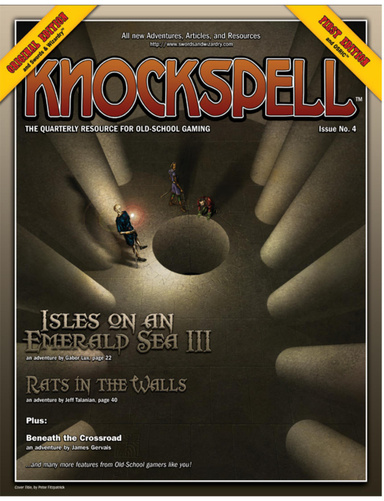 |
| Knockspell #4 cover art by Peter Fitzpatrick |
The scenes of Thorin's company marching through Erebor while Smaug is "not at home" also convey this sense of cyclopean immensity too:
 |
| The dwarves exploring Erebor, The Lonely Mountain, from "The Battle of Five Armies" (2014) |
Very large levels also provide additional options during game play, as I detail next.
Size as Options
Showcasing the breadth of possibility for the whole of AD&D does not mean that simple and "anything goes" funhouse environs are the required format for mega-dungeons---whether built by Zagig Yragerne, Halaster Blackcloak, or the scions of Uncle from Maure Castle---but that in gaming there, all tools are available to the players and the DM. All PC classes should have equal opportunity to shine, including druids, assassins, barbarians, and bards, among all the remaining PC and NPC classes (well, maybe not cavaliers.... ;) ). All PC races should be able to flex their detection muscles too---dwarves finding stonework traps and elevators, gnomes determining sloping passages and direction of travel, elves and half-elves finding secret doors, and half-orcs acting as intermediaries with humanoids, and gnomes and hobbits entering small spaces.
A related aspect that larger mega-dungeon levels support is expandable capacity: the mega-dungeon keeps inspiration and creativity flowing by offering plenty of room for sub-levels, side levels, split levels, demi-planes, and other pet projects. This keeps the players and the DM creatively intrigued and engaged, since formerly-explored areas can be enriched with new encounter areas, perhaps even via variable features, and allows the creation of distinctly unique challenges and areas to support less-common and non-standard classes, monsters, and encounter types.
I group these two together under their own heading since I see them both as closely-related but different approaches to supporting options. The breadth of possibility focuses on the wide expanse of core rules and their supplemental additions and expansions, while expandable capacity focuses on the actual dungeon level, its architecture, and environs, rather than the rules that govern what encounters occur within the level.
Size as Really Freaking Huge
These attributes drill down into the above two, but still stand-out in my mind as important criteria that merit their own focus and discussion.
Verticality as Large and Open Spaces: Large monsters like dragons and rocs, elementals and purple worms need wide and spacious areas to operate within, so dungeon level designs need to provide room for such creatures , and to accommodate the tactical selection of encounter terrain being brought to bear in combat and flight by both mega-dungeon inhabitants and invaders.
This is where the the 20' to 50' wide corridors from the DMG's Appendix A come into play, along with the chambers and rooms of unusual shape and size (CaRoUSSs, perhaps ;) ). However, long or wide corridors that connect to central plazas, squares, or parade grounds can serve similar functions, too, as can numbers of 10' wide corridors converging into hubs, with their long lines of sight.
Verticality as Depth Within and Between Levels: Verticality is highly-valued in the mega-dungeon design ethos, and is generally credited to Jennell Jaquays' Caverns of Thracia and Dark Tower, which feature movement up and down within levels, across and between levels, and vertical features spanning multiple levels like chasms and wells, balconies and overlooks, and interconnected cavern systems.
Verticality within a level is, in my mind, nearly as important as verticality between levels, but both are essential to good mega-dungeon play. The levels need room to breathe, to provide the space required for those large encounter areas, and that means that they probably need 50 to 100 feet of depth per level (those pits that don't fall through into a new level below need to fit within the level's depth, along with the headroom for those 30 to 50' ceilings.
Verticality within a level is, in my mind, nearly as important as verticality between levels, but both are essential to good mega-dungeon play. The levels need room to breathe, to provide the space required for those large encounter areas, and that means that they probably need 50 to 100 feet of depth per level (those pits that don't fall through into a new level below need to fit within the level's depth, along with the headroom for those 30 to 50' ceilings.
To give room for those spaces, the depth between levels should likely be 50 or more feet. That also allows room for smaller clusters of rooms at landings, or off of stairs. It also helps to keep players guessing about the depth that they're going down between levels---if each level is only 10 feet down from the previous one, they'll have an easier time guessing where their PCs are, and the challenges that their PCs will face.
 |
| Multi-Level Dungeon Features from Roger Musson's "The Dungeon Architect, Part 2" Artwork by Iain McCaig |
Verticality as Total Depth: As the space within and between levels increases, the mega-dungeon grows downward, deeper into the depths. First DM'd at GaryCon II and North Texas RPGCon #2, my "Escape from Level 14" scenario thrust the PCs from the level 10 dungeon challenge they were expecting and dumped them lost into level 14. They needed to find their way up and out, if possible.
For that scenario, built using my old Castle Greyhawk elevations, they were ~4200 feet below the surface, which is about 8/10th of a mile. Earth's deepest mines are ~2 1/2 miles down, so as I build my new elevation maps, I'll allocate the necessary room for each level's footprint (as a placeholder I only used 50 feet per level, for the most part, in the original versions), which will increase the depths for the lower dungeon levels even further. That should also enable connections to the drowic underworld for some of the deepest levels, perhaps.
Big and complex enough that players and their PCs can get lost: For reasons to get the PCs lost in the first place, see Roger Musson's "Dungeon Architect" articles, referenced in the first article of this series.
Getting lost is a design function of the mega-dungeon's size, interconnectedness within and across levels, and its external connections to other environments ("extraconnectedness" perhaps?). Teleporters---with or without similarly-designed areas of levels---are not the main reasons that PCs get lost in mega-dungeons. Flight from encounters is why PCs get lost. Players can't map while fleeing at , and if they end up going up/down a level, fall into a pit or a chute to another level, wander down a sloping passage, etc., then they're well and truly lost, and the entire tenor of the evening changes to finding a path back to familiar ground.
When PCs are lost, strange actions may be taken, like:
- players desperately consulting the mappers, trying to guesstimate distances and turn counts travelled
- gnome, dwarf, and stout halfling PCs being consulted for GPS coordinates
- characters asking for directions, or bribing (or charming) dungeon denizens for the same
- divination spells suddenly being memorized
Sufficiently vast in scope that the players and their characters will never completely explore the largest levels, much less the entirety of the mega-dungeon itself. Always will some monsters remain undiscovered and undefeated, traps unsprung, enigmas unsolved, and treasures unlooted.
|
| Sean Bean on the futility of finishing Castle Greyhawk |
As Boromir asserts, one does not beat Castle Greyhawk by exploring its every nook and cranny, and then move onto the next checkbox in the AD&D gaming experience ;)
Next Up?
For part three, I will examine how I key mega-dungeon levels, including the types of paper/sheets I use, and some volume-based keying strategies, unless I tangentialize on other topics first---such as traps, a dungeon encounter type that I hold great love for. We'll see!
Thanks for reading and your comments!
Allan.


Great post, I'm bookmarking this. Incidentally do you ever use geomorphs for megadungeons? I am working on a megadungeon where the central hub of each level is established on a map and keyed, but there are passages leading off that connect to geomorphs, thus making each level theoretically infinitely expandable.
ReplyDeleteThanks for the kinds words, John!
DeleteI love geomorphs, and have not only collected and used a variety of different types in building dungeon levels, but Tony Rosten and I designed various new geomorphs for use in our centerfold dungeons in our The Twisting Stair mega-dungeons design zine.
Some of my favorite geomorphs (and some sample levels built using them) include:
- the TTS ones, in particular the 3D geos in issue #3
- Erol Otus' geos, which were the first set I'm aware of to include any 3D elements; for a level created using them, see http://www.greyhawkonline.com/grodog/gh_castle_grodog_level-foodling_with_geomorphs-fae-small.jpg
- two examples assembled from TSR geos: https://www.greyhawkonline.com/grodog/gh_castle_grodog_level_03_geos_low.jpg and https://knights-n-knaves.com/phpbb3/viewtopic.php?t=16516
- DungeonMorph Dice geomorphs, with the level drawn from them: https://grodog.blogspot.com/2020/04/foodling-with-dungeonmorph-dice-to-castle-greyhawk-sub-level.html
Allan.
Great post! In particular, I’m inspired to include more verticality within the levels of my maps. Lots of possibilities there that I don’t tap into often enough.
ReplyDeleteAllan;
ReplyDeleteLove the "Verticality as Depth Within and Between Levels" section. I often forget the importance and fun of spaces that allow vertical as well as normal movement within a level. Vaulted ceilings, pits, wells, stairs that go up or down but not to a new level, water features etcetera. That feeling when you walk out of a room and find you are on a ledge overlooking a large cathedral like space.
I also loved that you brought up getting lost. Too often GMs give players an almost god like sense of where they are on a map. This removes some of the fun of exploration. Getting lost and finding your way is a great feeling. The fear of getting lost also adds a great value to the mapper function. They help you not only know where you are but how to find some of the consumables the party needs like water.
I am looking forward to the next part. :-)
Fantastic. I’m 54, British, so grew up with the wonderful Roger Musson articles. I still struggle with verticality within levels and even within rooms - maybe it’s time to draw up a random table of vertical features
ReplyDelete